

Key Takeaways
- Home workouts offer unmatched convenience and zero membership cost, but equipment variety is limited.
- Gyms provide structured environments, social accountability, and access to specialized equipment.
- Consistency - not location - is the strongest predictor of long-term fitness progress.
- Cost, schedule flexibility, and personal motivation style are the most practical factors to weigh.
- A hybrid approach combining both settings works well for many people.
Our Verdict
Neither home training nor gym training is objectively superior - each environment has real strengths that align with different lifestyles, budgets, and goals. Home workouts remove barriers to entry, while gyms provide resources that are difficult to replicate at home. The most effective choice is whichever one you will actually stick with consistently.
| Best for | Recommended |
|---|---|
| Those with tight schedules or limited budgets | Home Workouts |
| People who need external motivation and social accountability | Gym Training |
| Intermediate to advanced lifters seeking progressive overload with heavy loads | Gym Training |
| Families, travelers, or those in rural areas with limited gym access | Home Workouts |
The Core Trade-Off: Convenience vs. Resources
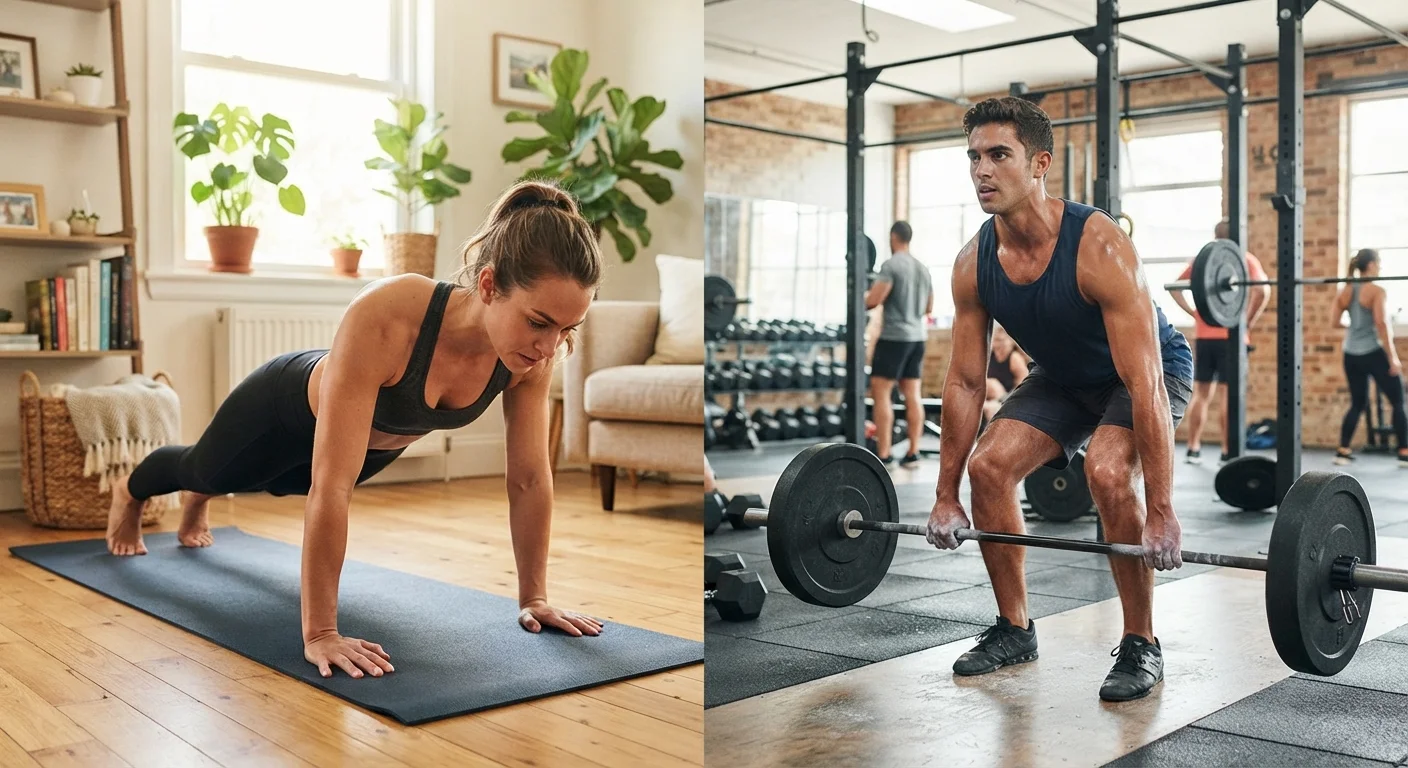
When weighing home workouts against gym training, the central tension is simple: home offers convenience, while the gym offers resources. Neither cancels out the other - they represent genuinely different environments that suit different people in different seasons of life.
Home training removes nearly every logistical barrier. There's no commute, no membership fee, no waiting for equipment, and no self-consciousness about being watched. For people with demanding schedules or young children, that frictionless access can be the difference between exercising and not exercising at all.
Gym training, on the other hand, provides a dedicated physical space designed for one purpose. That environment - separated from household distractions, stocked with diverse equipment, and often filled with other people working toward similar goals - carries its own motivational pull. Understanding what drives your consistency is more useful than debating which setting is theoretically better. As explored in our look at workout timing, the best habit is ultimately the one you maintain.
Cost and Equipment: An Honest Breakdown
Cost is often the first factor people consider, and it deserves a realistic look. A basic gym membership in the U.S. typically ranges from around $10 to $80 per month depending on location, facility type, and amenities. Boutique studios and specialty gyms (cycling, climbing, CrossFit) run considerably higher.
Home training can be low-cost or surprisingly expensive, depending on what you buy. Bodyweight-only routines require no equipment at all. Adding resistance bands, a set of adjustable dumbbells, a pull-up bar, or a kettlebell can total $100-$400 - a one-time purchase that pays for itself quickly against recurring membership fees. A full home gym with a power rack and barbell set is a significant investment, though it eliminates monthly costs entirely.
The hidden cost of gym membership is often underestimated: unused memberships represent one of the most common financial waste patterns in personal spending. Conversely, home equipment that sits idle is a sunk cost with no ongoing fee.
| Home Workouts | Gym Training | |
|---|---|---|
| Upfront cost | Low to moderate (equipment optional) | Low to none (membership required) |
| Ongoing cost | None after equipment purchase | $10-$80+/month membership |
| Convenience | Very high - no commute or wait | Moderate - requires travel and scheduling |
| Equipment variety | Limited unless heavily invested | Extensive - full range available |
| Progressive overload potential | Moderate - requires creativity | High - easy to increment loads |
| Social accountability | Low - self-directed | High - environment and community |
| Privacy | Complete | Shared public space |
| Flexibility of schedule | Anytime, 24/7 | Dependent on gym hours |
Variety, Progression, and Long-Term Results
One of the strongest arguments for gym training is equipment variety and its role in progressive overload - the principle of gradually increasing training demands over time. Cable machines, barbells, adjustable benches, and a full dumbbell rack make it easier to incrementally add resistance, which is a cornerstone of building strength and muscle over months and years.
Home training can absolutely support progressive overload, but it requires more creativity. Increasing rep ranges, changing tempo, elevating your feet during push-ups, and progressing to harder movement variations (such as moving toward single-leg or single-arm exercises) are all legitimate tools. The ceiling is lower for those pursuing serious strength goals without investing in substantial home equipment.
For cardio, both settings are competitive. Running, cycling, jump rope, and HIIT routines are effective at home. Treadmills, rowing machines, and stair climbers offer variety at the gym - but none are strictly necessary for cardiovascular health. Understanding the physiological difference between training modalities can sharpen your planning; see how cardio and strength training affect your body differently.
Make Consistency Your Primary Goal
Before investing in equipment or signing up for a membership, spend two to three weeks simply exercising wherever is easiest for you - even if those sessions are short. Observing what actually pulls you toward or away from exercise reveals more about your needs than any comparison article can. Build the habit first, then optimize the environment around it.
Accountability, Motivation, and What Science Suggests
Research on exercise adherence consistently identifies social support and environmental cues as meaningful factors in long-term consistency. Gyms provide both: the act of going somewhere specifically to train, seeing others working out, and sometimes having access to personal trainers or group fitness classes can reinforce the habit loop.
Home training demands stronger self-direction. Without external structure, it's easier to skip sessions, shorten workouts, or let household tasks bleed into exercise time. That said, many people find home training liberating - they prefer training in privacy, on their own schedule, without social pressure.
Neither profile is a character flaw. Identifying which environment activates your consistency is a practical self-assessment worth making honestly. It's also worth questioning common assumptions about what fitness requires - fitness myths that derail beginners often involve overstating the necessity of gym access or specialized equipment.
For many Americans, a hybrid approach - gym visits two to three times per week supplemented by home sessions - offers the best of both worlds without full dependence on either. The most important variable remains adherence over time, not the setting itself.
This article is for general informational and educational purposes only. It is not a substitute for personalized advice from a qualified fitness or healthcare professional. Consult a healthcare provider before beginning any new exercise program, especially if you have an existing health condition or injury.