

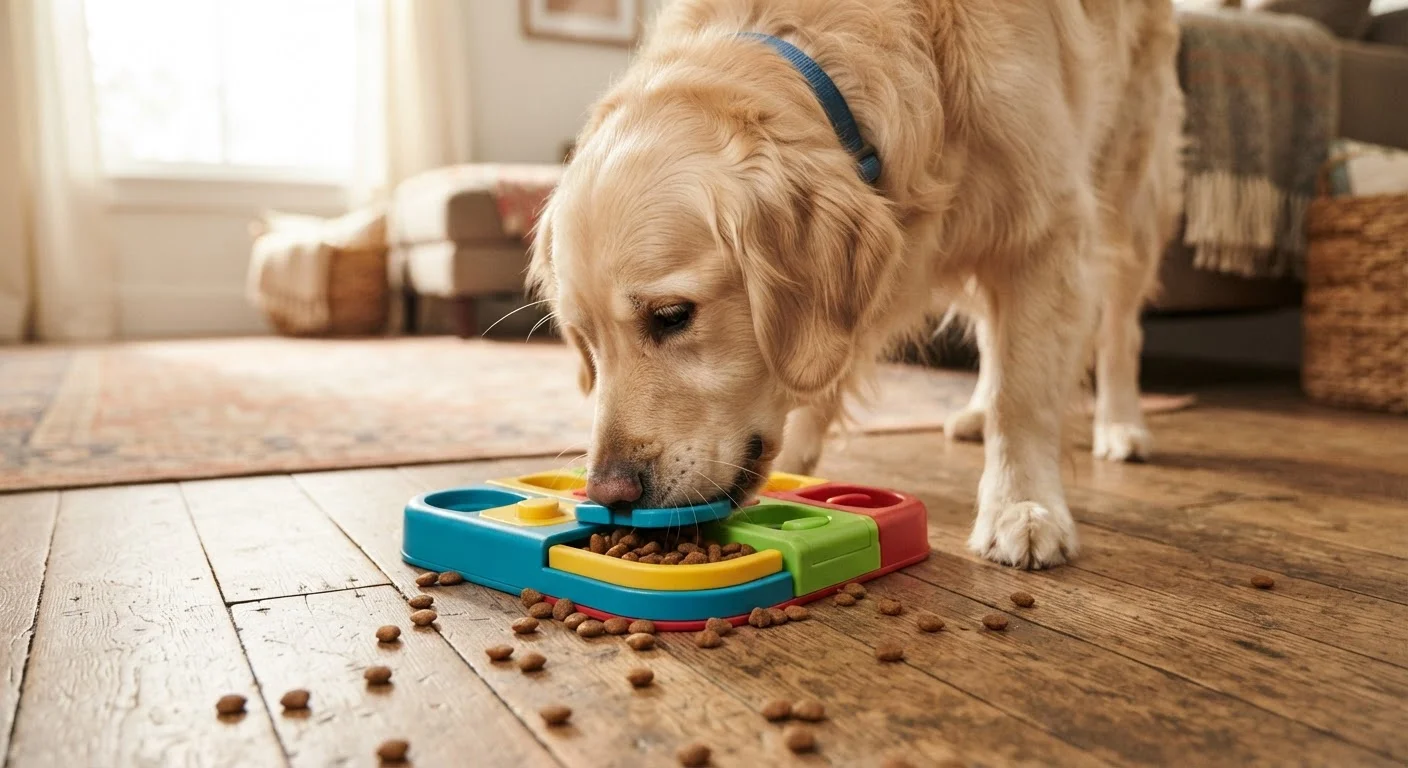
Key Takeaways
- Feeding enrichment slows eating, reduces boredom, and supports mental wellbeing for most pets.
- Scatter feeding, puzzle feeders, and snuffle mats are low-cost ways to add cognitive challenge at mealtime.
- Start with the easiest difficulty level and gradually increase challenge as your pet gains confidence.
- Always supervise new feeding tools and consult your vet if your pet has health or dietary restrictions.
- Rotating enrichment methods keeps novelty high and prevents your pet from losing interest.
What you will need
Why Mealtime Enrichment Matters
In the wild, animals spend a significant portion of their day working to find food - sniffing, foraging, problem-solving. For pets fed from a standard bowl, that entire behavioral sequence is compressed into seconds. The result is animals that are physically fed but cognitively understimulated. This gap contributes to common behavioral problems including destructive chewing, excessive vocalization, and anxious pacing.
Feeding enrichment restores some of that lost cognitive work. It slows eating (which can support digestion), activates scent-driven and problem-solving circuits in the brain, and gives pets a constructive outlet for energy they would otherwise spend less productively. As part of a broader wellness approach, it connects directly to what mental stimulation research suggests: cognitive engagement is as important to overall pet health as physical exercise.
Consult Your Vet Before Changing Feeding Methods
Pets with orthopedic issues, brachycephalic (flat-faced) anatomy, or conditions like bloat (gastric dilatation-volvulus) may require specific feeding positions or restrictions. Always check with your veterinarian before introducing puzzle feeders or scatter feeding, especially for dogs prone to eating too quickly or those with known digestive sensitivities.
What You'll Need to Get Started
Feeding enrichment doesn't require expensive equipment. Many effective setups use items already in your home. The key is choosing tools appropriate for your pet's species, size, and feeding habits.
What you will need
Rotate Methods to Maintain Novelty
Using the same puzzle feeder every meal can cause your pet to lose interest within weeks. Alternating between scatter feeding, snuffle mats, and different puzzle types keeps the challenge fresh. For more on why variety matters, see the case for rotating your pet's enrichment routine.
Watch for Frustration and Food Guarding
Some pets become anxious or frustrated when food access is delayed. If your pet whines excessively, stops engaging, or guards the feeder aggressively, step back to an easier difficulty level or return to a standard bowl temporarily. Forcing engagement with a puzzle that is too difficult can create negative associations with mealtime.
Step-by-Step: Setting Up Mealtime Enrichment
Follow these steps to introduce feeding enrichment safely and effectively. Each step builds on the last, so working through them in order will give your pet the best chance of engaging successfully from the very first session.
Assess Your Pet's Current Mealtime Habits
Before introducing any enrichment tool, observe how your pet currently eats. Does the bowl empty in under 30 seconds? Does your pet seem restless or bored between meals? Rapid eating and post-meal restlessness are common signals that mealtime enrichment could provide real benefit. Note your pet's species, size, and any dietary restrictions - these will guide which tools are appropriate.
Choose the Right Enrichment Method for Your Pet
Match the tool to your pet's species, cognitive level, and physical ability. Dogs generally take well to snuffle mats, puzzle feeders, and scatter feeding on grass or a mat. Cats often prefer lick mats or feeders that require pawing at compartments. Small animals like rabbits benefit from hay-stuffed toys or forage boxes. Birds respond well to skewered vegetables or food wrapped in paper to unwrap.
For a deeper breakdown by species, see enrichment strategies tailored by species.
[tool_cards]Start at the Easiest Difficulty Level
Whether you're using a commercial puzzle or a DIY muffin-tin setup, begin with the simplest configuration. For puzzle feeders, leave compartment lids off or place food in shallow, visible recesses. For scatter feeding, spread kibble across a small, flat surface rather than a dense mat. The goal at this stage is to let your pet succeed quickly and build a positive association with the new feeding format.
Measure and Transfer the Full Meal Portion
Use your pet's standard daily portion - do not add extra food as a reward for using the feeder. Measure the meal as you normally would, then transfer it into the enrichment device. If you are splitting meals across multiple methods (e.g., half in a snuffle mat and half scatter fed), divide the portion accordingly. Keeping total intake consistent is essential for weight management. The Pet Nutrition hub has practical guidance on portioning across life stages.
Supervise the First Several Sessions
Stay nearby while your pet works through the feeder, especially in the first week. Watch for signs of frustration, attempts to flip or chew the device, or any food that falls into hard-to-reach spaces. Ensure your pet can access all portions of the meal - food left behind means unintended caloric restriction. Gradually reduce supervision as your pet demonstrates safe, independent engagement.
Gradually Increase Difficulty Over Time
Once your pet completes the feeder calmly and consistently - typically within one to two weeks - move to a slightly more complex configuration. Add puzzle lids, move to a denser snuffle mat, or introduce a feeder with multiple puzzle layers. Tracking progress informally (e.g., noting how long each session takes) helps you pace difficulty increases appropriately. Enrichment should remain achievable - challenging but never impossibly so.
This article provides general pet care information and is not a substitute for professional veterinary advice. Always consult a licensed veterinarian regarding your individual pet's health, diet, and behavioral needs.