

Key Takeaways
- Degraded oil turns into sludge that can permanently restrict oil flow to critical engine components.
- Engine repairs caused by oil neglect can cost several times more than years of routine oil changes.
- Modern vehicles often tolerate longer intervals between changes, but the interval still must be followed.
- Oil life monitoring systems are more reliable guides than arbitrary mileage rules alone.
- A well-documented oil change history can protect resale value and warranty coverage.
Engine Oil Degradation
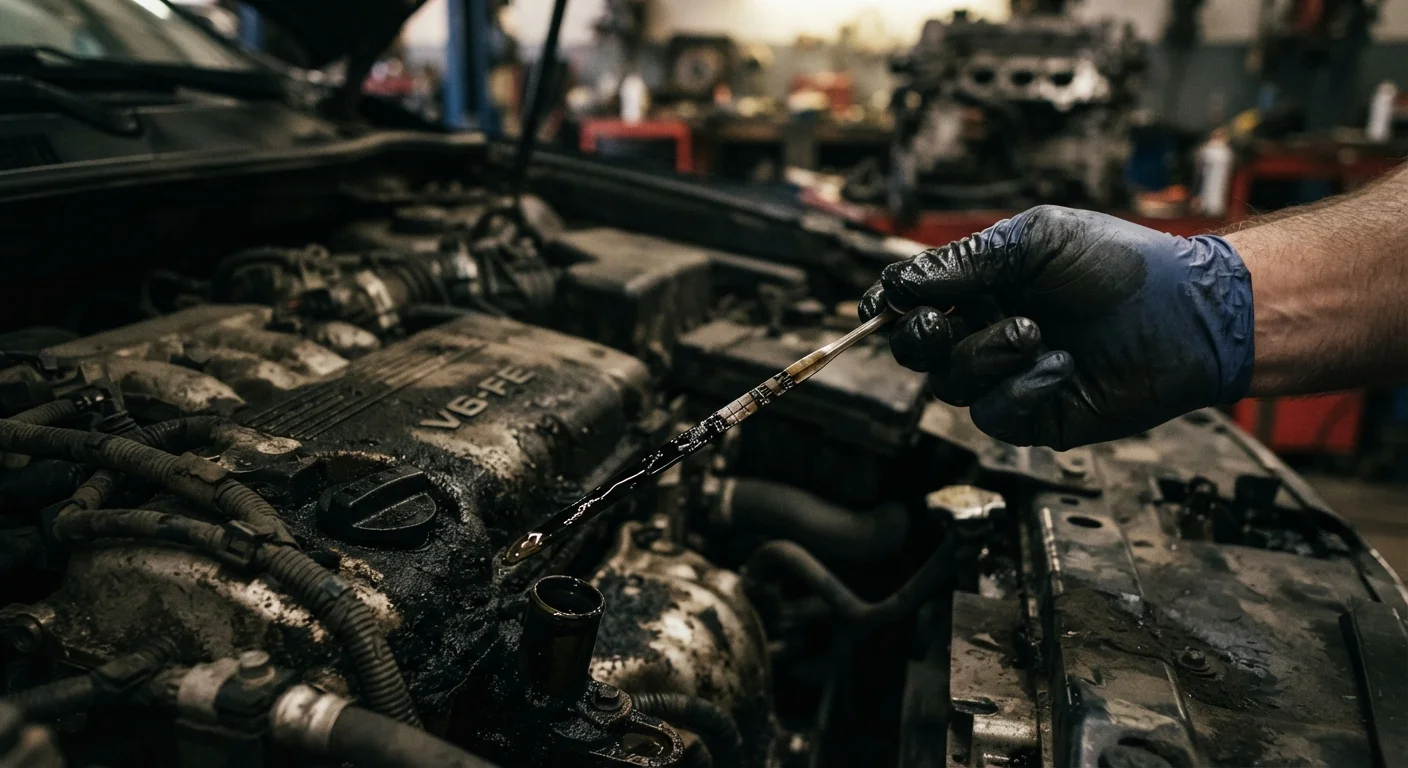
Engine oil degrades over time and mileage as it absorbs heat, combustion byproducts, and microscopic metal particles. As it breaks down, it loses its ability to lubricate and protect moving engine parts. Skipping or delaying oil changes allows this degraded oil to remain in your engine, where it can cause accelerating wear and lasting damage.
Motor oil degrades through thermal oxidation and chemical contamination; additives that neutralize acids and prevent sludge are consumed well before the base oil itself visibly thickens.
What Oil Actually Does Inside Your Engine
Engine oil performs several jobs simultaneously: it lubricates metal surfaces moving against each other at high speed, carries heat away from critical components, suspends and transports combustion byproducts to the filter, and chemically neutralizes acids that form during normal operation. Fresh oil manages all of this effectively. Old oil does not.
As oil ages, its additive package depletes. The detergents that clean engine surfaces, the dispersants that keep contaminants in suspension, and the anti-wear compounds that protect metal surfaces all break down over time and mileage. What remains is thicker, more acidic fluid that is increasingly poor at the jobs it was designed to do.
Synthetic vs. Conventional Oil Intervals
Full-synthetic oil generally resists thermal breakdown and oxidation longer than conventional oil, which is why many manufacturers specify it for extended intervals. If your vehicle was designed for conventional oil but you've switched to synthetic, confirm with your owner's manual or a qualified mechanic whether your interval changes - don't assume synthetic always means you can go longer.
The Sludge Problem Nobody Talks About
The most damaging consequence of neglected oil is sludge - a thick, tar-like deposit that forms when degraded oil, water vapor, and combustion gases combine under heat. Sludge accumulates in oil passages, valve covers, and pickup tubes. Once it partially blocks the oil pickup tube - the inlet that draws oil up to the pump - oil pressure drops and parts that depend on pressurized oil flow begin running partially dry.
Sludge damage is particularly insidious because it doesn't announce itself with a dramatic failure. Oil pressure may appear normal until the blockage is severe. By the time a warning light activates, significant wear has often already occurred. Engine flushes can address minor buildup, but advanced sludge typically requires disassembly - an expensive labor-intensive job.
$5,000-$10,000+
Typical engine repair or replacement cost
Industry repair data consistently places major engine work - including replacement on mid-size vehicles - in this range, compared to routine oil service costs measured in tens of dollars.
40%
Of engine wear occurs at cold startup
Engineering research on engine tribology indicates a significant share of total engine wear happens in the first moments after starting, when oil hasn't yet fully circulated - making oil condition at startup especially important.
The Real Cost Comparison
A routine oil change is one of the least expensive services a vehicle requires. Engine repairs are among the most expensive. Bearing replacement, camshaft damage, and timing chain wear caused by oil starvation can easily reach repair bills in the thousands of dollars. A complete engine replacement on a mid-size vehicle commonly runs from several thousand dollars into five figures depending on the vehicle and whether a rebuilt or new engine is used.
Skipping several oil changes to save money is a genuinely poor financial trade-off when viewed against those downstream costs. For more context on how maintenance decisions affect what your vehicle is worth over time, see how depreciation intersects with upkeep.
Keep Your Oil Change Receipts
Store every oil change receipt - whether from a shop or a DIY job with a logged date and mileage - in your glove box or a digital folder. This documentation protects your warranty rights and supports your vehicle's resale value. A simple habit that costs nothing can be worth hundreds of dollars when it matters.
Knowing the Right Interval for Your Vehicle
One common reason drivers skip oil changes is confusion about how often they're actually needed. The 3,000-mile rule that many people still follow was relevant for older vehicles running conventional oil. Most modern vehicles using full-synthetic oil have manufacturer-recommended intervals significantly longer than that - often 7,500 to 10,000 miles or more. Applying the old rule unnecessarily wastes money; ignoring the correct interval causes damage.
Your owner's manual is the definitive source for your vehicle's oil change interval. Many newer vehicles also include an oil life monitoring system that calculates remaining oil life based on actual driving conditions - short trips, cold starts, and towing all accelerate oil degradation faster than highway miles. Trust that system over generalizations. For a broader view of when each maintenance task is due, a complete maintenance timeline can help you stay organized. And if you're sorting fact from fiction on maintenance advice generally, common car maintenance myths are worth understanding before you act on them.
Protecting Warranty Coverage and Resale Value
Manufacturers can deny powertrain warranty claims when a vehicle lacks documented evidence of proper maintenance. An oil change skipped without a record isn't just a missed service - it's a gap in your maintenance history that can be used to argue the damage was owner-caused rather than a manufacturing defect.
When it's time to sell or trade in, buyers and dealers review service records. A car with documented, consistent oil changes signals a conscientious owner. One with gaps raises questions about what else was neglected - and that skepticism is reflected in the offer price. The math consistently favors staying current on oil changes.
This article is for general informational purposes only. Always consult your vehicle's owner's manual and a qualified mechanic for guidance specific to your car and driving conditions.