

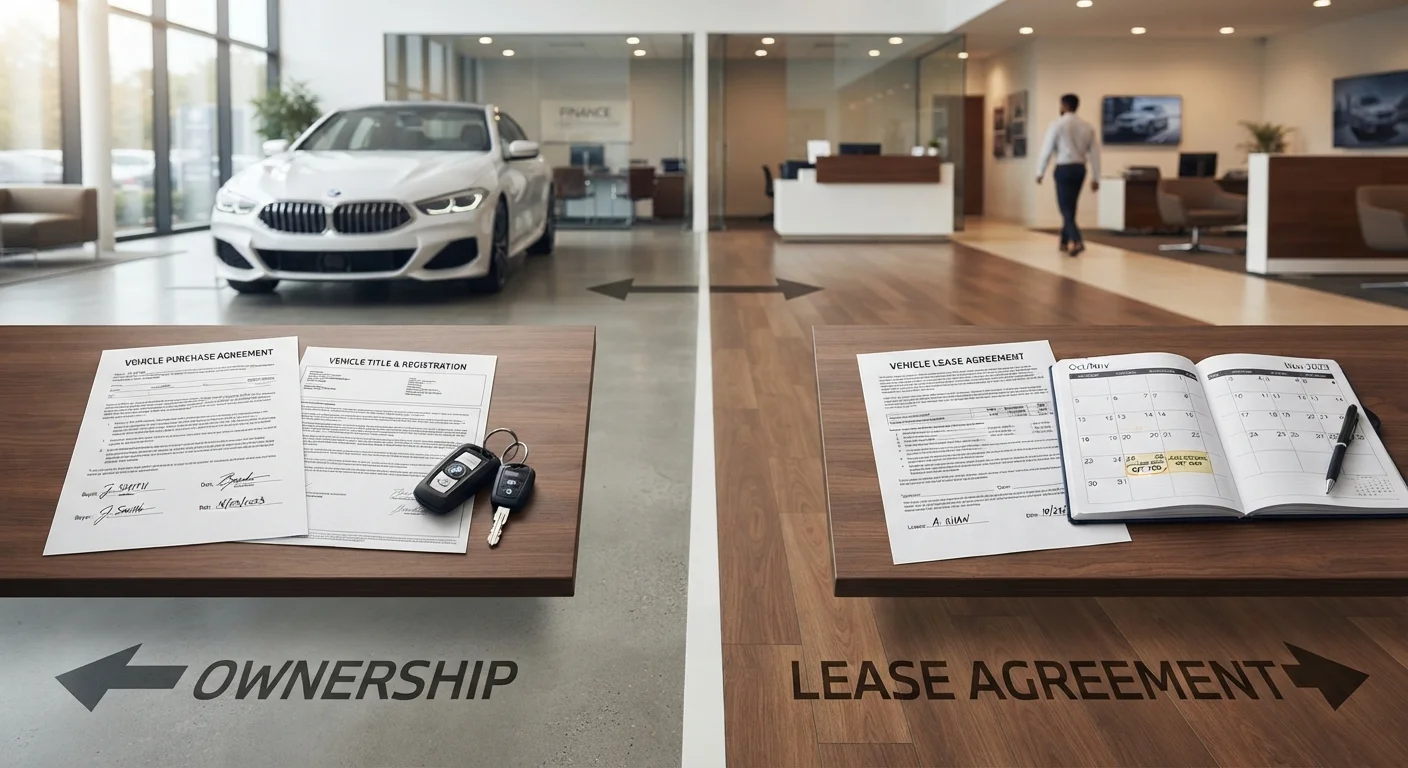
Key Takeaways
- Leasing typically means lower monthly payments but no equity built at the end of the term.
- Buying costs more upfront but results in an asset you fully own, free of payments.
- Mileage limits and wear-and-tear fees can make leasing significantly more expensive than advertised.
- Over a ten-year horizon, buying and holding a vehicle is generally the lower total-cost path.
- Neither option is universally superior - your driving habits and financial goals determine the right fit.
Option A
Leasing
The flexible, lower-upfront-cost option with built-in limitations.
Best for: Drivers who want a newer vehicle every few years, drive predictable mileage, and prefer lower monthly payments over building equity.
Option B
Buying
The long-term ownership path that builds equity over time.
Best for: Drivers who plan to keep a vehicle for many years, drive high mileage, and want to eliminate monthly payments eventually.
If you drive high annual mileage
Buying
Lease agreements typically cap annual mileage at 10,000-15,000 miles. Exceeding that triggers per-mile overage charges that can add up quickly.
If you want predictable costs and a newer vehicle every 2-3 years
Leasing
Leasing locks in a set monthly payment and hands off depreciation risk to the dealer, which suits drivers who prioritize newer tech and lower maintenance exposure.
If minimizing lifetime vehicle spending is your priority
Buying
Owning and maintaining a paid-off vehicle long-term almost always produces a lower total cost than a continuous cycle of lease payments.
If you have limited cash for a down payment right now
Leasing
Lease deals often require less money down than a purchase loan, though you should factor in acquisition fees and first-month payment due at signing.
If you modify vehicles or have variable lifestyle needs
Buying
Leases restrict modifications and hold you liable for any wear beyond normal use - ownership gives you full flexibility to use the vehicle as you see fit.
What You're Actually Agreeing To
When you lease a vehicle, you're paying for the portion of the car's value you consume during the lease term - typically two to four years. You return the vehicle at the end, owing nothing further if you've stayed within mileage limits and kept it in acceptable condition. When you buy, you're financing or paying outright for the entire vehicle and will own it free and clear once the loan is satisfied.
That distinction shapes every cost that follows. A lease monthly payment is usually lower than a loan payment on the same vehicle because you're only financing depreciation, not the full purchase price. But that lower number comes with strings: mileage caps (commonly 10,000-15,000 miles per year), disposition fees when you return the car, and potential charges for excess wear. As our editorial team notes in why affordable monthly payments can be a financial trap, focusing on the monthly figure alone can obscure what you're really paying.
The Side-by-Side Numbers
To compare these options fairly, you need to look beyond monthly payments and account for every dollar that leaves your pocket over the same time horizon.
| Criterion | Leasing | Buying |
|---|---|---|
| Monthly payment | Generally lower | Generally higher |
| Down payment | Often minimal | Typically 10%-20% of price |
| Ownership at end of term | None - return the vehicle | Full ownership, no payments |
| Mileage flexibility | Capped; overages cost extra | Unlimited |
| Modification allowed | No | Yes |
| Long-term total cost (10 yrs) | Higher (continuous payments) | Lower (payments end) |
| Depreciation risk | Borne by lessor | Borne by owner |
| Early exit penalty | Substantial early termination fees | Sell or trade any time |
Consider a simple scenario: a driver leases the same class of vehicle back-to-back for six years versus buying and financing it over six years. The lessee makes payments continuously throughout and ends with no asset. The buyer finishes their loan - often around five years - and then drives payment-free. Over a 10-year horizon, the buyer who holds the vehicle typically spends meaningfully less, even accounting for older-vehicle maintenance costs. See our breakdown of total ownership math for new vs. used vehicles for context on how depreciation affects these outcomes.
~14,500
Average miles driven per year by U.S. drivers
Federal Highway Administration data indicates the average American driver logs approximately 14,500 miles annually - often near or above standard lease mileage caps.
15%-25%
Typical first-year vehicle depreciation
Industry estimates consistently show new vehicles lose between 15% and 25% of their purchase value within the first 12 months of ownership.
$0.15-$0.30
Per-mile overage charge on most leases
Driving 5,000 miles over a lease's annual cap at $0.25 per mile adds $1,250 in fees at return - a cost rarely highlighted in lease advertisements.
Hidden Costs on Both Sides
Leasing carries costs that don't always appear in the advertised payment. Acquisition fees (typically $500-$1,000) are charged at the start of a lease. Disposition fees ($300-$500) are often due when you return the vehicle. Gap coverage - which protects you if the car is totaled and you owe more than its value - is sometimes bundled in, but not always. And if you exceed your mileage allowance, per-mile charges of $0.15-$0.30 are common.
Buying isn't cost-free either. Interest on a loan compounds over the loan term; a longer loan lowers monthly payments but raises total interest paid significantly. How loan terms shape what you actually pay is worth reviewing before signing any financing agreement. Buyers also absorb the full depreciation curve - new vehicles typically lose 15%-25% of their value in the first year alone.
Gap Coverage: Don't Skip This Detail
If a leased or financed vehicle is totaled or stolen, standard auto insurance typically pays only the current market value - which may be less than what you still owe. Gap insurance (Guaranteed Asset Protection) covers that difference. Some lease agreements include it automatically; most auto loans do not. Confirm your coverage status before driving off the lot, and consult your insurance provider for terms specific to your policy.
Which Path Fits Your Situation
Neither leasing nor buying is wrong. They serve different financial profiles and lifestyles. If you drive a company car for short periods, need a vehicle for a temporary assignment, or simply value knowing your maintenance exposure is limited to a warranty period, leasing can be a rational choice. If you're building long-term financial stability, want to eliminate a recurring vehicle expense, or drive more than the average American's roughly 14,500 miles per year, buying and holding usually wins on total cost.
The single most important step before signing either agreement is running the full numbers - not just the monthly payment - across your expected holding period. For a broader lens on how upfront-vs-lifetime cost trade-offs appear across purchase categories, why the cheapest option often costs the most over time offers a useful framework.
This article is for general informational purposes only and does not constitute financial, legal, or personalized automotive advice. Consult a qualified financial professional before making decisions based on your specific circumstances.