

Key Takeaways
- Supplements are regulated differently from drugs - the FDA does not approve them for safety or efficacy before they reach store shelves.
- Label terms like 'percent daily value' and 'proprietary blend' have specific meanings worth understanding before purchasing.
- Third-party certification seals indicate independent testing for purity and label accuracy, but do not confirm a supplement works as claimed.
- Interactions between supplements and prescription medications are real and worth discussing with a qualified healthcare provider.
- A healthcare professional is the right resource for deciding whether any supplement is appropriate for your individual situation.
Start here
Why Supplement Shopping Feels So Confusing
Next
What Supplement Labels Are Actually Telling You
Then
Third-Party Certifications: What They Verify (and What They Don't)
Going deeper
Dosage Language and Why It Matters
Final step
Before You Buy: Talking to Your Healthcare Provider
Why Supplement Shopping Feels So Confusing
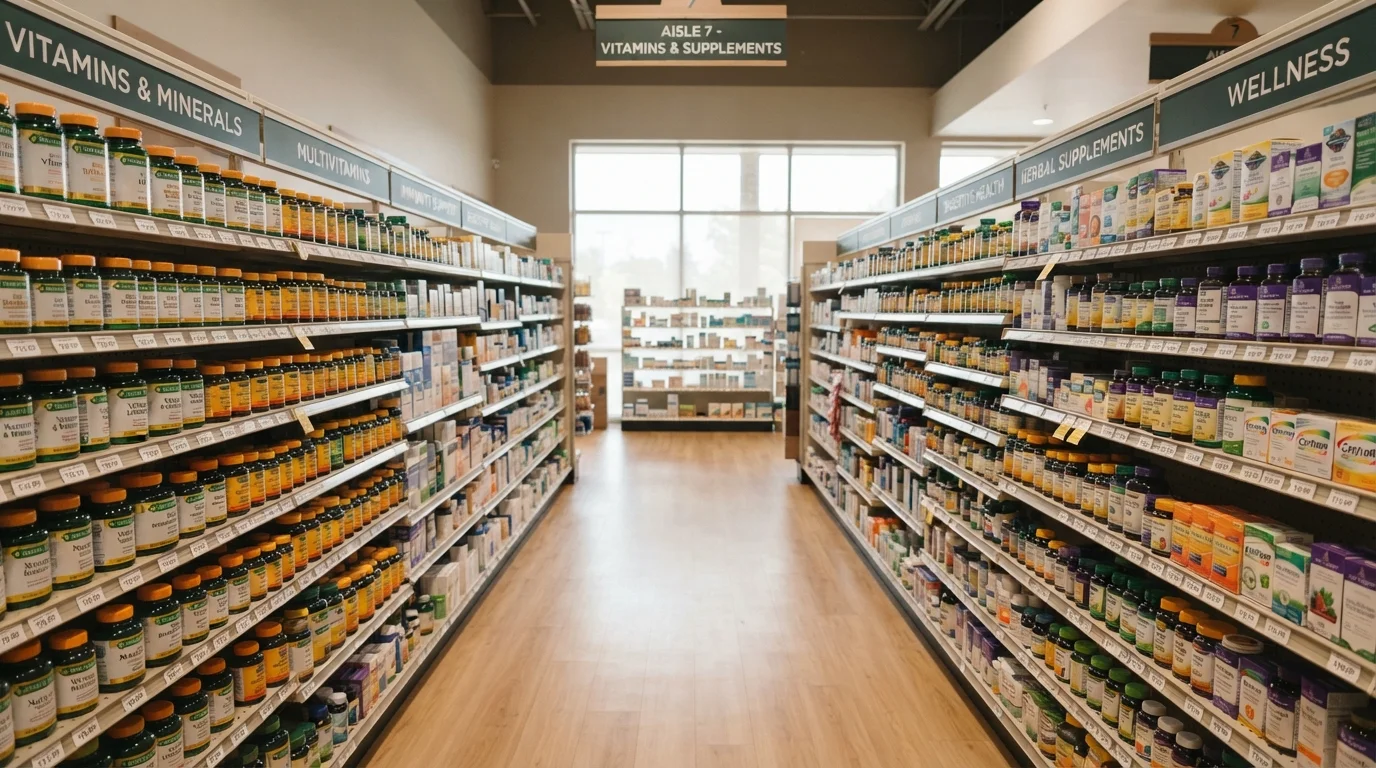
Walk into any pharmacy or grocery store and you'll find an entire aisle dedicated to supplements - vitamins, minerals, herbal extracts, probiotics, and protein powders competing for your attention with bold health claims and scientific-sounding language. It's a crowded market worth tens of billions of dollars annually in the United States, and the sheer volume of choices can leave even well-informed shoppers feeling lost.
A key reason the category feels opaque is regulatory. Unlike prescription or over-the-counter drugs, dietary supplements do not require FDA approval before they are sold. Manufacturers are responsible for product safety, but there is no mandatory pre-market review of whether a supplement actually works as advertised. That means much of the verification burden falls on you, the consumer - which is exactly why understanding a few foundational concepts pays off.
Dietary supplement
A product intended to add nutritional value to the diet, including vitamins, minerals, herbs, amino acids, and enzymes. Supplements are regulated differently from foods and drugs in the U.S.
Supplement Facts panel
The standardized label block required on supplement packaging that lists serving size, ingredient amounts, and percent daily values. It's the nutrition-label equivalent for supplements.
Percent daily value (%DV)
A number on a label showing how much of a nutrient one serving provides compared to a general daily reference amount set by the FDA. It is not a personalized recommendation.
Proprietary blend
A mixture of ingredients listed as a group on a label with only the total combined weight disclosed. Individual ingredient amounts within the blend are not required to be revealed.
Third-party certification
Independent testing by an outside organization that verifies a supplement's label accuracy and purity. It does not confirm that the supplement is medically effective.
Elemental dose
The actual amount of a usable mineral (like calcium or magnesium) in a supplement, separate from the weight of the compound it's chemically bound to. These numbers are often different.
What Supplement Labels Are Actually Telling You
The Supplement Facts panel is the standardized block of information required on every dietary supplement sold in the U.S. It lists serving size, servings per container, and the nutrients or ingredients present along with their amounts. Understanding this panel is the first skill worth developing.
Two terms trip up a lot of shoppers. Percent daily value (%DV) tells you how a serving compares to a federally established daily reference amount - useful context, but not a personal prescription. Proprietary blends list multiple ingredients as a group with only the combined weight shown, concealing how much of any single ingredient is actually present.
For a thorough walkthrough of every element on the panel - including how to interpret 'other ingredients' and what 'standardized extract' means - see our Supplement Labels Decoded field guide.
Scan the ingredient list beyond the Supplement Facts
Below the Supplement Facts panel, look for the 'other ingredients' section, which lists fillers, binders, colorings, and allergens like soy, gluten, or dairy. If you have food sensitivities, this section is just as important as the active ingredients list.
Third-Party Certifications: What They Verify (and What They Don't)
Because supplement quality isn't government-guaranteed, independent certification programs have emerged to fill part of the gap. Organizations such as USP (U.S. Pharmacopeia), NSF International, and ConsumerLab test products for label accuracy, contaminant levels, and manufacturing consistency. Seeing one of their seals on a bottle means an independent lab has checked that the product contains what it claims and isn't tainted with heavy metals or undisclosed substances.
What these seals do not confirm is effectiveness. A certified supplement has passed a purity test - not a clinical trial. It won't cause harm from contamination, but it hasn't been independently proven to produce any specific health result. That's an important distinction to hold onto whenever marketing language becomes persuasive.
Our detailed breakdown of what each major certification program tests for can help you evaluate seals with more confidence.
Certification Scope Varies by Program
Different certification organizations test for different things. USP focuses on identity, potency, and purity according to its published standards. NSF offers a program specifically for sport supplements that also screens for banned substances. ConsumerLab conducts independent purchasing and testing rather than manufacturer-initiated certification. Knowing which program issued a seal helps you interpret what it actually guarantees.
Dosage Language and Why It Matters
Supplement labels use specific language around amounts that can be misleading without context. Terms like elemental calcium or magnesium refer to the actual usable mineral content - not the total weight of the compound it's bound to, which is always higher. A label listing 500 mg of calcium carbonate, for example, contains roughly 200 mg of elemental calcium.
More is not automatically better. Fat-soluble vitamins like A, D, E, and K accumulate in the body and can reach harmful levels with prolonged excessive intake. Water-soluble vitamins like C and B vitamins are excreted more readily but are not entirely without risk at very high doses. Understanding that 'more than the %DV' isn't always beneficial is an important check on marketing that frames high-dose formulas as premium.
If you're considering combining supplements or wondering how timing affects absorption, what researchers know about stacking and interactions is worth reading before you build a routine.
High Doses Are Not Always Harmless
Fat-soluble vitamins (A, D, E, K) accumulate in body tissue and can reach toxic levels with prolonged high-dose supplementation. Even some water-soluble nutrients carry risks at very high intakes over time. If a product's dose significantly exceeds 100% of the daily value, that is worth discussing with a healthcare provider before use.
Before You Buy: Talking to Your Healthcare Provider
No amount of label literacy fully replaces a conversation with a qualified professional. A doctor, registered dietitian, or pharmacist can review your current medications, assess whether you have a genuine deficiency worth addressing, and flag potential interactions that aren't obvious from product packaging alone.
Before any appointment, it helps to come prepared. Write down every supplement you currently take - including dose and frequency - and bring the bottles if possible. Be ready to explain your goal: are you trying to address a specific symptom, fill a dietary gap, or support general wellness? That context shapes the guidance you'll receive.
For a practical framework to guide that conversation, our pre-supplement checklist walks through the questions worth raising with your provider before you commit to anything new.
This article is for general informational and educational purposes only and does not constitute medical advice. Always consult a qualified healthcare professional before starting, stopping, or changing any supplement or medication regimen.