
Supplement Labels Decoded: A Field Guide to Serving Size, % DV, and Ingredient Lists

| Governing agency (U.S.) | FDA (Food and Drug Administration) |
| Panel name on supplements | Supplement Facts (distinct from Nutrition Facts) |
| %DV reference diet | 2,000 calories per day (adult general reference) (FDA labeling regulations) |
| Ingredients listed by | Descending order of predominance by weight (21 CFR Part 101) |
| Proprietary blend disclosure | Total blend weight only; individual ingredient amounts not required |
| "†" dagger symbol meaning | Daily Value not established for that ingredient |
What the Supplement Facts Panel Is Actually Telling You
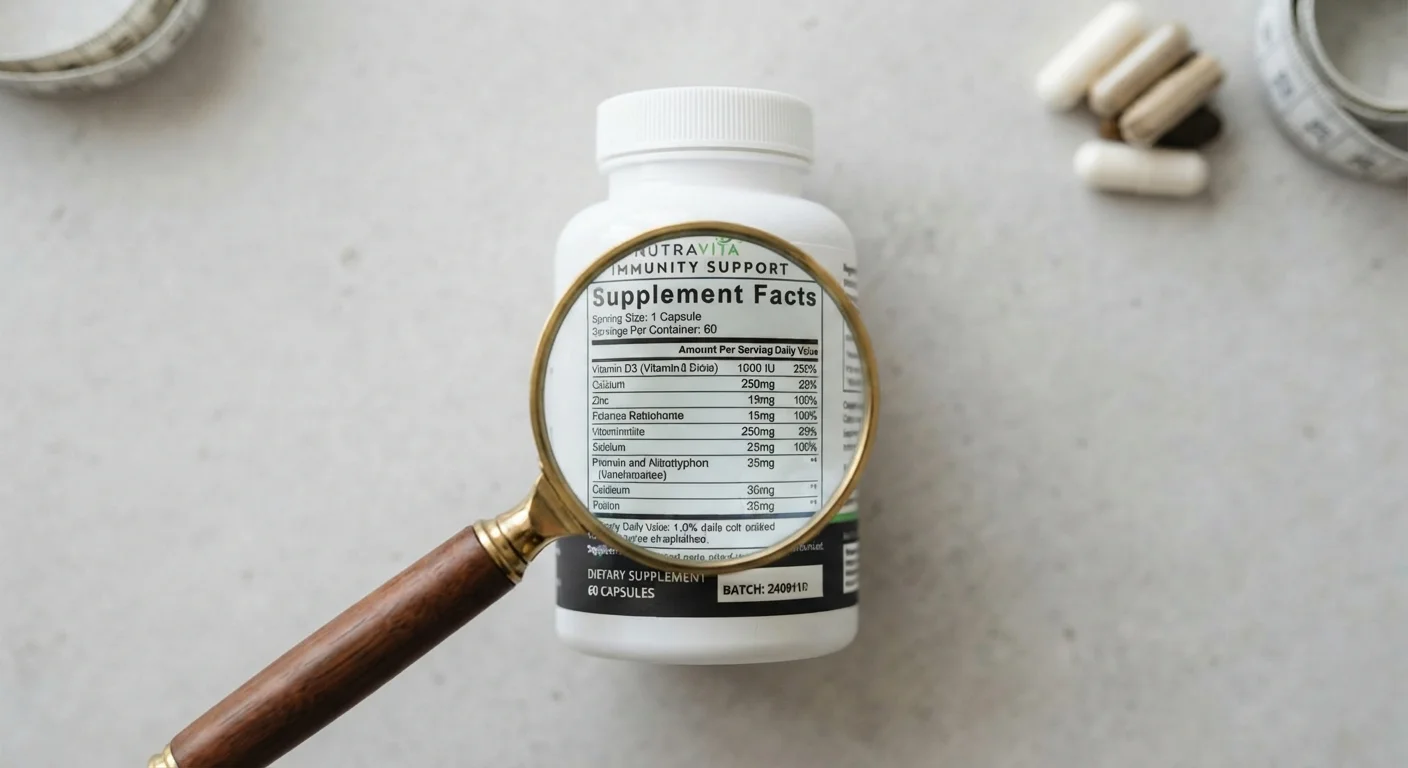
Every dietary supplement sold in the United States must carry a Supplement Facts panel - a standardized label governed by the Food and Drug Administration (FDA). Think of it as the nutritional equivalent of the Nutrition Facts panel on food packaging, but with a few important differences that catch many consumers off guard.
| Governing agency (U.S.) | FDA (Food and Drug Administration) |
| Panel name on supplements | Supplement Facts (distinct from Nutrition Facts) |
| %DV reference diet | 2,000 calories per day (adult general reference) (FDA labeling regulations) |
| Ingredients listed by | Descending order of predominance by weight (21 CFR Part 101) |
| Proprietary blend disclosure | Total blend weight only; individual ingredient amounts not required |
| "†" dagger symbol meaning | Daily Value not established for that ingredient |
The panel opens with serving size, which defines the unit the manufacturer used to calculate everything else on the label - capsules, tablets, scoops, or milliliters. This number is chosen by the manufacturer, not set by a regulatory body, so two products containing the same ingredient may list very different amounts simply because their serving sizes differ. Always compare amounts per serving when evaluating products side by side.
Below serving size, servings per container tells you how many doses the package contains. A bottle listing 90 capsules with a 3-capsule serving size contains 30 doses - not 90. This distinction directly affects cost and how long the supply lasts.
This article provides general health information for educational purposes only. It is not medical advice. Always consult a qualified healthcare professional before starting, stopping, or changing any supplement regimen.
Percent Daily Value (%DV): What It Measures and What It Doesn't
Percent Daily Value (%DV) expresses how much of a nutrient a single serving provides relative to a general reference target - typically based on a 2,000-calorie adult diet as established by the FDA. A vitamin D supplement showing 125% DV means one serving exceeds the general reference intake for that nutrient.
Serving Size
The manufacturer-defined unit used as the basis for all nutrient amounts listed on the Supplement Facts panel. It may be measured in capsules, tablets, scoops, or liquid volume.
Percent Daily Value (%DV)
A percentage expressing how much of a nutrient one serving provides relative to a general daily reference intake established by the FDA, typically based on a 2,000-calorie adult diet.
Proprietary Blend
A combination of ingredients listed collectively under a brand name, with only the total blend weight disclosed - not the individual amounts of each component inside the blend.
Other Ingredients
Non-active substances such as fillers, binders, coatings, and preservatives used in manufacturing, listed separately below the main Supplement Facts panel.
Excipient
An inactive substance used in supplement or pharmaceutical manufacturing to aid stability, flow, or delivery - such as magnesium stearate or silicon dioxide.
Reference Daily Intake (RDI)
Population-level reference values for daily nutrient intake, set by the FDA and used as the basis for calculating %DV on product labels. Individual needs may differ substantially.
Critical limitations to keep in mind:
- %DV does not apply to every ingredient. For substances without an established Daily Value - many botanical extracts, amino acids, and proprietary compounds - the %DV column will show a dagger symbol (†) and a footnote stating "Daily Value not established." This is common and expected, but it also means you have no regulatory benchmark to anchor the dose to.
- Individual needs vary. Reference Daily Intakes are population-level estimates. Age, sex, health status, diet, and genetics all affect what any individual actually requires. A %DV is a starting point for conversation with a healthcare provider, not a personal prescription.
- Higher %DV is not always better. Some fat-soluble vitamins (A, D, E, K) accumulate in the body and can reach harmful levels with sustained high intake. Percentages well above 100% DV are not automatically beneficial or safe.
Proprietary Blends and the Transparency Problem
A proprietary blend (sometimes labeled a "matrix," "complex," or "formula") is a group of ingredients listed under a single collective name, with only the total weight of the blend disclosed - not the individual amounts of each ingredient inside it. The FDA permits this practice, and manufacturers sometimes cite trade-secret protection as justification.
From a consumer standpoint, this creates a meaningful gap: you may know a blend contains 500 mg of a mixture of five botanicals, but you cannot tell from the label how much of any single ingredient is present. This matters when research on a particular ingredient's effects is tied to a specific dose. The gap between a label's claims and a supplement's actual effects is explored in greater depth in our related coverage.
~80,000
Dietary supplement products estimated on the U.S. market
According to the FDA, tens of thousands of dietary supplements are available to U.S. consumers, making label literacy especially important.
†
Dagger symbol frequency on supplement labels
Many botanical and specialty ingredients lack an established Daily Value, so the dagger symbol appears routinely on labels - signaling no regulatory benchmark exists for that ingredient.
When evaluating a product that uses a proprietary blend, note whether the total blend weight is sufficient to provide meaningful amounts of every ingredient it claims to contain, and whether the ingredients are listed in descending order by weight - which is required.
"Other Ingredients": The Secondary List That Deserves Attention
Below the Supplement Facts panel, most labels carry a separate Other Ingredients list. These are not the active or functional nutrients - they are the excipients, binders, fillers, coatings, colorants, and preservatives used to manufacture the product. Common examples include magnesium stearate (a flow agent), silicon dioxide (anti-caking), gelatin or cellulose (capsule material), and various natural or artificial flavors.
"Other Ingredients" does not mean "unnecessary" or "harmful" - many of these substances are inert and widely used in both food and medicine manufacturing. However, this section is worth scanning for:
- Allergens - soy, dairy, gluten, shellfish, and tree nuts can appear as processing aids or carriers.
- Dyes and artificial colors - relevant for individuals who prefer to avoid them.
- Capsule material - gelatin capsules are animal-derived; consumers following vegetarian or vegan diets should look for vegetable cellulose (HPMC) alternatives.
Third-Party Testing as a Label Supplement
Because the FDA does not approve dietary supplements before they go to market, some manufacturers voluntarily submit to third-party verification programs (such as those run by USP, NSF International, or Informed Sport). A third-party seal on the label indicates that an independent organization has tested the product for ingredient accuracy and contaminants - though it does not guarantee the product will produce a specific health effect. Look for these seals as an additional transparency signal beyond what the Supplement Facts panel alone can convey.
Label literacy follows you across consumer categories. The same skills that help you parse a supplement panel are transferable: reading a skincare ingredient list follows similar structural logic, and pet owners may find the discussion of pet food label structures a useful companion read.
This article is for informational purposes only and does not constitute medical or dietary advice. Consult a licensed healthcare professional for guidance specific to your health needs.