

Key Takeaways
- Every insurance policy contains several distinct sections, each with a different function.
- The declarations page summarizes your coverage at a glance but is not the complete contract.
- Exclusions define what the policy will not cover - often the most consequential section to read.
- Riders and endorsements allow you to customize or expand standard coverage for specific needs.
- Coverage limits and deductibles directly affect what you receive when a claim is paid.
- Reading the full policy - not just the summary - is essential before signing.
Insurance Policy Structure
An insurance policy is a legal contract divided into distinct sections, each serving a specific purpose. These sections collectively define what is covered, what is excluded, how much the insurer will pay, and under what conditions a claim can be made. Knowing where to find this information - and what it means - helps you evaluate coverage before committing.
Policies are governed by state insurance regulations, which dictate minimum disclosures and standard language requirements; actual terms vary by insurer and policy type.
The Declarations Page: Your Policy at a Glance
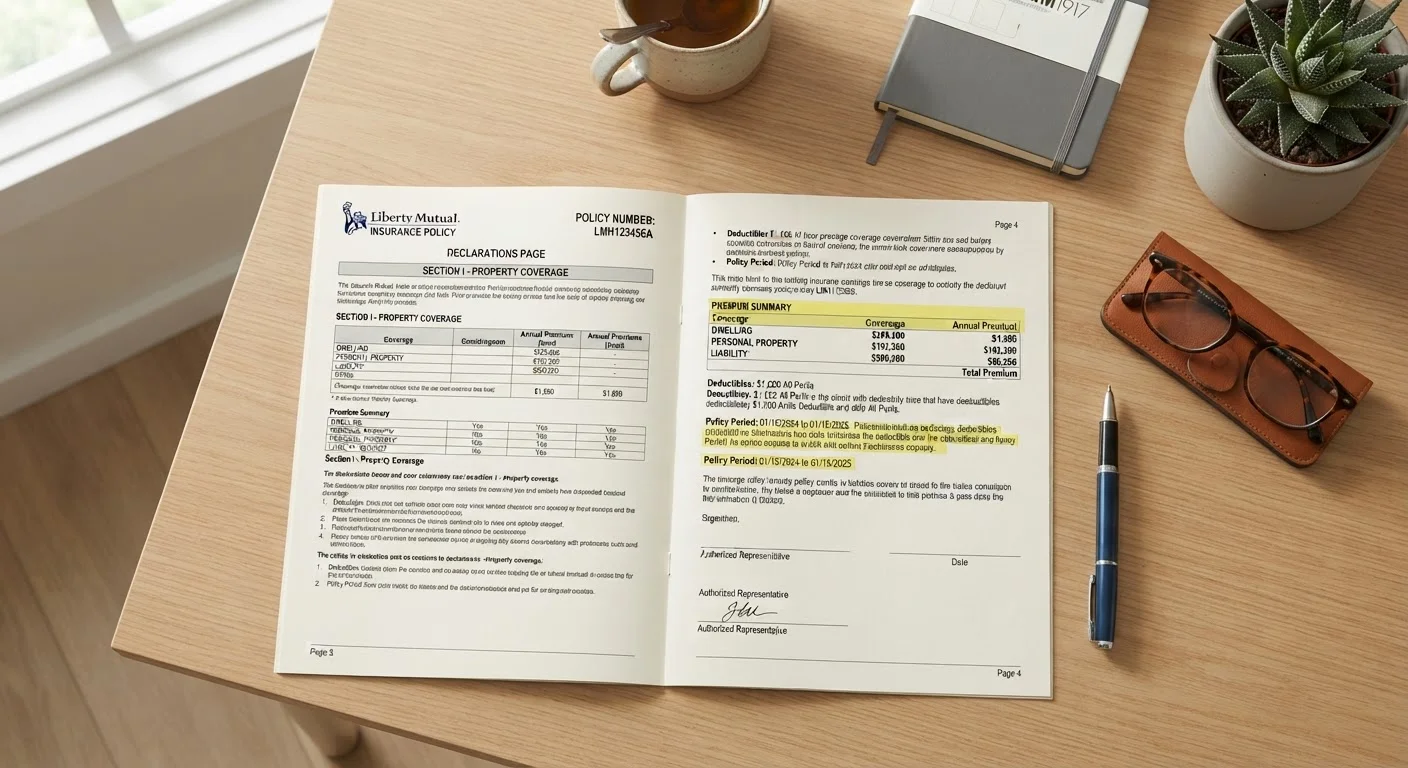
The first page most policyholders see is the declarations page - a concise summary of who is insured, what is covered, and for how long. It identifies the named insured, the policy period, the insurer, premium amounts, and key coverage limits or deductibles.
Think of the dec page as a cover sheet. It is a useful reference, but it does not define the full scope of your contract. Every figure listed there - limits, deductibles, premium - ties back to detailed terms buried deeper in the document. Understanding what deductibles and premiums actually mean is an important first step before interpreting these numbers.
1 in 3
Policyholders who read their full policy
Industry surveys consistently suggest a minority of consumers read their complete policy document rather than relying only on the summary or agent explanation.
~40%
Of denied claims cite exclusions as the reason
Insurance industry data indicates exclusions are among the most cited reasons for claim denials across property and casualty lines.
Insuring Agreement, Definitions, and Conditions
Following the declarations page, policies typically contain three foundational sections:
- Insuring Agreement: This is the insurer's promise - a broad statement of what events or losses the policy covers. It sets the outer boundary of coverage before any exclusions are applied.
- Definitions: Insurance contracts rely on precise language. A definitions section explains how key terms - such as 'occurrence,' 'property,' or 'bodily injury' - are interpreted throughout the document. A word that seems ordinary in everyday speech may carry a narrower legal meaning here.
- Conditions: These are the obligations both you and the insurer must meet for coverage to apply. Common conditions include timely reporting of a claim, cooperating with investigations, and paying your premium on schedule. Failing to meet a condition can jeopardize a claim, so this section deserves careful attention.
For a deeper look at how these concepts play out in practice, see what can invalidate an insurance claim.
Read Definitions Before the Policy Body
Start with the definitions section before reading coverage terms or exclusions. Insurance contracts often assign narrower meanings to common words, and misreading a term can lead you to misunderstand what is - or is not - covered. A few minutes spent on definitions can prevent significant confusion later.
Exclusions: What the Policy Will Not Cover
The exclusions section is arguably the most important part of any policy - and the most commonly overlooked. Exclusions carve out specific perils, situations, or types of property that the insurer will not pay for, regardless of what the insuring agreement seems to promise.
Standard homeowners policies, for example, typically exclude flood and earthquake damage. Many health plans exclude certain elective procedures. Life insurance policies may exclude deaths resulting from specific circumstances. Coverage gaps often arise precisely because of these exclusions, and policyholders only discover them at claim time.
Reading the exclusions before signing - not after a loss - is one of the most practical steps any consumer can take.
Riders, Endorsements, and Coverage Limits
A rider (also called an endorsement) is a written modification attached to the base policy. Riders can expand coverage - for example, adding scheduled jewelry coverage to a homeowners policy, or adding a critical illness benefit to a life insurance plan - or they can restrict it. Each rider becomes part of the contract and should be read alongside the main policy.
Coverage limits define the maximum the insurer will pay per claim or per policy period. A limit that seems adequate today may fall short if costs rise or circumstances change. It is worth reviewing limits periodically, especially after major life events such as purchasing a home or starting a business.
Before agreeing to any policy, reviewing these components together gives you a clearer picture of actual protection. The questions to ask before signing any insurance policy can help guide that review.
Policy Language Varies by State and Insurer
State regulators set minimum standards for policy language and disclosures, but insurers have latitude in how they structure coverage beyond those minimums. A term like 'occurrence' or 'property damage' may be defined differently across two policies that appear similar. Never assume that coverage in one policy automatically applies the same way in another.
This article is for general informational and educational purposes only. It is not personalized insurance, legal, or financial advice. Coverage terms, exclusions, and regulations vary by insurer and state. Always read your actual policy documents carefully and consult a licensed insurance agent or adviser for guidance specific to your situation.