

Key Takeaways
- Standard homeowners policies almost never cover flood damage - separate flood insurance is required.
- Running a business from home can void personal property and liability coverage under many standard policies.
- High-value items like jewelry and collectibles often hit sublimits far below their actual worth.
- Ride-share and delivery drivers typically face a coverage gap between personal auto and commercial policies.
- Reviewing your policy's exclusions section - not just its declarations page - reveals what is truly not covered.
- A licensed insurance agent or adviser can help identify gaps and explain options for supplemental coverage.
Why Standard Policies Leave Gaps
Insurance policies are contracts with precise boundaries. They're designed around statistical averages - the risks most policyholders face most of the time. What falls outside that average often falls outside coverage, too. The result is a set of predictable blind spots that catch people off guard at the worst possible moment: when a claim is filed and denied.
Understanding these gaps isn't about assuming the worst - it's about being informed. As the sections of a standard homeowners policy illustrate, the declarations page tells you what a policy covers in broad terms, but the exclusions section tells you what it doesn't - and that's where gaps live.
Below are the coverage gaps that most commonly surprise everyday policyholders, along with plain explanations of why they exist.
Flood Damage
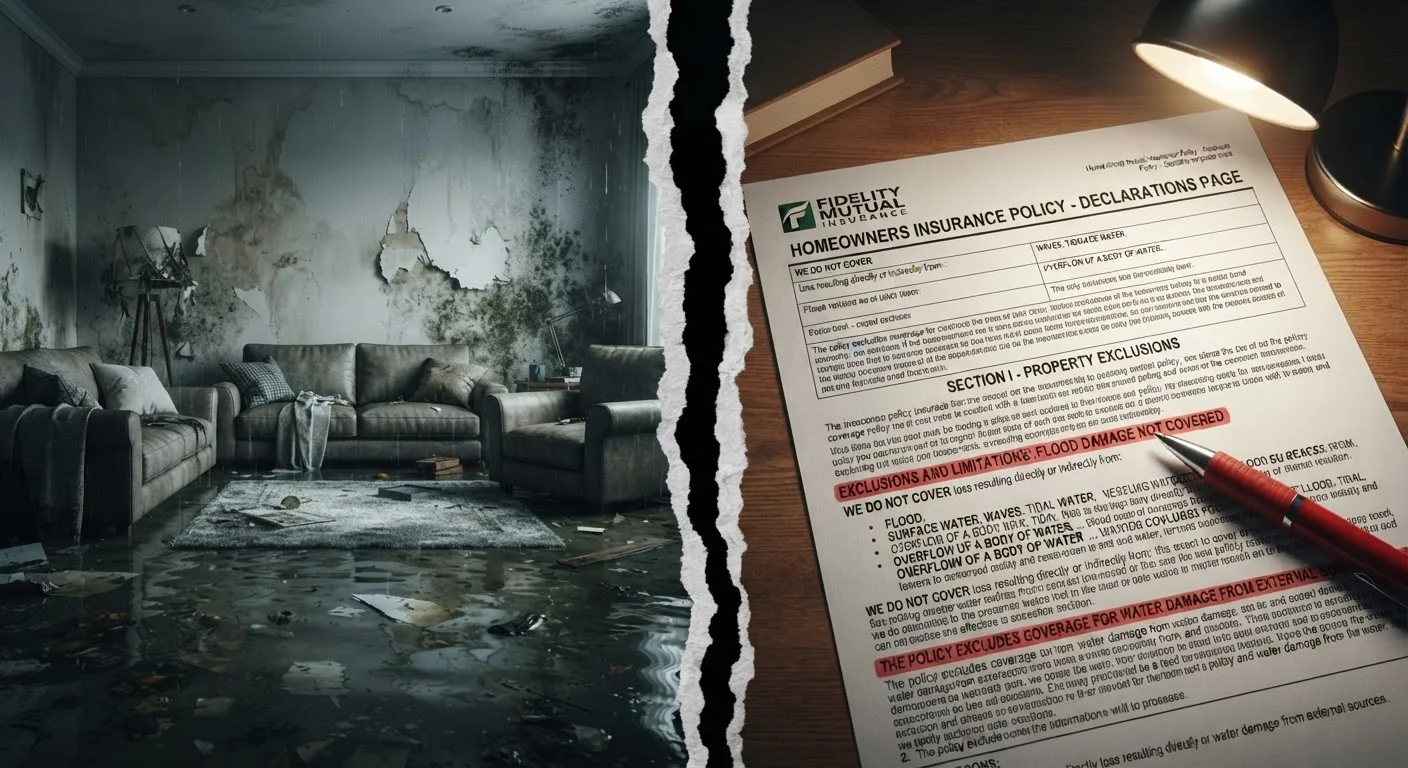
This is perhaps the most consequential coverage gap in personal insurance. Standard homeowners and renters policies do not cover flood damage - not from rising rivers, storm surge, or heavy rainfall overwhelming drainage systems. The exclusion applies even when flooding is caused by a declared natural disaster.
Flood insurance is sold separately, most commonly through the federally backed National Flood Insurance Program (NFIP), though some private insurers also offer it. Coverage typically has a 30-day waiting period before it takes effect, meaning it can't be purchased the moment a storm approaches. Many homeowners in non-coastal areas assume they're at low risk, but flood maps shift over time and even moderate rainfall events can cause significant water intrusion.
Flood damage is excluded from virtually every standard homeowners policy - even after a federally declared disaster.
Home-Based Business Activities
If you operate a business from home - whether freelancing, running an online shop, or seeing clients - your standard homeowners or renters policy likely offers little or no protection for that activity. Business equipment may only be covered up to a small sublimit (sometimes $2,500 or less), and business liability - such as a client being injured on your property - is typically excluded entirely.
This gap has grown as remote work and side businesses have become more common. A home-based business endorsement or a separate business owner's policy (BOP) can address these exposures, but the right solution depends on the type and scale of the business. A licensed agent familiar with commercial lines can clarify what options apply.
Home business liability is almost always excluded from standard homeowners coverage, regardless of business size.
High-Value Personal Property
Standard policies cover personal belongings, but they apply sublimits to specific categories - jewelry, watches, furs, firearms, silverware, and collectibles often face caps well below what those items are actually worth. For example, a policy might cap jewelry coverage at $1,500 for theft, even if the insured piece is worth substantially more.
A scheduled personal property endorsement (sometimes called a floater) allows policyholders to list individual high-value items by appraised value. This typically requires a recent appraisal and costs additional premium, but it closes the gap for items that genuinely exceed standard limits. This is a distinct layer of protection from what a standard policy provides - something worth reviewing if you own significant valuables.
Jewelry, collectibles, and firearms are subject to sublimits that can be far below an item's true replacement value.
Ride-Share and Delivery Driving
Personal auto insurance is designed for personal use. When a vehicle is being used to transport passengers or deliver goods for compensation - even occasionally - standard personal policies may deny claims that occur while the app is active. At the same time, the ride-share company's commercial coverage may only apply once a passenger is in the vehicle, leaving a gap during the period when the driver is logged in and waiting for a match.
This "period 1" gap (app on, no passenger yet) is a well-documented coverage problem for gig economy drivers. Some insurers offer ride-share endorsements that bridge this gap for personal policies. If you drive for any app-based platform, it's essential to disclose this to your insurer - concealing it could invalidate a claim entirely. See our overview of auto insurance coverage types for context on what standard personal auto policies actually include.
Gig economy drivers often face a dangerous window where neither personal nor commercial coverage applies.
Sewer Backup and Water Damage
Water damage from a burst pipe inside the home is usually covered. Water damage from a backed-up sewer line or overflowing drain is usually not - even though both can cause equivalent destruction. Sewer backup is treated as a separate peril and requires a specific endorsement on most homeowners policies.
Ground seepage and gradual leaks that go unreported are also typically excluded under a "neglect" or "maintenance" clause. Insurers expect policyholders to address slow-developing issues before they become claims. This is worth knowing not only for coverage reasons but also as a practical maintenance reminder.
Backed-up sewers and drains are specifically excluded perils requiring a separate endorsement on most home policies.
Trampolines, Dog Bites, and Certain Liability Risks
Homeowners liability coverage protects against injury claims made by others on your property - but many insurers exclude or restrict coverage based on specific hazards. Trampolines, swimming pools without required fencing, and certain dog breeds are frequently listed as exclusions or grounds for policy nonrenewal.
Dog bites represent a significant share of homeowners liability claims in the U.S. Some policies exclude coverage for specific breeds outright; others may add surcharges or require documentation. If you own a dog or are considering one, it's worth verifying whether your policy includes any breed-based restrictions. Similarly, any feature on your property considered an attractive nuisance - a legal concept describing hazards that may draw children - may affect your liability exposure and coverage terms.
Certain dog breeds and property features may be explicitly excluded from homeowners liability coverage.
How to Start Closing the Gaps
Identifying a coverage gap is only useful if you take steps to address it. For most people, the starting point is a thorough read of existing policy documents - particularly the exclusions and conditions sections. If the language is unclear, a licensed insurance agent or independent broker can walk you through what applies to your specific situation.
Start With Your Policy's Exclusions Section
Most policyholders read only the declarations page, which summarizes what's covered. The exclusions section - often deep in the document - specifies what the policy will not pay for, and that's where gaps are defined. Before purchasing supplemental coverage, read your existing exclusions carefully so you know exactly what you're trying to fill. A licensed insurance agent can help interpret language that isn't clear.
Supplemental coverage - such as a flood policy through the National Flood Insurance Program (NFIP), a scheduled personal property endorsement, or a business owner's policy - exists precisely to fill these holes. Each comes with its own eligibility rules, premiums, and exclusions, so it's worth consulting a qualified professional before making changes. For a deeper look at how gaps and myths interact, see our article on insurance myths that lead to costly coverage decisions.
Before agreeing to any new or supplemental policy, consider reviewing the questions to ask before agreeing to any insurance policy to ensure you understand what you're actually purchasing.
This article is for general informational and educational purposes only and does not constitute personalized insurance, financial, or legal advice. Coverage terms, exclusions, and availability vary by provider, policy, and state. Consult a licensed insurance agent or adviser for guidance specific to your situation.