

Key Takeaways
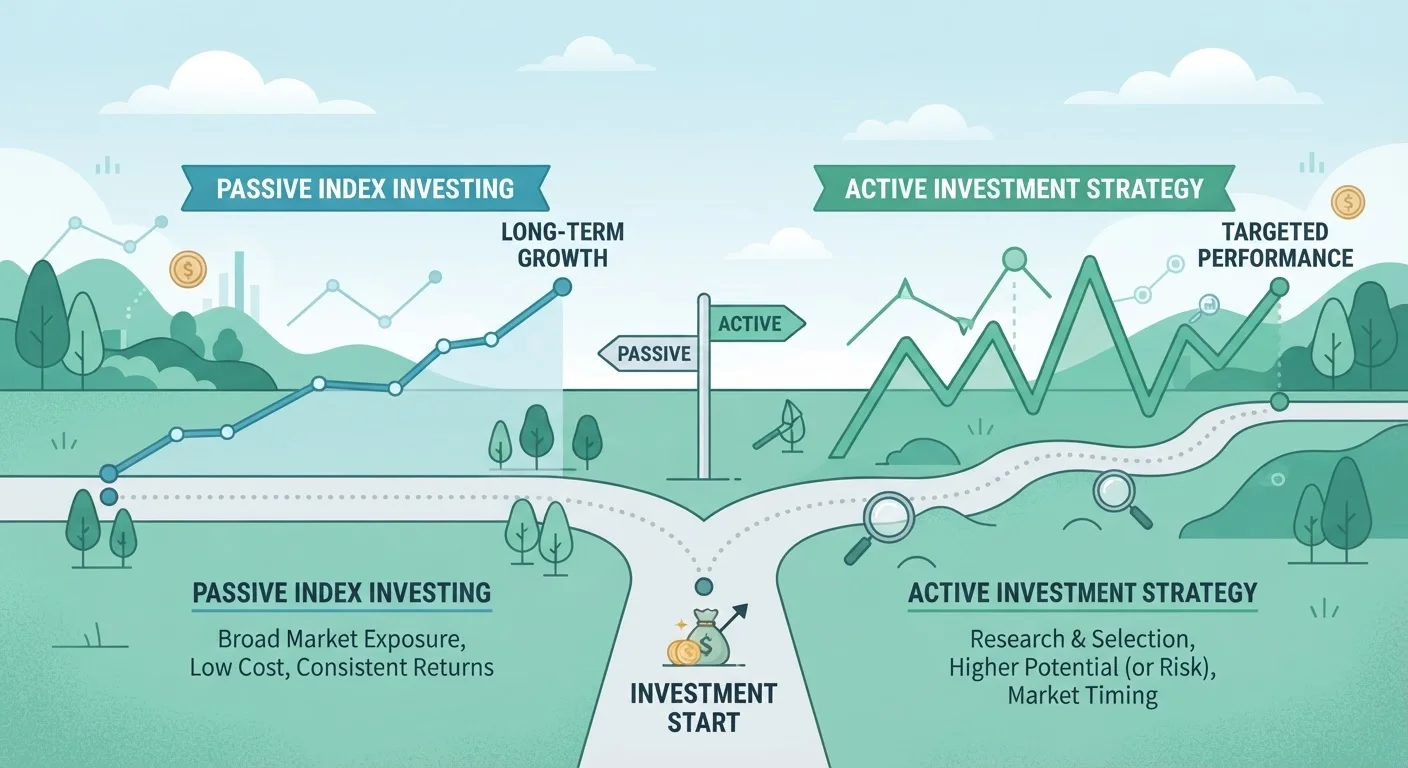
- Index funds track a market benchmark passively; actively managed funds rely on a manager's decisions to try to outperform it.
- Index funds typically carry lower expense ratios, which directly affects long-term net returns.
- Research consistently shows most actively managed funds underperform their benchmark index over long periods.
- Neither fund type guarantees returns - both carry market risk and can lose value.
- Understanding fees and investment goals is essential before choosing either approach.
- Consulting a licensed financial adviser can help align fund choices with your personal situation.
Option A
Index Funds
The passive, market-matching approach.
Best for: Beginners and cost-conscious investors seeking broad market exposure with minimal fees and hands-off management.
Option B
Actively Managed Funds
The hands-on, market-beating attempt.
Best for: Investors comfortable with higher costs who want a professional manager making deliberate security selection decisions.
If you're just starting out and want simplicity
Index Funds
Index funds require no expertise to select holdings and tend to have lower costs, making them a straightforward entry point for beginners building foundational investing knowledge.
If you want a professional manager actively selecting investments
Actively Managed Funds
Actively managed funds give you access to a portfolio manager's research and judgment, which some investors find reassuring - though higher fees and performance variability are real trade-offs.
If minimizing fees is your top priority
Index Funds
Index fund expense ratios are typically a fraction of those charged by active funds, and compounding that cost difference over decades can have a meaningful impact on total returns.
If you believe skilled managers can consistently outperform the market
Actively Managed Funds
If you're confident in a manager's track record and strategy, actively managed funds offer the possibility - though not the guarantee - of returns above a market benchmark.
What Each Fund Type Actually Does
Before comparing the two, it helps to understand the mechanics behind each. If you're new to investment vehicles altogether, see our plain-language overview of mutual funds for essential context.
Index funds are designed to replicate the performance of a specific market index - such as the S&P 500 or the total U.S. bond market. The fund holds the same securities, in roughly the same proportions, as the index it tracks. There is no manager making daily decisions about which stocks to buy or sell. The portfolio simply mirrors the index, and it changes only when the index itself changes.
Actively managed funds work differently. A portfolio manager - supported by a team of analysts - makes ongoing decisions about which securities to hold, when to buy, and when to sell. The goal is to outperform a benchmark index by identifying undervalued assets or avoiding overvalued ones. This requires continuous research and judgment.
Both fund types pool money from multiple investors, which means both offer built-in diversification across many holdings rather than betting on a single stock.
| Criterion | Index Funds | Actively Managed Funds |
|---|---|---|
| Management style | Passive - tracks an index | Active - manager selects securities |
| Typical expense ratio | Generally very low (e.g., under 0.10%-0.20%) | Generally higher (e.g., 0.50%-1.00%+) |
| Goal | Match market benchmark returns | Outperform market benchmark |
| Portfolio turnover | Low - changes only with index | Higher - ongoing buying and selling |
| Long-term performance (general evidence) | Matches index minus minimal fees | Most underperform index after fees over time |
| Complexity for investors | Simple - no manager selection needed | Requires evaluating manager track record |
| Diversification | Broad, built into index composition | Varies by fund strategy and manager |
The Cost Difference and Why It Matters
One of the most concrete distinctions between these fund types is cost. Every fund charges an expense ratio - an annual fee expressed as a percentage of your investment. For index funds, this ratio tends to be very low because there is no active management team to compensate. For actively managed funds, fees are higher because they cover research, analysis, and the portfolio manager's expertise.
~0.05%
Typical index fund expense ratio
Many broad-market index funds carry annual expense ratios well below 0.10%, according to industry data from Morningstar and fund providers.
~0.66%
Average active fund expense ratio
Morningstar's annual fee study has found the average asset-weighted expense ratio for actively managed funds to be considerably higher than passive alternatives.
~80-90%
Active funds underperforming benchmark (15 years)
S&P Dow Jones SPIVA reports have consistently found that the large majority of U.S. active equity funds underperform their benchmark index over 15-year periods.
Why does this matter? Fees are deducted from your returns before you receive them. Over a 20- or 30-year investment horizon, even a seemingly small annual fee difference can compound into a significant dollar amount. This doesn't mean active funds are never worth their cost - but it does mean the manager needs to outperform the index by enough to justify the additional expense, which is a meaningful hurdle.
It's also worth noting that actively managed funds may generate more taxable events (from buying and selling securities within the fund), which can have implications in taxable accounts. A licensed tax professional can help you think through this if it applies to your situation.
What the Evidence Suggests About Performance
A natural question is: do actively managed funds actually outperform index funds? The honest answer is that, on average and over long time periods, most do not. Research published over many years - including data from the S&P Dow Jones SPIVA reports - has consistently found that the majority of actively managed funds underperform their benchmark index after fees over 10- and 15-year periods.
That said, some managers do outperform - particularly in certain market conditions or niche asset classes. The challenge for investors is identifying those managers in advance, before that outperformance occurs. Past performance does not guarantee future results, and this caveat applies especially to active funds where individual manager decisions drive outcomes.
For beginners, this evidence is worth understanding - not to dismiss active management entirely, but to set realistic expectations. If you're exploring what investing actually involves at a foundational level, our beginner's guide to investing walks through risk, time horizons, and diversification before you commit any capital.
A Common Misconception Worth Addressing
Some beginners assume index funds are "safe" and active funds are "risky" - but both carry market risk and can decline in value. Index funds fall when the market falls; they don't protect against broad downturns. The distinction is about cost, strategy, and long-run performance patterns - not about eliminating risk. If you've encountered other investing myths that may be shaping your thinking, our article on common investing myths addresses several directly.
How to Think About Your Own Decision
Choosing between index and actively managed funds isn't purely an analytical exercise - it also depends on your goals, timeline, and comfort with uncertainty. A few questions worth reflecting on:
- What is your investment time horizon? Longer horizons give compounding more time to work, which makes fee differences more impactful.
- How important is cost control to you? If keeping expenses low is a priority, index funds have a structural advantage.
- Do you want involvement from a manager? Some investors find comfort in knowing a professional is monitoring the portfolio actively.
- Are you investing in a tax-advantaged account or a taxable account? The tax treatment of fund distributions can influence which type makes more sense for your situation.
This article is general financial education, not personalised advice. Before making investment decisions, consider speaking with a licensed financial adviser who can evaluate your specific circumstances. It's also worth reviewing our financial readiness checklist to confirm your foundations are in place before putting money into any fund.
And if you're still clarifying the broader distinction between putting money aside versus putting it to work, our article on saving vs. investing offers a helpful starting point.
This article is for general informational and educational purposes only and does not constitute personalised financial, investment, tax, or legal advice. Investment values can go down as well as up, and past performance does not guarantee future results. Please consult a qualified, licensed financial adviser before making investment decisions based on your individual circumstances.