

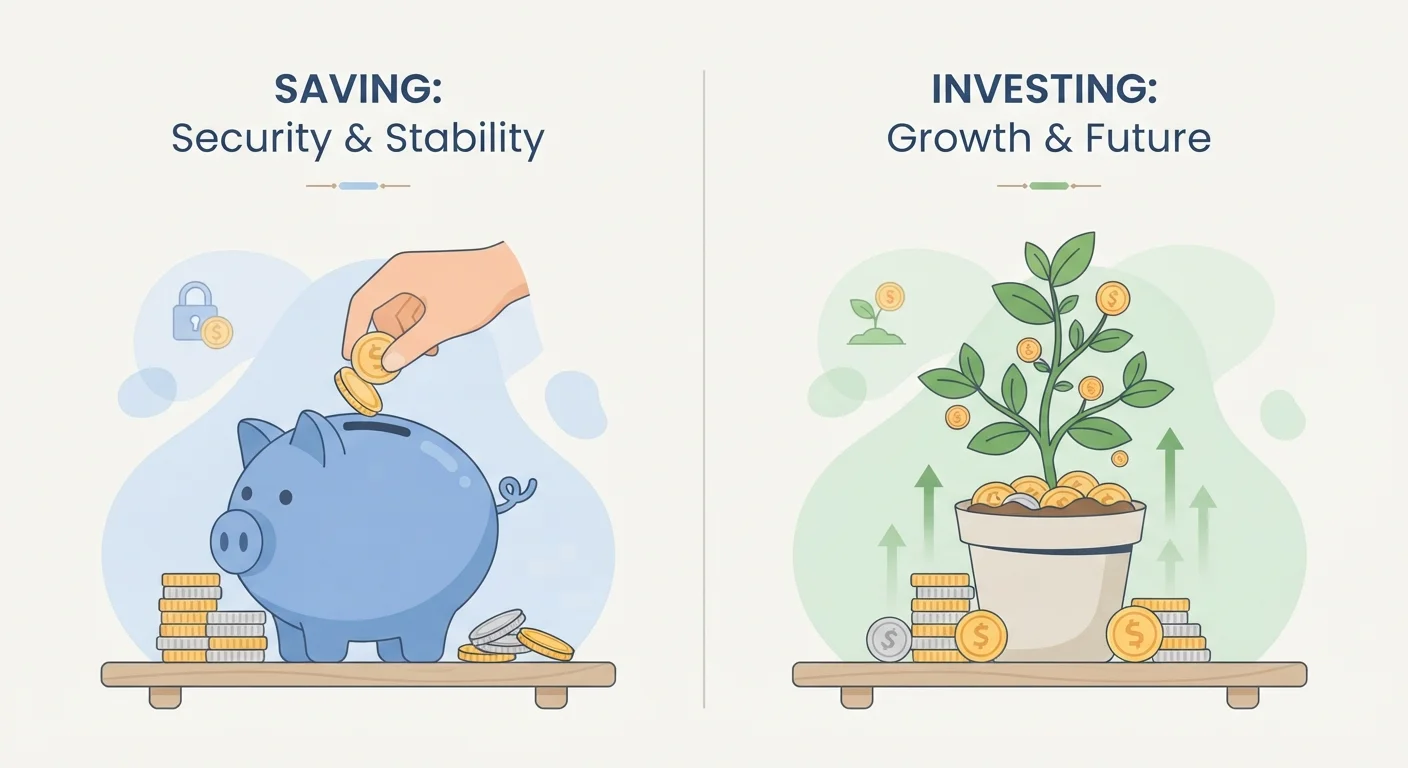
Key Takeaways
- Saving prioritizes safety and accessibility; investing prioritizes long-term growth potential.
- Savings accounts carry virtually no risk of loss; investments can lose value.
- Most financial educators suggest building an emergency fund through saving before investing.
- Compound interest benefits both savers and investors, but works differently in each context.
- You don't have to choose one over the other - a sound financial plan generally uses both.
Saving vs. Investing
Saving means setting aside money in a secure, accessible account - like a bank savings account - where the balance doesn't fluctuate. Investing means putting money into assets such as stocks, bonds, or funds with the expectation that it may grow over time, though it also carries the risk of loss. Both are essential tools in personal finance, but they serve different goals and timelines.
In financial planning, the distinction often comes down to liquidity and risk: savings are low-risk and highly liquid, while investments trade some liquidity and certainty for potential long-term growth.
What Saving Actually Means
Saving is the practice of setting money aside in a secure, stable account - typically a bank savings account or a credit union share account. The defining features are safety and accessibility. Your principal (the amount you deposit) does not decrease, and you can generally withdraw funds when you need them.
Savings accounts earn interest, but rates are often modest. Even so, that interest compounds over time - meaning you earn interest on your interest as well as your original balance. To understand how that mechanism works in detail, see our article on how compound interest works.
Saving is the right tool when your goal is short-term or when you need funds to remain stable. An emergency fund, a down payment you plan to use within a year, or money set aside for a predictable expense are all well-suited to a savings account. For a closer look at how savings accounts differ from one another, comparing high-yield and traditional savings accounts is a useful next step.
Make Your Savings Work Harder
Not all savings accounts offer the same interest rate. High-yield savings accounts, often offered by online banks, can pay significantly more than traditional savings accounts while maintaining the same safety features. If your savings are sitting in a low-rate account, it may be worth comparing your options - though rates vary and change over time.
What Investing Actually Means
Investing means allocating money to assets - such as stocks, bonds, mutual funds, or real estate - with the expectation that they will grow in value over time. Unlike a savings account, investment values fluctuate. You could end up with more money than you started with, or less. Risk is an inherent part of investing.
The potential upside of investing is that over long periods, certain asset classes have historically outpaced both savings account interest rates and inflation - though past performance does not guarantee future results. This makes investing a common approach for longer-term goals like retirement or funding a child's education years away.
If you're new to the mechanics of investing, our guide on investing fundamentals for beginners covers core concepts like risk tolerance, diversification, and time horizons before you commit any money. It's also worth reviewing common investing myths that often discourage people from starting.
~55%
U.S. adults who own stocks or funds
According to Gallup's annual Economy and Personal Finance survey, roughly 55-61% of American adults report owning stocks, either directly or through retirement accounts.
3-6 months
Recommended emergency fund in expenses
Financial educators and institutions widely recommend maintaining three to six months of living expenses in accessible savings before prioritizing investments.
How Saving and Investing Work Together
Saving and investing are not competing strategies - they are complementary ones. Most sound personal finance plans use both, allocated based on timeline and purpose.
A practical way to think about it: money you will need within the next one to three years generally belongs in savings. Money you won't need for five or more years may be suitable for investing, since longer time horizons allow you to weather market volatility. This is sometimes described as matching your time horizon to your tool.
Many financial educators suggest a sequencing approach: build a foundational emergency fund through saving first, then direct additional money toward investments. The reasoning is straightforward - if an unexpected expense forces you to withdraw money from investments at the wrong time, you may lock in a loss. A stable savings cushion prevents that scenario.
Developing consistent saving habits is its own skill. Our article on building a personal savings habit offers practical strategies for making saving a reliable part of your financial routine. And if you're working from a broader money management perspective, our budgeting basics hub is a useful starting point.
Common Mistakes to Avoid
Understanding the difference between saving and investing also means knowing where people commonly go wrong with each.
- Saving when you should be investing: Keeping all long-term money in a savings account may feel safe, but inflation can erode purchasing power over time. Money intended for retirement decades away may be better served in an investment account - though risk tolerance and individual circumstances matter. Always consult a qualified financial adviser before making decisions about your own situation.
- Investing money you may need soon: Putting short-term funds into investments exposes them to market volatility. If you need the money in six months and markets decline, you may be forced to sell at a loss.
- Neglecting the emergency fund: Jumping straight to investing without a savings buffer is a fragile approach. Unexpected expenses become financial crises when there's no liquid reserve to draw from.
Some saving habits that feel responsible can quietly create problems over time. Our article on early saving mistakes explores missteps that often go unnoticed until they compound.
This article is for general informational and educational purposes only and does not constitute personalized financial, investment, tax, or legal advice. Please consult a licensed financial professional before making decisions about your own financial situation.