

Key Takeaways
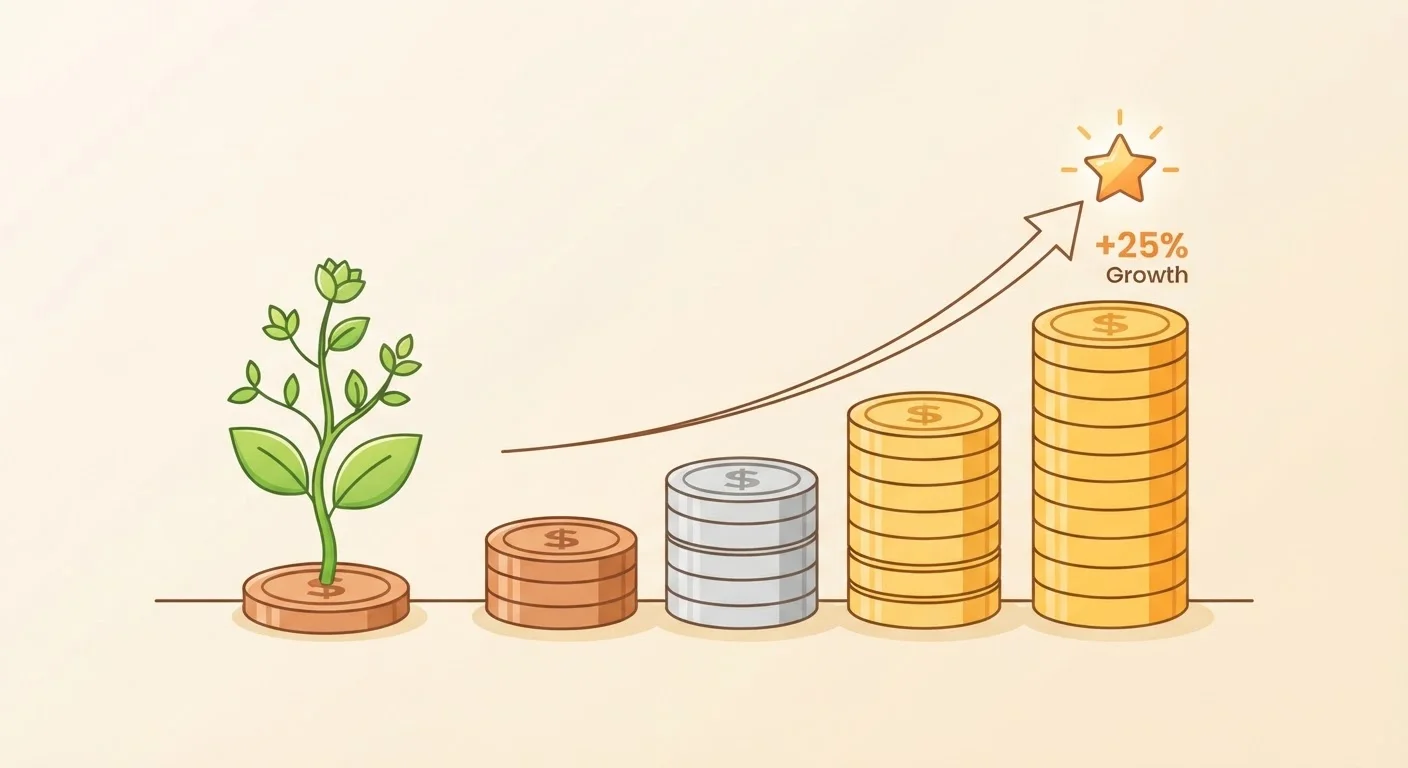
- Compound interest grows your balance by earning returns on previously earned interest, not just your original amount.
- The longer money compounds, the more dramatic the growth - time is the key ingredient.
- Compounding works against you on debt, such as credit cards and loans, just as powerfully as it works for you in savings.
- Starting early matters more than starting with a large amount.
- Understanding compounding is foundational to making sound saving and borrowing decisions.
Compound Interest
Compound interest is interest calculated not only on the money you originally deposited or borrowed, but also on the interest that has already accumulated. In plain terms: your interest earns interest. Over time, this creates a snowball effect where your balance grows faster and faster - without you adding anything extra.
Compounding frequency matters: interest can compound daily, monthly, quarterly, or annually. More frequent compounding produces slightly higher returns for savers and slightly higher costs for borrowers.
The Core Idea: Interest on Interest
Most people learn about interest as a straightforward percentage - borrow $1,000 at 5%, pay $50 per year. That is simple interest. Compound interest works differently: each time interest is calculated, it is added to your balance, and the next calculation is based on that larger number.
Here is a concrete illustration. Suppose you deposit $1,000 into a savings account that earns 5% interest, compounded annually.
- Year 1: You earn $50 in interest. Balance: $1,050.
- Year 2: You earn 5% of $1,050 - that is $52.50. Balance: $1,102.50.
- Year 3: You earn 5% of $1,102.50 - that is $55.13. Balance: $1,157.63.
Nothing was added to the account. The growth comes entirely from interest compounding on itself. Over decades, this effect becomes dramatic - which is why compound interest is often described as the engine behind long-term wealth building.
Rule of 72
Estimated years for money to double
Divide 72 by your annual interest rate to estimate how many years it takes for a balance to double through compounding - a widely cited financial education shorthand.
Daily
Most common compounding frequency for savings accounts
Many U.S. savings accounts compound interest daily and credit it monthly, meaning your balance grows slightly faster than accounts that compound monthly or annually.
Why Time Is the Most Important Variable
The single biggest factor in compound interest is not the amount you start with - it is how long the money has to grow. A common illustration used in financial education compares two hypothetical savers who earn the same rate of return:
- Saver A begins at age 25 and contributes regularly for 10 years, then stops.
- Saver B waits until age 35 and contributes regularly for 30 years straight.
Despite contributing for three times as many years, Saver B may end up with less at retirement - because Saver A's money had an additional decade to compound. This pattern illustrates why starting early, even with modest amounts, carries a meaningful long-term advantage.
This is also why financial educators frequently emphasize not waiting for the "right moment" to start saving. The cost of delay is real, even if it is invisible in the short term. For more on how saving and investing fit into a broader financial picture, see the difference between saving and investing.
Start Small - But Start Now
You do not need a large sum to benefit from compounding. Even modest, consistent contributions to a savings or retirement account give your money more time to grow. The earlier you begin, the less you may need to contribute later to reach the same goal.
When Compounding Works Against You
Compound interest is neutral - it accelerates growth in either direction. On a savings account, it builds your balance. On debt, it increases what you owe.
Credit card balances are a common example. If you carry a balance and only make minimum payments, unpaid interest is added to the principal each billing cycle, and the next month's interest is calculated on that larger amount. Over time, a manageable balance can become significantly harder to pay off simply because of compounding interest charges.
The same principle applies to auto loans and other installment debt. The structure of the loan - interest rate, loan length, and compounding method - determines how much you ultimately pay beyond the original purchase price. Understanding this is especially relevant when financing a vehicle and evaluating loan terms.
Compounding in the Context of Inflation
One important nuance: compound interest on savings does not exist in a vacuum. Inflation - the gradual rise in prices over time - can offset some or all of the purchasing power gained through compounding. If your savings account earns 2% annually but inflation is running at 3%, your balance grows in dollar terms but shrinks in real terms.
This is why financial educators often distinguish between nominal returns (the stated interest rate) and real returns (the rate after accounting for inflation). For a deeper look at how inflation interacts with your savings, see how inflation quietly erodes savings over time.
Understanding both forces - compounding and inflation - together gives you a more complete picture of how your money actually moves over time. This is general financial education, not personalized advice; for guidance tailored to your situation, consult a qualified financial adviser.
APY vs. APR: Know the Difference
When comparing savings accounts, look for the Annual Percentage Yield (APY), which reflects compounding. The Annual Percentage Rate (APR) does not account for compounding frequency. A higher APY on a savings account means your balance grows faster. For debt products, APR is the standard disclosure figure - understanding both helps you evaluate any financial product accurately.
This article is for informational and educational purposes only and does not constitute personalized financial, investment, or tax advice. Consult a licensed financial professional for guidance specific to your circumstances.