

Key Takeaways
- Hair typing systems classify curl patterns on a scale from straight (Type 1) to tightly coiled (Type 4).
- The letter subcategories (A, B, C) indicate the tightness of the curl within each number group.
- Curl pattern alone does not determine which products will work best for your hair.
- Porosity, density, and strand width are equally important factors to understand.
- Most people have more than one hair type on their head at the same time.
- Hair typing is a starting point for exploration, not a definitive prescription for your routine.
Hair Typing System
A hair typing system is a classification framework that organizes hair into categories based on its natural curl or wave pattern. The most widely used system, developed in the 1990s, uses a number-and-letter code (Types 1-4, with subtypes A, B, and C) to describe hair from straight to tightly coiled. It's designed to help people identify their texture and find care routines that suit their hair's natural structure.
Curl pattern is determined primarily by the shape of the hair follicle - elliptical follicles produce curlier hair, while round follicles produce straighter strands. Curl pattern is only one dimension of hair; porosity, density, and strand width also significantly affect how hair behaves and responds to products.
How the Number-and-Letter Code Works
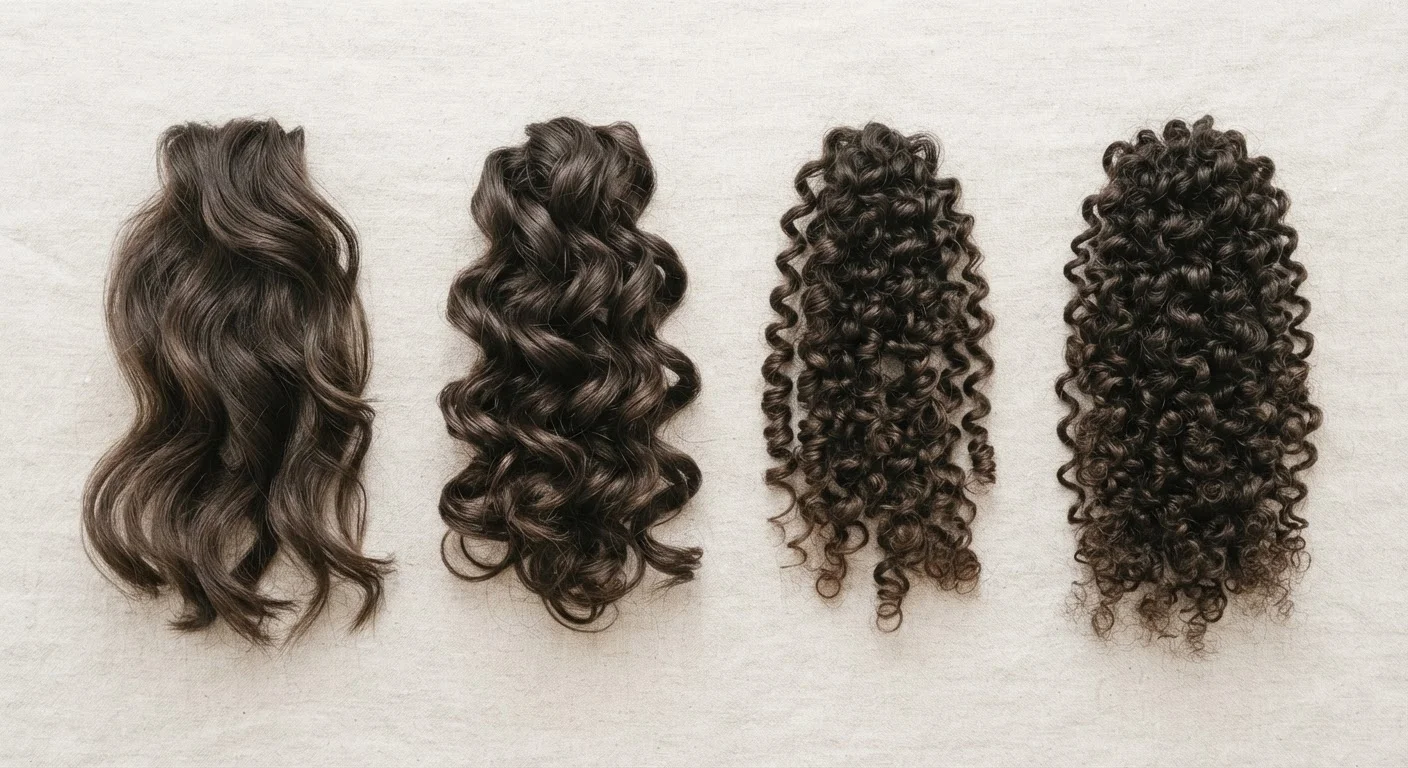
The most widely used framework organizes hair into four main types. Type 1 hair is straight with little to no natural curl. Type 2 describes wavy hair that forms a loose S-shape. Type 3 covers curly hair with defined, springy spirals. Type 4 encompasses coily and kinky patterns that form tight coils or zig-zag shapes.
Within each number, the letters A, B, and C indicate increasing tightness or definition. Type 3A curls, for example, are large and loose, while 3C curls are densely packed corkscrew spirals. This subcategory structure is where nuance lives - and where many people find their actual hair behavior best described.
One important reality: most people don't have a single hair type across their entire scalp. It's common to have 3A waves at the front hairline and 3C coils at the nape of the neck. Typing your hair section by section gives a more accurate picture than assigning one universal label.
Hair Typing Has Known Limitations
Critics of the standard typing system note that it was originally developed with certain textures more thoroughly represented than others, and that Type 4 in particular is often described with less granularity than Types 1 through 3. Many stylists in the natural hair community now use the number-letter system alongside additional metrics - like porosity and density - to provide a more complete and equitable assessment of all hair textures.
What Curl Pattern Does - and Doesn't - Tell You
Knowing your curl pattern helps you understand the physical structure of your strand and anticipate how it might behave. Tighter curl patterns, for instance, tend to experience more shrinkage and can be more prone to tangling because the cuticle layers of adjacent strands catch on each other. Looser wave patterns generally retain length more visibly and may not require as much detangling effort.
But curl pattern is not a reliable guide on its own for choosing moisturizers, stylers, or cleansers. Those decisions hinge more heavily on three other characteristics:
- Porosity: How easily your hair absorbs and holds moisture.
- Density: How many individual strands grow per square inch of scalp.
- Strand width: Whether individual hairs are fine, medium, or coarse in diameter.
A person with 4C coils and low porosity needs a very different moisturizing approach than someone with the same curl pattern and high porosity. Curl type describes shape; these other factors describe behavior. For more on how external forces interact with hair structure, see our article on heat styling and hair health.
~90%
Of curl pattern determined by follicle shape
Dermatological research consistently attributes the vast majority of natural curl pattern to the geometry of the hair follicle, which is primarily genetically determined.
3-5
Hair characteristics needed for full texture profile
Hair care professionals typically assess curl pattern alongside porosity, density, strand width, and scalp condition to build a complete picture of a client's hair needs.
Up to 30%
Shrinkage in tight coil patterns (Type 4)
Type 4 coils can appear significantly shorter than their actual length when dry due to the tight spiral structure - a factor that affects how people evaluate their own hair growth and length retention.
Using Hair Typing as a Practical Starting Point
The real value of hair typing is that it gives you a shared vocabulary. When a stylist or product description references Type 3B hair, you immediately have a general reference point. That common language makes it easier to search for tutorials, discuss your hair with a professional, or evaluate whether a formulation is designed with your texture in mind.
Think of it the way you might think about reading any product label - it gives you orientation, not a complete answer. Just as understanding fabric composition helps you care for clothing (for a parallel exercise in decoding labels, see our guide to textile terms), understanding your curl type is a first filter, not a final word.
Test Porosity at Home First
Drop a clean, product-free strand of hair into a glass of room-temperature water and wait two to three minutes. If the strand floats, you likely have low porosity; if it sinks quickly, porosity is high; if it hovers midway, it's medium. This simple observation can be more useful than your curl type alone when choosing a deep conditioner or leave-in treatment.
Practically speaking, use your hair type to narrow your search, then refine based on porosity and density results. Try products formulated for your curl range, observe how your hair responds over several weeks, and adjust from there. Experimentation informed by a framework is far more efficient than guessing without any reference at all.
This article is for informational and educational purposes only. Individual hair characteristics vary widely; consult a licensed cosmetologist or trichologist for personalized hair care guidance.