

| U.S. label law | Required on most garments sold in the U.S. (Textile Fiber Products Identification Act (FTC)) |
| Care symbols standard | ASTM D5489 / ISO 3758 (American National Standards Institute (ANSI)) |
| Most common fiber blends | Cotton-polyester, wool-nylon, cotton-elastane (General industry convention) |
| Fabric weight range | Lightweight: under 150 GSM; Heavyweight: 300+ GSM (Standard textile classification) |
| Number of ASTM care symbols | Over 50 standardized symbols across 5 categories (ASTM D5489) |
What the Law Requires on Every Label
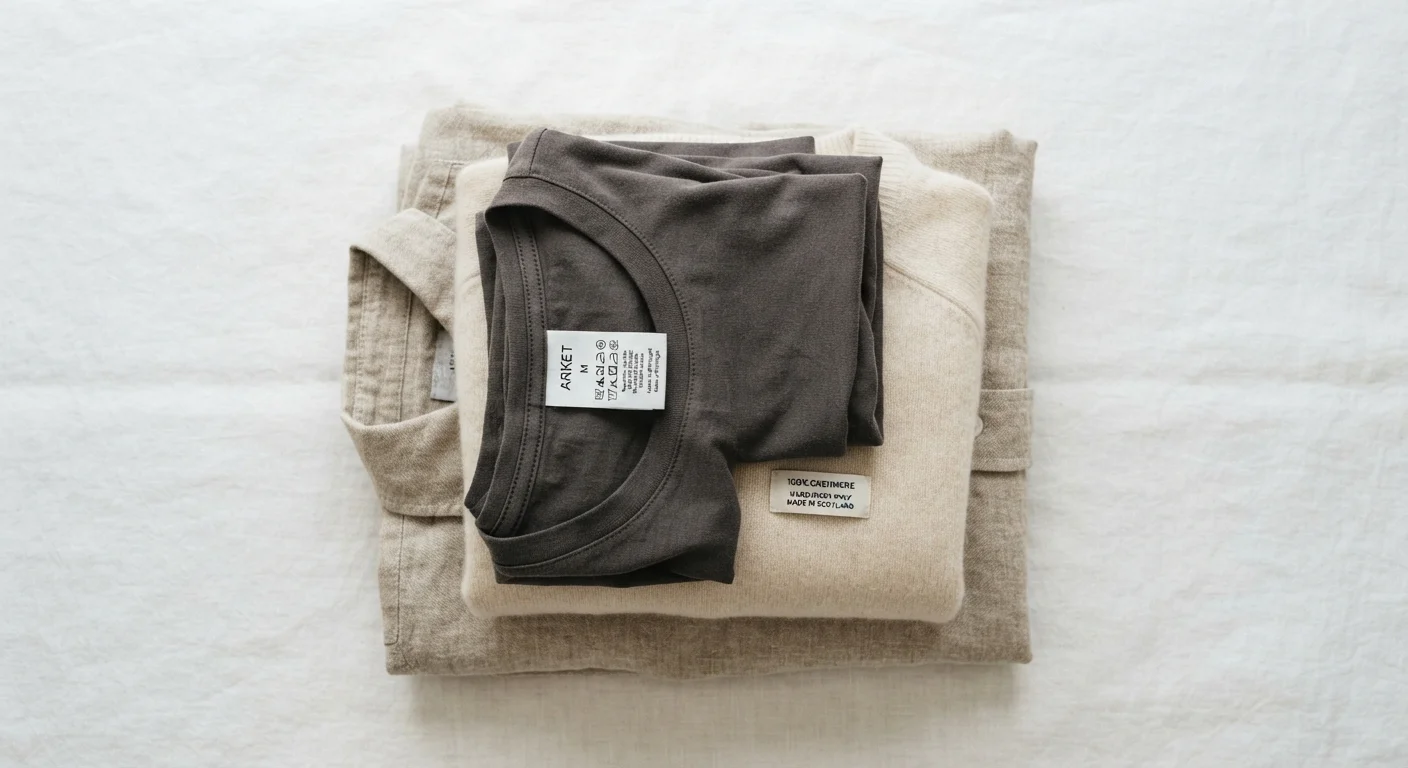
Most clothing sold in the United States is legally required to carry a label disclosing three things: fiber content, country of origin, and manufacturer identification. This is mandated by the Textile Fiber Products Identification Act, administered by the Federal Trade Commission (FTC). A separate FTC rule - the Care Labeling Rule - requires permanently attached care instructions on most garments as well.
Fiber content must be listed by percentage in descending order. A label reading 60% cotton, 35% polyester, 5% elastane tells you which material dominates the fabric and which plays a supporting role. Elastane (also marketed as spandex or Lycra) at just 5% adds meaningful stretch to an otherwise rigid blend - a small percentage with a significant functional impact.
Understanding this hierarchy helps you set realistic expectations. A garment labeled mostly polyester will likely feel different and behave differently in heat or humidity than one that is predominantly linen or cotton. For a broader vocabulary around these terms, see the fashion vocabulary guide for additional context.
| U.S. label law | Required on most garments sold in the U.S. (Textile Fiber Products Identification Act (FTC)) |
| Care symbols standard | ASTM D5489 / ISO 3758 (American National Standards Institute (ANSI)) |
| Most common fiber blends | Cotton-polyester, wool-nylon, cotton-elastane (General industry convention) |
| Fabric weight range | Lightweight: under 150 GSM; Heavyweight: 300+ GSM (Standard textile classification) |
| Number of ASTM care symbols | Over 50 standardized symbols across 5 categories (ASTM D5489) |
Fiber Types and What They Mean in Practice
Fiber content is the single most predictive factor for how a garment will wear, wash, and age. Here is what the most common fibers actually signal:
- Cotton: Breathable and absorbent, but prone to shrinkage and wrinkling unless treated. Higher-count cottons (like combed or Pima) have longer fibers and a smoother hand feel.
- Polyester: Durable, wrinkle-resistant, and moisture-wicking in performance contexts. It retains dye well but breathes less efficiently than natural fibers.
- Wool: Naturally temperature-regulating and odor-resistant. Merino wool is finer and less scratchy than standard wool; both require more careful laundering.
- Linen: Derived from flax, linen is exceptionally breathable and strengthens with washing, but wrinkles readily - a quality many wearers consider part of its character.
- Viscose / Rayon: A semi-synthetic fiber made from wood pulp. Drapes softly and mimics silk aesthetics, but can be fragile when wet and often requires hand washing.
- Elastane / Spandex: Never used alone; always blended to add stretch and recovery. Degrades faster than most other fibers, particularly with frequent heat exposure.
Fiber content
The percentage breakdown of each raw material used to make a fabric - for example, 80% cotton, 20% polyester. In the U.S., federal law requires this disclosure on most garment labels.
Warp and weft
The two sets of threads interlaced to create a woven fabric. Warp threads run lengthwise; weft threads run crosswise. Their arrangement determines a fabric's weave type.
GSM (grams per square meter)
A measure of fabric weight. Lower GSM indicates a lighter, more breathable fabric; higher GSM signals a denser, heavier material better suited to structure or warmth.
Hand feel
The tactile quality of a fabric - how it feels when touched. Descriptors include soft, crisp, silky, or coarse, and are influenced by fiber type, finishing processes, and weave structure.
Finishing
Chemical or mechanical treatments applied after weaving or knitting that alter a fabric's appearance, texture, or performance - such as wrinkle resistance, water repellency, or pre-shrinking.
Pilling
The formation of small fiber balls on a fabric's surface caused by friction during wear or washing. Fabrics with shorter, looser fibers - like some wool and cotton blends - are more prone to pilling.
Decoding Care Symbols
U.S. care labels follow the ASTM D5489 standard, which organizes instructions into five symbol categories: washing, bleaching, drying, ironing, and dry cleaning. Each category uses a base icon - a tub for washing, a triangle for bleaching - modified by dots, lines, or crosses to indicate temperature and restriction levels.
Label Reading Differs by Country
Care symbol systems vary internationally. The U.S. follows ASTM D5489, while the European Union and many other countries use ISO 3758. If you purchase clothing abroad or through international retailers, the symbols may look similar but carry slightly different meanings. When in doubt, a quick search of the specific symbol against the applicable standard can prevent costly laundry mistakes.
Key principles that help most shoppers immediately:
- A bar under any symbol signals a gentler setting is needed. Two bars means delicate.
- A cross through any symbol means do not perform that action - a crossed-out tub means do not machine wash.
- Dots inside the drying or ironing symbol indicate heat level: one dot is low, three dots is high.
Ignoring care symbols is one of the most common causes of premature garment wear. A wool sweater labeled with a crossed-out tub and a hand icon requires hand washing - machine washing, even on a gentle cycle, can cause irreversible felting and shrinkage. If you find label reading across product categories useful, the same interpretive approach applies when reading skincare product labels.
Weave Structures and Why They Matter
Beyond fiber content, weave or knit structure shapes how a fabric drapes, breathes, and holds its shape. Labels rarely spell out weave type, but the fabric name usually signals it:
- Twill (e.g., denim, chino): Diagonal ribbing visible on the surface; more durable and structured than plain weave.
- Plain weave (e.g., poplin, muslin): Simple over-under interlacing; crisp, lightweight, and relatively breathable.
- Satin weave: Floating threads create a smooth, lustrous surface. Prone to snagging and requires careful storage.
- Jersey knit: Stretchy, single-face knit used in T-shirts and casual wear; prone to pilling along high-friction areas over time.
- Fleece: A knitted fabric that is brushed to create a soft, insulating nap - not the same as wool fleece, which is a natural fiber.
Recognizing these constructions helps you anticipate real-world performance before a purchase - and explains why two garments with identical fiber content can feel and wear completely differently.
5
Care symbol categories on garment labels
Per the ASTM D5489 standard: washing, bleaching, drying, ironing, and dry cleaning.
~65%
Share of global apparel fiber use that is synthetic
According to Textile Exchange's Preferred Fiber & Materials Market Report.