

Key Takeaways
- Active noise cancellation (ANC) uses microphones and processing to electronically counter low-frequency ambient sound.
- Passive isolation physically blocks sound through materials and earcup design, working best at mid-to-high frequencies.
- ANC excels in steady, droning environments like planes and trains; passive isolation handles broad noise spectrums better.
- Combining both methods offers the most comprehensive noise reduction available in modern headphones.
- Battery dependency and audio processing artifacts are real trade-offs of ANC that passive isolation avoids entirely.
Our Verdict
Neither approach is universally superior - each targets different noise profiles and listening contexts. ANC is the stronger tool for predictable low-frequency drone, while passive isolation provides reliable, battery-free broadband noise blocking. For most listeners who commute, work in open offices, or travel frequently, a headphone design that combines both will deliver the most consistent real-world performance.
| Best for | Recommended |
|---|---|
| Frequent flyers and commuters dealing with engine drone | Active Noise Cancellation (ANC) |
| Those who need reliable noise blocking without charging | Passive Isolation |
| Open-office workers facing mixed ambient noise | Combined ANC + Passive Isolation |
| Listeners sensitive to audio artifacts or pressure sensation | Passive Isolation |
How Each Method Actually Works
Understanding the difference between active noise cancellation and passive isolation starts with what each one is actually doing to sound waves before they reach your ears.
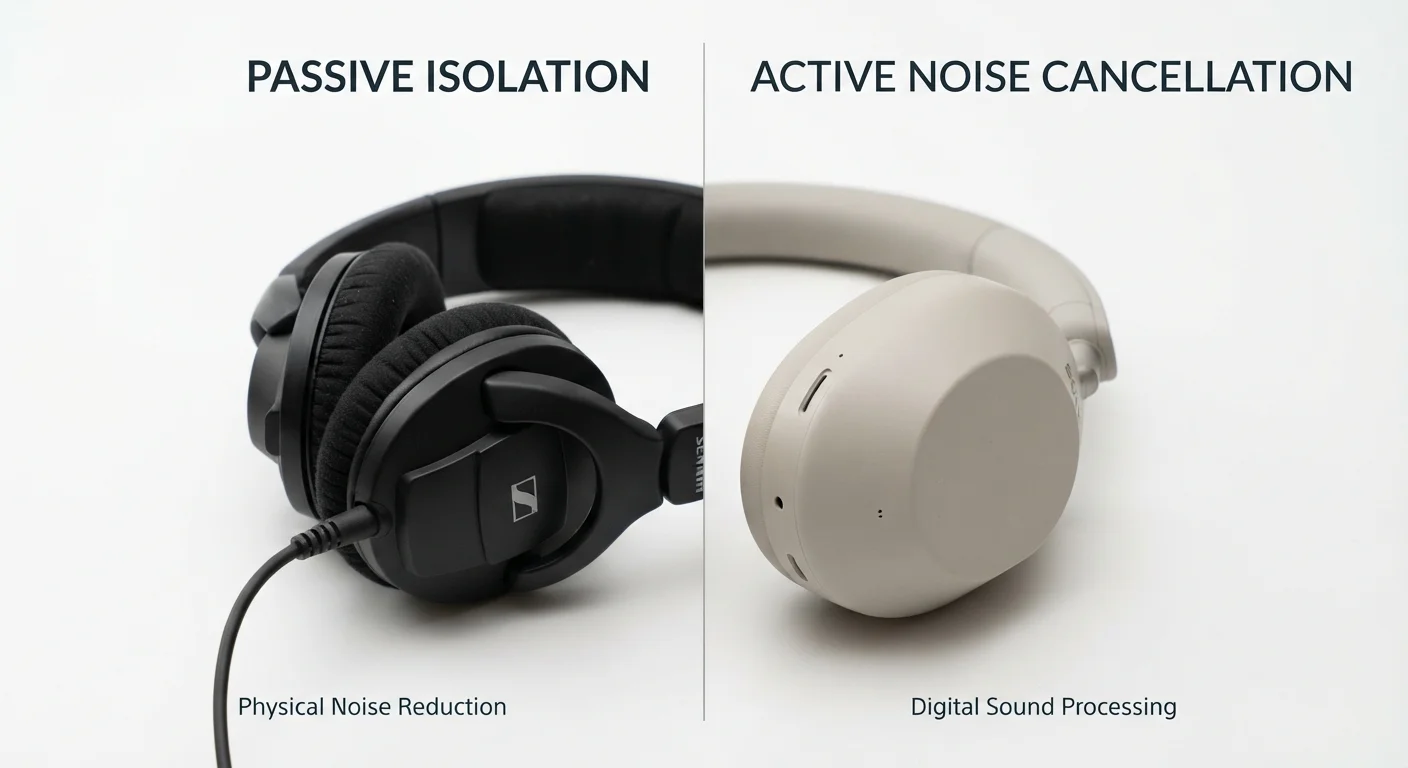
Passive isolation is purely physical. Dense earcup padding, a tight seal around the ear, and thick housing materials absorb and deflect incoming sound. No electronics are involved - the headphone itself acts as a barrier. This approach is most effective against mid- and high-frequency sounds, roughly 1 kHz and above, such as voices, keyboards, and street noise.
Active noise cancellation (ANC) takes an electronic approach. Microphones mounted on the headphone sample the ambient sound in real time. An onboard processor generates an inverted audio signal - a mirror image of the incoming noise waveform - and feeds it into the drivers alongside your audio. The two signals cancel each other out through a principle called destructive interference. ANC is most effective against consistent, low-frequency noise below roughly 1 kHz: airplane cabin hum, HVAC systems, train rumble, and road noise from a car.
Because these frequency ranges are complementary rather than overlapping, many headphone manufacturers combine both methods - using thick earcups for passive attenuation alongside ANC circuitry for low-end drone.
Where Each Approach Falls Short
| Active Noise Cancellation | Passive Isolation | |
|---|---|---|
| Mechanism | Electronic phase-cancellation via microphones | Physical barrier from materials and earcup design |
| Most effective frequency range | Low frequencies (below ~1 kHz) | Mid-to-high frequencies (above ~1 kHz) |
| Best use environment | Airplane cabins, trains, steady drone | Offices, gyms, variable ambient noise |
| Battery required | Yes - ANC stops without power | No - works regardless of charge |
| Handles sudden/irregular noise | Poorly - struggles with unpredictable sounds | Better - physical barrier is always present |
| Potential audio artifacts | Possible pressure sensation or coloration | None from the isolation method itself |
Passive isolation struggles with low-frequency sound because long-wavelength bass waves pass through physical materials more easily. This is why foam ear protection worn at a concert still lets the bass thump through. Sealing quality also matters enormously - glasses, beards, or an imperfect fit can compromise passive attenuation significantly.
ANC has its own limitations. Because it relies on predicting and inverting incoming noise, it performs poorly against sudden, irregular sounds like a colleague's sneeze or a door slamming. Some users also report a faint pressure sensation or slight audio coloration when ANC is active - a byproduct of the phase-cancellation processing. Critically, ANC requires battery power. Once the battery dies, the active cancellation stops entirely, and you're left relying only on whatever passive isolation the physical design provides.
Don't Rely on ANC as a Safety Tool
ANC is designed for listening comfort, not hearing protection in hazardous environments. Occupational noise exposure requires certified hearing protection rated to OSHA or NIOSH standards - consumer ANC headphones do not meet this bar. Using ANC headphones at high volumes in noisy settings can still result in cumulative hearing damage.
For a broader view of what else affects your headphone experience beyond noise handling, see our look at wired vs. wireless trade-offs - battery life and latency play into daily usability just as much as noise performance.
Choosing Based on Your Real-World Environment
The right approach depends on the noise profile you're actually dealing with, not a generic spec sheet claim.
~25 dB
Typical passive attenuation for over-ear headphones
Well-sealed over-ear headphones generally achieve 20-30 dB of passive attenuation across mid and high frequencies under controlled conditions.
~20-35 dB
Additional low-frequency reduction from ANC
ANC systems in consumer headphones can reduce perceived low-frequency noise by 20-35 dB depending on headphone design and noise consistency.
- Air travel and long commutes: ANC is the clear advantage here. Airplane cabin noise sits predominantly in the 100-400 Hz range - exactly where ANC is most effective. Studies in aviation acoustics have consistently found that low-frequency engine noise causes listener fatigue over long durations, making active cancellation genuinely useful rather than a marketing feature.
- Open offices and co-working spaces: Human speech occupies 300 Hz to 3 kHz, which straddles both the ANC and passive ranges. A headphone with strong passive seal plus ANC tends to outperform either method alone in this environment.
- Gyms, construction zones, or outdoor use: Variable, unpredictable noise with significant high-frequency content benefits most from thick passive isolation. ANC alone won't address impact sounds or broadband noise bursts effectively.
- Studio monitoring or critical listening: Many audio engineers prefer headphones without ANC active, since the processing can introduce subtle phase artifacts. High-isolation passive designs are the standard in recording environments.
If you're evaluating headphones primarily for isolation performance, testing the passive seal quality - how well the earcup conforms to your head - is at least as important as any ANC specification listed on the box.