

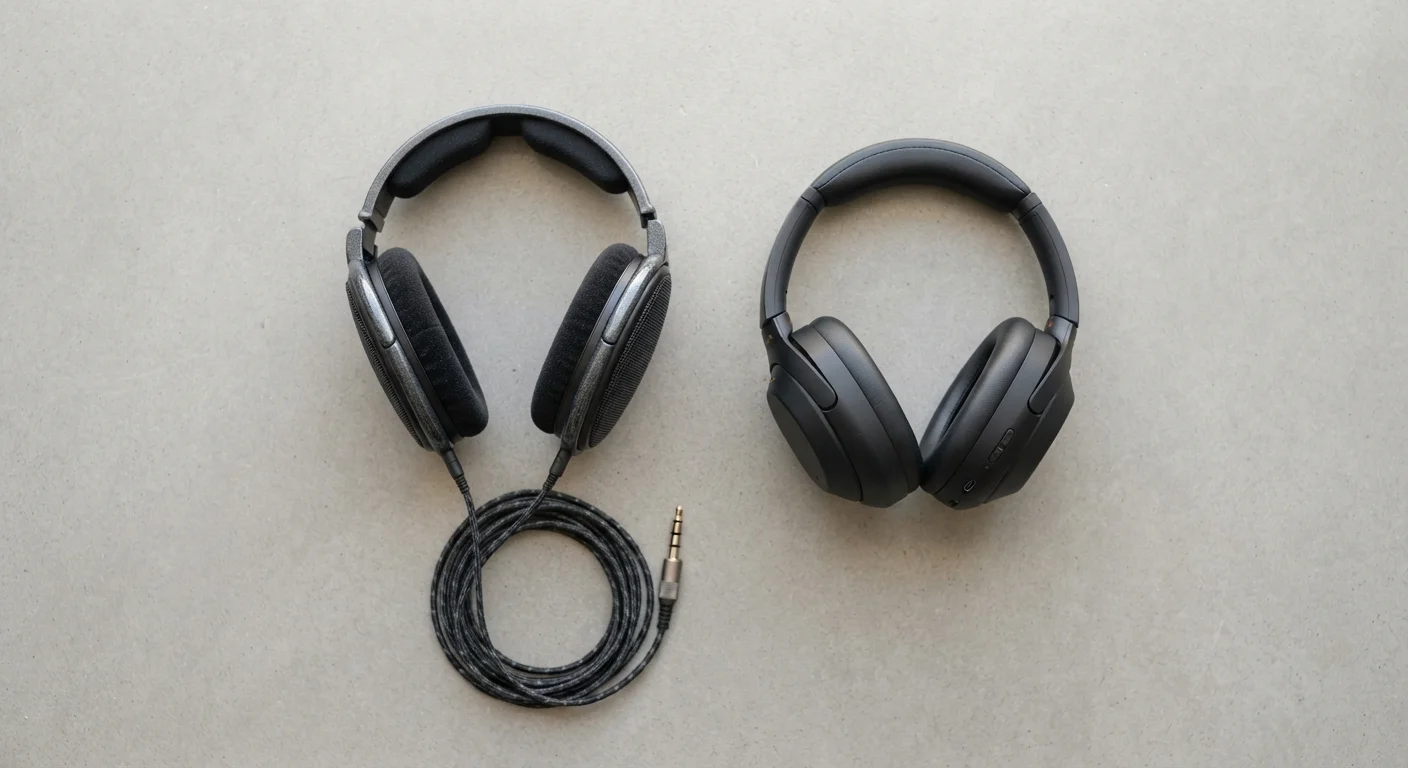
Key Takeaways
- Wired headphones deliver audio without compression or signal loss from wireless transmission.
- Wireless headphones introduce latency and audio codec compression, though modern codecs narrow the gap significantly.
- Battery life is wireless headphones' biggest practical constraint; wired models have no power requirement.
- Convenience favors wireless; long-term reliability and repairability generally favor wired.
- The right choice depends heavily on your primary use case, not a universal hierarchy of quality.
Option A
Wired Headphones
The reliable, no-compromise audio classic.
Best for: Listeners who prioritize consistent audio quality, zero latency, and freedom from battery anxiety.
Option B
Wireless Headphones
The flexible, cable-free everyday companion.
Best for: Commuters, gym-goers, and anyone who values freedom of movement over absolute signal purity.
If you primarily listen at a desk or home studio setup
Wired Headphones
A stable, uncompressed signal and no battery charging cycle makes wired the lower-friction option for stationary listening.
If you commute, exercise, or move between rooms frequently
Wireless Headphones
Freedom from cable management and compatibility with devices lacking a headphone jack makes wireless far more practical in motion.
If latency matters - gaming, video editing, or live monitoring
Wired Headphones
Even low-latency wireless codecs introduce some delay; wired connections are effectively instantaneous for real-time audio work.
If you want noise cancellation as part of your setup
Wireless Headphones
Active noise cancellation (ANC) is almost exclusively a wireless feature today, since it requires its own onboard processing and power.
If budget is a primary concern
Wired Headphones
At any given price point, wired models typically offer more transducer quality per dollar because there's no wireless hardware cost built in.
The Core Difference: How Each Type Moves Audio
Every headphone converts an electrical audio signal into sound waves. The critical question is how that signal gets from your source device to the driver. With wired headphones, it travels as an analog electrical signal through a physical cable - direct, immediate, and lossless in transmission. With wireless headphones, the signal is digitized, compressed using a Bluetooth audio codec (such as SBC, AAC, aptX, or LDAC), transmitted over radio frequency, and then decoded inside the headphone. Each step in that wireless chain introduces potential for quality trade-offs.
That doesn't automatically make wireless worse - modern codecs like LDAC and aptX HD transmit at bitrates high enough that most listeners in real-world conditions can't distinguish the result from a lossless wired signal. But the chain is longer, and more things can go wrong. For an explanation of terms like codec and bitrate, see our headphone jargon guide.
| Criterion | Wired Headphones | Wireless Headphones |
|---|---|---|
| Audio transmission | Analog, uncompressed | Digital, codec-compressed |
| Latency | Effectively zero | 40-200ms depending on codec |
| Battery required | No | Yes, built-in rechargeable |
| Active noise cancellation | Rarely available | Widely available |
| Headphone jack needed | Yes (or adapter) | No |
| Long-term durability | Cable replaceable; no battery degradation | Battery degrades over 2-3 years |
| Typical price-to-quality ratio | Higher driver quality per dollar | Cost includes wireless hardware |
| Freedom of movement | Limited by cable length | Full freedom within Bluetooth range |
Latency, Battery, and the Practical Daily Reality
Two factors dominate real-world use beyond audio quality: latency and battery dependence.
Latency is the delay between audio being sent and your ears hearing it. Wired connections are effectively zero-latency - the signal moves at electrical speed. Wireless Bluetooth introduces delay ranging roughly from 40 milliseconds to over 200 milliseconds depending on the codec and device. For music playback, this is imperceptible. For gaming, video editing, or anything where audio must sync tightly to visuals or actions, even modest latency becomes noticeable. If that's your context, wired remains the cleaner choice.
Battery life is wireless headphones' most significant practical constraint. Most wireless over-ear models offer somewhere between 20 and 40 hours of playback per charge, but that figure drops with ANC enabled, at higher volumes, or in cold temperatures. Running out mid-commute is a real scenario. Wired headphones draw no power from batteries - ever.
~33ft
Typical Bluetooth operating range
Most Class 2 Bluetooth devices maintain stable connection within approximately 10 meters, though obstacles and interference can reduce this in practice.
500 cycles
Approximate lithium-ion charge cycles before notable capacity loss
Battery University notes that lithium-ion cells generally retain around 80% capacity after 300-500 full charge cycles, varying by cell quality and usage patterns.
40-320 kbps
Wireless codec bitrate range (SBC to LDAC)
SBC, the baseline Bluetooth audio codec, tops out around 328 kbps; Sony's LDAC can transmit up to 990 kbps, narrowing the gap with lossless wired audio.
Wireless headphones also accumulate charge cycles over time, and lithium-ion batteries degrade. After two to three years of daily use, a wireless headphone's battery capacity may be noticeably reduced. Wired headphones, by contrast, can last decades if the cable and drivers are maintained. This is a meaningful long-term ownership consideration that's easy to overlook at purchase time.
Compatibility, Convenience, and What Each Requires of You
The 3.5mm headphone jack has been disappearing from smartphones for years - a trend explored in our article on slim phone trade-offs. This has real implications for wired headphone users. Without a native jack, wired listening on a modern phone requires a USB-C or Lightning adapter, which adds a dongle to carry, can affect audio quality depending on the DAC (digital-to-analog converter) in the adapter, and introduces another thing to lose.
Wireless headphones sidestep this entirely. They pair via Bluetooth with virtually any modern device - phone, tablet, laptop, or smart TV. Multipoint pairing, available on many mid-range and higher wireless models, lets you stay connected to two devices simultaneously and switch between them automatically. For anyone managing multiple devices, that convenience is substantial.
The flip side: wireless headphones need to be paired, charged, kept in range, and occasionally re-paired after firmware updates or device resets. None of these are significant burdens individually, but collectively they represent friction that wired headphones simply don't have. If you're also comparing wireless audio for room-filling sound, the same trade-off logic applies - see our Bluetooth speaker feature breakdown for how wireless audio scales to whole-room setups.
USB-C Audio Adapters Vary Widely in Quality
Not all USB-C to 3.5mm adapters perform equally. Passive adapters depend on a DAC built into the phone, which may be low-quality or absent entirely. Active adapters include their own DAC chip and generally deliver more consistent results. If you're using wired headphones with a phone that lacks a native jack, the adapter itself is worth researching - it's part of your audio chain.
Sound Quality: Where the Gap Is Real and Where It Isn't
Among audiophile communities, wired is often treated as categorically superior. The honest picture is more nuanced. At the highest price tiers, the best wired headphones do offer a signal purity that wireless cannot fully replicate - there's simply no compression step in the chain. For critical listening, studio monitoring, or high-resolution audio files, this matters.
For most everyday listening - streaming music at standard or high quality, podcasts, video calls - the audible difference between a good wireless codec and a wired connection is minimal to nonexistent. Studies on listener perception consistently show that trained ears under controlled conditions can sometimes detect codec compression, but casual listeners in real environments typically cannot.
Form factor intersects with this discussion too. An over-ear wired headphone may be the reference-quality choice, while a wireless in-ear may suit a different lifestyle entirely - our form factor comparison covers how that dimension affects your experience independently of connection type.
If noise isolation or ANC is part of your decision, that adds another variable. Active noise cancellation vs. passive isolation is its own trade-off worth understanding before you commit to either connection type.