

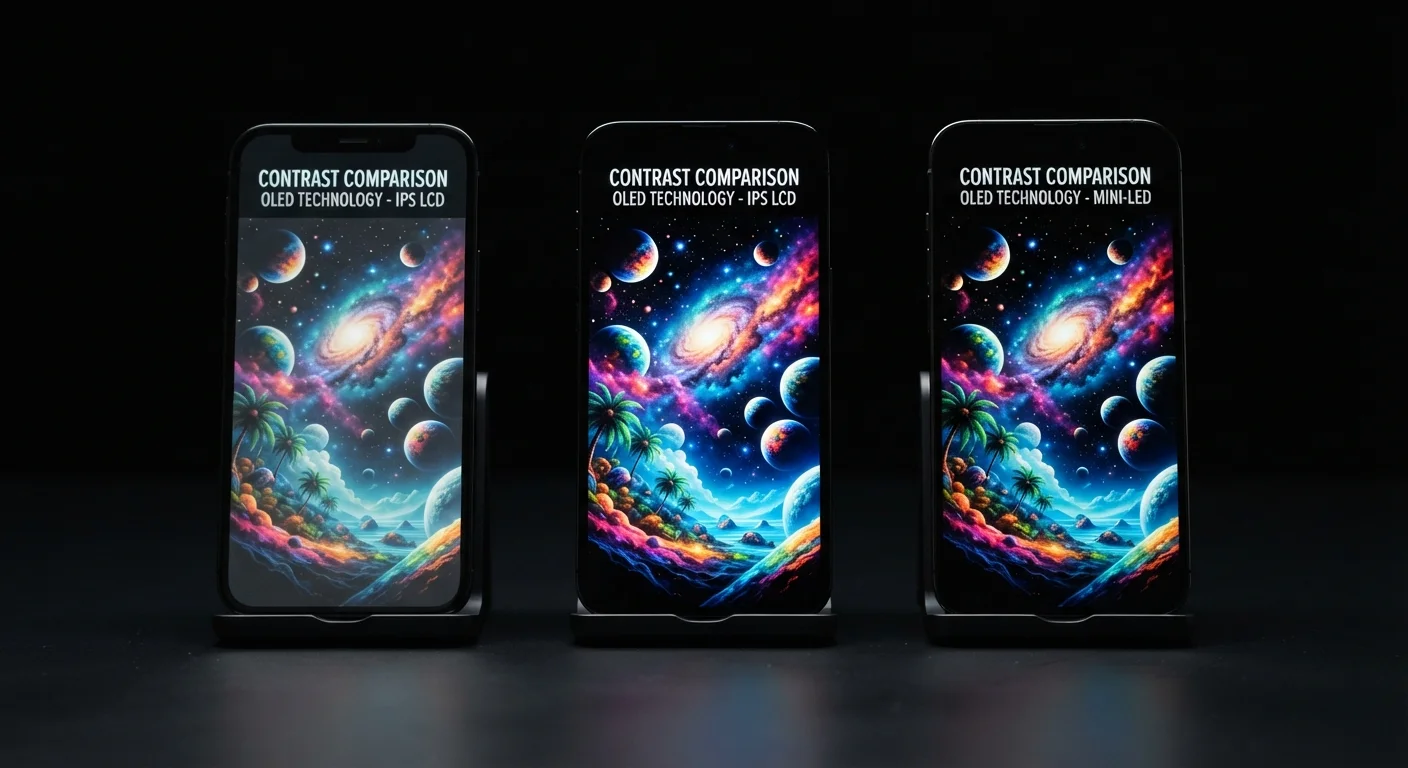
Key Takeaways
- OLED and AMOLED screens produce their own light per pixel, enabling true blacks and higher contrast.
- LCD panels rely on a backlight, which limits contrast but offers consistent brightness and lower cost.
- AMOLED is a variant of OLED - the 'AM' refers to the active-matrix circuit that drives each pixel.
- Battery life differences between screen types depend heavily on the content you're viewing.
- Outdoor visibility and color accuracy are practical daily factors that vary significantly across screen types.
Our Verdict
Each screen technology makes real trade-offs. OLED and AMOLED excel at contrast, color depth, and power efficiency on dark content, while LCD panels offer consistent brightness and remain common in value-tier phones. There is no universally superior option - the right choice depends on how and where you use your phone most.
| Best for | Recommended |
|---|---|
| Those who watch a lot of video or prioritize visual quality | OLED / AMOLED |
| Budget-conscious buyers who want reliable, consistent display performance | LCD (IPS) |
| Users who frequently use dark mode to conserve battery | OLED / AMOLED |
| Those in very bright outdoor environments needing consistent peak brightness | LCD (IPS) |
The Core Technology Behind Each Screen Type
When you look at a phone spec sheet and see "OLED," "AMOLED," or "LCD," you're reading a shorthand for how the display physically produces the image you see. Understanding the mechanism - not just the marketing - is what makes those labels meaningful.
LCD (Liquid Crystal Display) works by shining a white backlight through a layer of liquid crystals, which act like tiny shutters, and then through color filters. Every pixel on an LCD screen is always illuminated by that backlight, even when displaying black. The result is that blacks appear as a very dark gray rather than true black.
OLED (Organic Light-Emitting Diode) takes a fundamentally different approach: each pixel generates its own light. When a pixel needs to display black, it simply turns off completely. This is why OLED screens can achieve contrast ratios that LCDs cannot match - there is literally no light coming from a dark pixel.
AMOLED (Active-Matrix Organic Light-Emitting Diode) is a specific implementation of OLED. The "active matrix" part refers to the thin-film transistor circuit behind each pixel that controls it independently, allowing for faster pixel switching and more precise control. Most OLED screens in modern smartphones are technically AMOLED, though manufacturers sometimes use the two terms interchangeably. For practical purposes, if a spec sheet says AMOLED, treat it as OLED with enhanced pixel control.
For a broader look at how display technology applies beyond phones, see how OLED compares to QLED in TV panels.
How Screen Type Affects Your Daily Experience
The technology gap between these display types shows up in specific, predictable ways during everyday use.
Contrast and Color
OLED and AMOLED screens consistently deliver deeper blacks and more vivid colors because of their per-pixel lighting. This makes a noticeable difference when watching dark scenes in movies or using apps with dark themes. LCD panels produce more uniform color across the screen, which some users prefer for reading - the brightness is consistent rather than shifting by zone.
Battery Life
This is where the comparison gets nuanced. OLED screens use almost no power to display black pixels. If you use dark mode heavily or consume content with dark backgrounds, an OLED screen can draw significantly less power than an equivalent LCD. However, if you're viewing bright, colorful content - white web pages, social media feeds - the power difference narrows considerably.
Outdoor Visibility
High-brightness LCD panels can hold their own in direct sunlight, and some LCD phones have historically matched or exceeded mid-range OLED panels in peak brightness. Modern flagship OLED screens have largely closed this gap, but it's worth checking a phone's nits rating (a measure of brightness) regardless of panel type.
Burn-In Risk
OLED panels can develop permanent image retention - commonly called burn-in - if static elements like navigation bars or notification icons remain on screen for extended periods at high brightness. This is a known characteristic of the technology, not a defect unique to any brand. LCD panels are not susceptible to burn-in in the same way.
| OLED / AMOLED | IPS LCD | |
|---|---|---|
| Black levels & contrast | True black, very high contrast | Dark gray, moderate contrast |
| Color vibrancy | Vivid, saturated colors | Accurate, consistent colors |
| Battery use (dark content) | Lower - dark pixels use less power | Consistent regardless of content |
| Burn-in risk | Possible with static elements over time | Not susceptible to burn-in |
| Outdoor brightness | Excellent on flagships, varies on mid-range | Consistent across price tiers |
| Typical price segment | Mid-range to flagship | Value to mid-range |
| Viewing angles | Excellent at wide angles | Good with IPS; less so with TN panels |
Screen type is one piece of the display puzzle. For context on another key spec, see what refresh rate numbers actually mean for scrolling and gaming.
Where These Screens Show Up in the Market
Display type often tracks with price segment, though the lines have blurred as manufacturing costs have shifted.
LCD panels - specifically IPS LCD (In-Plane Switching LCD, which offers better color and viewing angles than older LCD variants) - remain common in phones priced below $400. They're also the dominant technology in many tablets, where their consistent backlight performs well for reading and document work. If you're comparing devices at the value end of the market, you'll encounter IPS LCD frequently and it's a capable technology for most everyday tasks.
OLED and AMOLED panels are now standard across most flagship phones regardless of operating system, and have moved into many mid-range devices as well. The "Super AMOLED" label used by some manufacturers refers to an integrated touch layer within the display stack, which can reduce reflections and improve outdoor readability.
Panel Type Alone Doesn't Tell the Full Story
Two phones labeled "AMOLED" can produce very different images depending on the manufacturer's color calibration, brightness limits, and display tuning. Some phones allow you to adjust color profiles in settings - switching between a vivid mode and a more natural or accurate mode - which can matter more than the panel type itself for day-to-day viewing comfort. Always evaluate a screen in person or look for independent display measurements when making a decision.
When evaluating any phone's screen, specs beyond panel type also matter: resolution, brightness in nits, color calibration, and how the manufacturer has tuned the display software. Two phones with OLED panels can look noticeably different from each other depending on these factors. For a wider view on how specs translate to real use, common smartphone myths worth setting straight covers several display-related misconceptions that frequently mislead buyers.
If you're still deciding between a phone and a tablet altogether, the display technology considerations above apply to both - see how tablets and smartphones compare for everyday use for a broader device-level breakdown.