

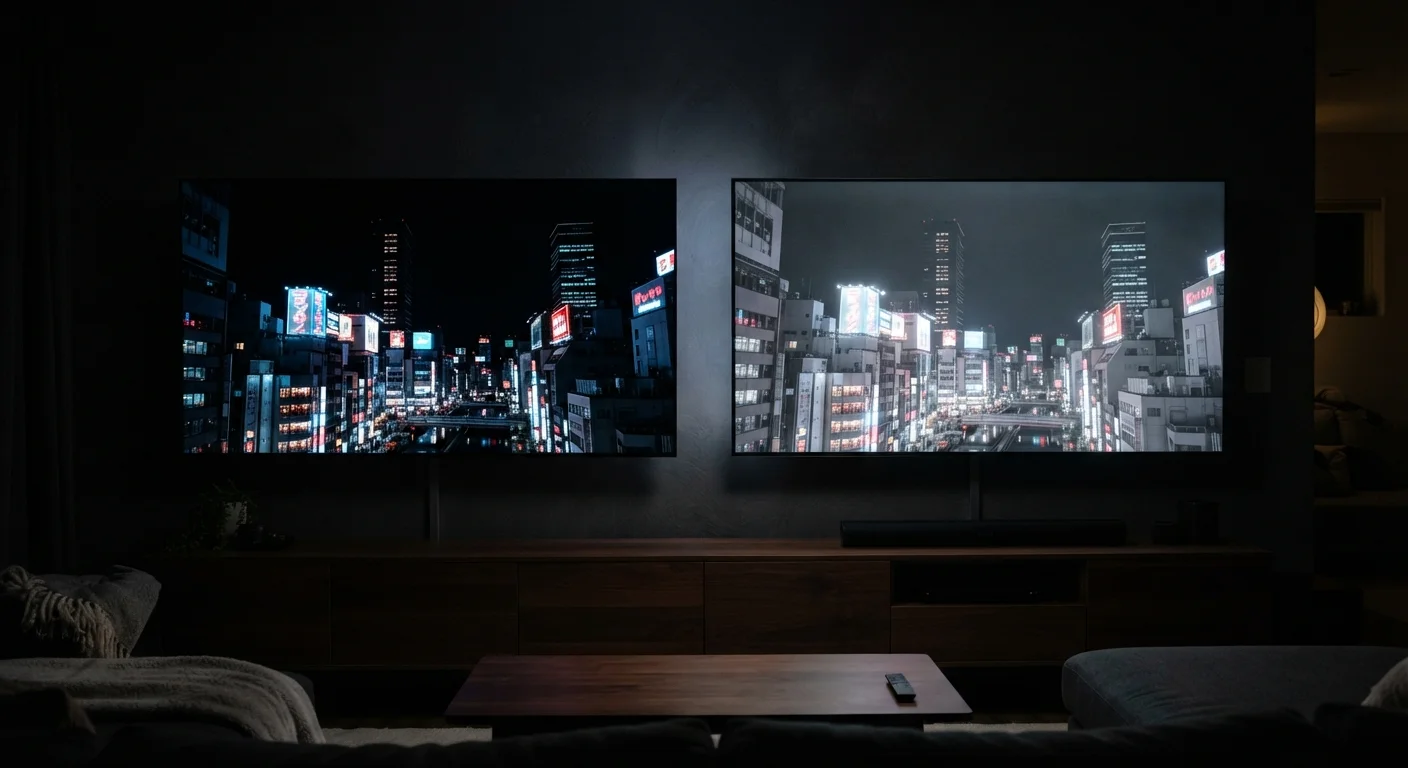
Key Takeaways
- OLED pixels produce their own light, enabling true blacks and near-infinite contrast ratios.
- QLED uses a quantum dot filter over an LED backlight to boost brightness and color volume.
- OLED panels carry a real, though manageable, risk of permanent image retention (burn-in) with static content.
- QLED generally reaches higher peak brightness, making it better suited for very bright viewing environments.
- Viewing angle performance strongly favors OLED, which maintains color accuracy further off-axis.
- Neither technology is universally superior - the right choice depends on your room, content, and habits.
Option A
OLED
The contrast and black-level champion.
Best for: Dark-room cinephiles and gamers who prioritize deep blacks, infinite contrast, and wide viewing angles.
Option B
QLED
The brightness and color volume powerhouse.
Best for: Bright living rooms and households that want punchy, high-peak-brightness visuals with lower long-term burn-in risk.
If you watch mostly movies and TV shows in a darkened room
OLED
OLED's pixel-level light control delivers the deep blacks and shadow detail that cinematic content demands, closely matching a theater-like experience.
If your TV lives in a sun-drenched living room with lots of ambient light
QLED
QLED panels achieve higher sustained brightness levels, helping the image remain visible and vibrant even against competing natural light.
If you game competitively and need fast response times and wide angles
OLED
OLED's near-instantaneous pixel response and wide viewing angles suit gaming setups, though extended use of static HUD elements warrants caution around burn-in.
If you leave the TV on as background viewing for many hours daily
QLED
Constant, static content (news tickers, sports scoreboards) poses a lower burn-in risk on QLED, offering more peace of mind for all-day use.
If you frequently watch from seating positions off to the side
OLED
OLED maintains accurate color and contrast at wide angles, whereas many QLED panels show noticeable color shift and contrast loss beyond about 30 degrees off-center.
How Each Technology Actually Works
Understanding the real trade-offs starts with the underlying physics. OLED - short for Organic Light-Emitting Diode - relies on individual pixels that emit their own light. When a pixel needs to display black, it simply switches off entirely. There is no backlight bleeding through, which is why OLED panels can achieve what manufacturers call infinite contrast ratios: the difference between the brightest white and the darkest black is as large as the display can produce.
QLED - Quantum Light-Emitting Diode - works differently. It is a refinement of conventional LED-backlit LCD technology. A layer of tiny semiconductor crystals (quantum dots) sits in front of the backlight, converting and filtering that light into a wider, purer range of colors. Because the backlight never fully turns off, blacks on QLED panels appear as very dark gray rather than true black - but the trade-off is substantially higher peak brightness potential.
For a broader look at how resolution interacts with panel type, see our guide to HD, 4K, and 8K in plain English.
| Criterion | OLED | QLED |
|---|---|---|
| Black levels & contrast | True black, near-infinite contrast | Very dark gray; contrast depends on local dimming |
| Peak brightness | Moderate; limited by organic compounds | High; LED backlight enables strong peaks |
| Color accuracy | Excellent, per-pixel control | Excellent, quantum dot enhancement |
| Viewing angles | Wide; minimal color shift | Narrower on VA panels; IPS improves but trades contrast |
| Burn-in risk | Real risk with prolonged static content | Negligible; LCD layer not susceptible |
| Response time | Near-instantaneous pixel response | Fast; slightly behind OLED at the extremes |
| Best environment | Dark or controlled-light rooms | Bright, high-ambient-light rooms |
Picture Quality: Where Each Technology Leads and Lags
Contrast and black levels are OLED's clearest advantage. Scenes with deep shadows - a night cityscape, a candlelit interior - reveal the gap most dramatically. QLED, even with advanced local dimming (where sections of the backlight dim independently), can show faint halos of light around bright objects against dark backgrounds, a phenomenon called blooming.
Peak brightness swings the other way. Many QLED panels sustain brightness levels that OLED displays cannot match in small highlight areas. In high dynamic range (HDR) content, this means sunlight glinting off water or an explosion can look more convincingly intense on a high-end QLED in a well-lit space.
Color accuracy and volume are competitive on both sides. Quantum dot technology allows QLED to cover a wide color gamut with strong saturation. OLED panels also deliver excellent color, with each pixel's color controlled independently, resulting in precise local color rendering. In controlled tests, both technologies score well on color accuracy - differences tend to matter more to calibration enthusiasts than to typical viewers.
~1,000,000:1
Typical OLED native contrast ratio
OLED panels achieve this by turning individual pixels off entirely, a structural advantage no backlit LCD technology can replicate.
2,000+ nits
Peak brightness on high-end QLED panels
Many premium QLED displays sustain peak brightness levels in small highlight windows that current OLED panels cannot match.
~30°
Off-axis angle before QLED color shift is visible
On VA-based QLED panels, noticeable color and contrast degradation tends to begin around 30 degrees from center under typical viewing conditions.
Viewing angles favor OLED. Standard QLED panels use a VA (Vertical Alignment) LCD layer that narrows perceived contrast off-axis, so colors can shift noticeably when viewed from the side. If your couch seats people at wide angles, this is a practical consideration. Some manufacturers address this with IPS (In-Plane Switching) LCD panels, which improve angles at the cost of contrast. For more on how display type affects real-world use, our smartphone screen types breakdown covers the same underlying technologies in a mobile context.
Burn-In, Longevity, and Practical Concerns
Burn-in - a permanent faint imprint of a static image on the panel - is a real characteristic of OLED technology, not a myth. The organic compounds in OLED pixels degrade at different rates depending on how hard they work. Displaying the same bright, static content for many hours daily over years can leave a ghost image. Modern OLED panels include mitigation features such as pixel shifting and screen savers, and for typical varied viewing habits, burn-in is rarely reported as a practical problem. That said, the risk is not zero, and users who display static content for extended periods - such as a fixed news channel or a video game HUD - should weigh this honestly.
Burn-In Risk in Context
Consumer electronics reviewers who have conducted long-term OLED burn-in tests - running static content for thousands of hours - generally find that normal, varied viewing habits produce little to no visible retention. The risk is most relevant for specific use cases: displaying a static cable news channel all day, leaving a gaming HUD at full brightness for many hours continuously, or using the TV as a permanent digital signage display. For most households watching a mix of streaming, sports, and movies, burn-in is an unlikely outcome rather than an inevitable one.
QLED panels do not carry the same burn-in risk because the LCD layer does not degrade in the same way. LED backlights do dim over time, but this tends to be a slow, uniform process rather than the localized degradation OLED can exhibit.
On response time, OLED has an inherent advantage: pixels switch nearly instantaneously, producing very low motion blur. QLED panels have improved substantially in this area, but high-motion content (sports, fast-paced gaming) still tends to look slightly cleaner on OLED.
Making the Right Call for Your Setup
Neither panel type wins across all criteria. The decision depends on three practical factors: your room's ambient light, your primary content, and how you use the TV.
- Dark room, movie-focused: OLED's contrast advantage is most visible here, and the burn-in risk is lowest when content varies.
- Bright room, mixed content: QLED's brightness headroom and durability make it the more forgiving choice.
- Gaming: OLED response times are excellent, but assess whether you'll have static overlays on screen for extended sessions.
- Large household, varied seating: OLED's wide viewing angles reduce the need for everyone to sit directly in front of the screen.
Panel technology is just one variable in the overall picture. For a comparable trade-off analysis in the audio space, see our wired vs. wireless headphones comparison - the same principle of "no single winner" applies across consumer electronics categories.