

Key Takeaways
- Assign every item a fixed zone-glovebox, console, back seat, or trunk-and stick to it.
- The glovebox should hold only documents and emergency essentials, nothing else.
- Loose objects in the cabin become projectiles during sudden stops; secure cargo matters for safety.
- A five-minute weekly reset prevents clutter from accumulating into a bigger problem.
- Seasonal readiness and car organization go hand-in-hand-review what you carry each season.
Why Car Organization Actually Matters
A cluttered vehicle isn't just an eyesore - it's a genuine safety hazard. Loose items on the floor can slide under brake pedals. Objects piled on rear seats become projectiles in a hard stop. And a disorganized cabin makes it harder to find what you actually need, whether that's your registration during a traffic stop or a first-aid item after a minor accident.
Organization also lowers daily stress. Drivers who know exactly where their insurance card, phone charger, and emergency kit live spend less mental energy managing their car - and more attention on the road. Think of car organization not as tidiness for its own sake, but as a system that serves safety and efficiency.
~88%
of drivers have items loose in their vehicle
Industry surveys consistently find the vast majority of drivers carry unsecured loose objects in their cabins at any given time.
5 min
Weekly reset time needed to maintain order
Vehicle organization experts broadly agree a brief weekly habit prevents the gradual drift that leads to full-scale declutter sessions.
This guide walks through each zone of your vehicle - glovebox to cargo area - with a clear framework for what belongs where and how to keep it that way.
The Glovebox: Small Space, Big Purpose
The glovebox is the most misused storage zone in most vehicles. Drivers stuff it with fast-food napkins, expired coupons, and miscellaneous hardware - then can't find their proof of insurance when a police officer is waiting.
Apply a strict rule: the glovebox holds documents and vehicle essentials only. That means:
- Current vehicle registration
- Proof of insurance (or your insurer's app information printed as backup)
- Owner's manual
- A small pen
- One compact flashlight
Everything else comes out. If your glovebox has extra room, a folded microfiber cloth is a reasonable addition - but resist the urge to fill space. Lean and purposeful beats stuffed every time.
Keep Your Glovebox Audit-Ready
Set a calendar reminder every six months to verify that your registration and insurance documents are current and legible. Expired or damaged documents can create complications during a traffic stop or accident claim. Swap out anything outdated immediately and shred the old copies.
For a broader look at what belongs in your vehicle at all times, see what safety-minded drivers keep on hand year-round.
Center Console and Door Pockets
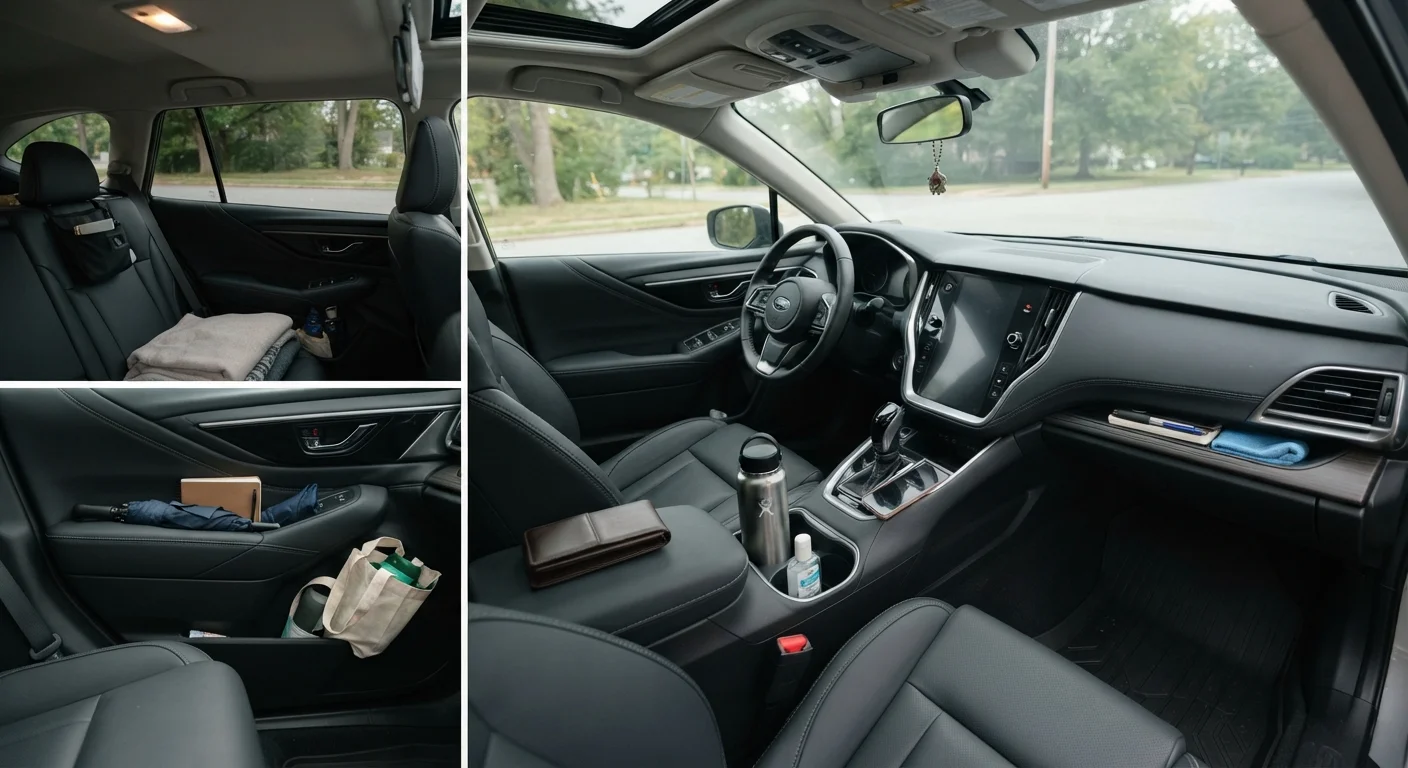
The center console is prime real estate - it's within arm's reach of the driver, which means it should hold only items accessed while driving or immediately after parking. Good candidates: hand sanitizer, lip balm, a charging cable, spare change for tolls or parking meters, and sunglasses.
Door pockets are best used for items that stay in the car permanently and don't need to be retrieved quickly: a small umbrella for the driver's door, a reusable bag in the passenger door. Avoid turning door pockets into trash bins - they're easy to ignore and easy to overload.
Use the 'one in, one out' rule for the center console: every time you add something, remove something of equal or lesser utility.
The console is limited in volume and high in temptation - without an active constraint, it fills up within weeks and becomes difficult to search quickly.
Photograph your glovebox documents once a year and store the images in a password-protected folder on your phone as a backup.
Registration and insurance cards can be lost or damaged; a digital backup - stored securely, not in a public photo album - adds a practical safety net.
One useful habit: keep a small, sealable bag in the console specifically for receipts and parking tickets. Review it weekly and clear it out. This prevents the "I'll deal with it later" drift that leads to console chaos within weeks.
Back Seat Management
Back seats vary widely depending on whether you regularly carry passengers, children, or gear. The organizing principle stays the same: nothing lives on the back seat permanently unless it belongs to an active system.
For families with young children, a back-of-seat organizer with defined pouches can contain snacks, small toys, and wipes without letting them migrate to the floor. The key is choosing one organizer with fixed compartments rather than open pouches that accumulate random items.
For drivers who don't regularly carry passengers, the back seat should be essentially empty. If you transport work materials or gym gear daily, designate a single bag that goes in and comes out with you - the bag lives with you, not the car.
Unsecured Cargo Is a Safety Risk
Even a one-liter water bottle can generate significant force in a sudden stop or collision if it's unsecured on a seat or rear deck. Any heavy or hard item not in the trunk should be in a secured bag on the floor or in a cargo net. This applies especially to tools, sports equipment, and grocery items.
Loose heavy objects on back seats or rear decks - gym bags, toolboxes, even water bottles - can cause serious injury in a collision. If you're not a passenger, it belongs in the trunk.
Trunk and Cargo Area Strategy
The trunk is where most car organization either succeeds or breaks down completely. Without structure, it becomes a rolling storage unit for forgotten reusable bags, sports equipment, and items you meant to bring inside three weeks ago.
Divide the trunk into two categories: permanent safety kit and active cargo. The permanent zone - ideally in the spare tire well area or secured against a side wall - holds your emergency and roadside preparedness items. The active zone handles whatever you're currently transporting.
A collapsible cargo organizer or a simple storage bin with handles makes this division physical and visible. Items in the safety kit don't migrate. Items in the active zone come out when the trip ends.
Your permanent trunk kit should include jumper cables or a jump starter, a basic tool kit, a reflective triangle or road flares, a first-aid kit, and gloves. Review what belongs in a year-round trunk kit for a thorough checklist. Also consider how your cargo needs shift between seasons - the seasonal transition guide covers what to swap in and out as conditions change.
Maintaining the System Over Time
The hardest part of car organization isn't setting it up - it's keeping it. Most systems collapse within a month because maintenance wasn't built into the routine.
A five-minute weekly reset is enough. Each weekend (or whenever you refuel), do a quick sweep: remove trash, return items to their assigned zones, check that the glovebox documents are current, and confirm the trunk safety kit is intact. That's it.
Tie deeper reviews to natural inflection points. Each seasonal transition is a good time to reassess what you're carrying and whether it still makes sense. Seasonal car care routines pair well with an organization audit - you're already hands-on with the vehicle, so it takes minimal extra effort.
Finally, be honest about what you actually use. Organization systems fail when they're built around an idealized version of your driving life rather than your real one. Build around your real habits, and the system will hold. For drivers building broader vehicle routines from scratch, the new driver maintenance guide offers a complementary framework worth reviewing.
Security and What You Leave Behind
An organized vehicle is also a less tempting target for break-ins. When valuables aren't visible, opportunistic theft risk decreases. For a clearer picture of when and where parked-car risk is actually elevated, see the parked car valuables risk overview.