

Key Takeaways
- Your owner's manual is the most reliable guide to your vehicle's specific maintenance schedule.
- Several key fluid and tire checks take less than five minutes and require no tools.
- Warning lights and unusual sounds are your car's way of flagging problems before they escalate.
- Keeping a maintenance log protects your investment and helps mechanics diagnose issues faster.
- Most expensive repairs can be traced back to deferred routine maintenance.
Start here
Why Maintenance Habits Matter More Than One-Time Fixes
Next
The Checks You Can Do Yourself
Then
Understanding Your Maintenance Schedule
Watch for
Warning Signs You Should Never Ignore
Make it routine
Building a Simple System That Sticks
Why Maintenance Habits Matter More Than One-Time Fixes
Most major car repairs don't happen without warning - they develop gradually from ignored small tasks. A missed oil change, an underinflated tire, or low brake fluid rarely causes an immediate breakdown, but each shortcut compounds over time. For new drivers, the most valuable lesson isn't how to fix things; it's how to prevent the need.
Think of car maintenance the way you'd think about any system that needs consistent attention to stay functional. Skipping steps doesn't save time - it borrows against a larger future cost. The good news is that most of what keeps a car running reliably is neither complicated nor expensive when done on schedule.
Understanding the real costs of car ownership starts with recognizing that routine upkeep is one of the most controllable expenses a driver faces. The less predictable costs tend to arrive when routine maintenance gets put off.
Owner's manual
The manufacturer-provided booklet specific to your vehicle that contains maintenance schedules, fluid specifications, and operating instructions.
OBD-II scanner
A small device that plugs into a port under your dashboard and reads fault codes stored by your car's onboard diagnostic system, helping identify why a warning light is on.
Tire pressure (PSI)
The amount of air in your tires, measured in pounds per square inch. Keeping tires at the manufacturer-recommended PSI improves safety, handling, and fuel efficiency.
Coolant
A fluid that circulates through the engine to regulate its temperature, preventing both overheating in summer and freezing in winter.
Dipstick
A long metal rod inserted into the engine or transmission that allows you to check the level and condition of oil without special tools.
Deferred maintenance
Scheduled upkeep that has been skipped or postponed, which often leads to more serious and costly repairs over time.
The Checks You Can Do Yourself
Several maintenance checks are genuinely within reach for anyone willing to spend a few minutes - no mechanical background required. These aren't substitutes for professional service, but they're early-warning tools that can catch problems before they grow.
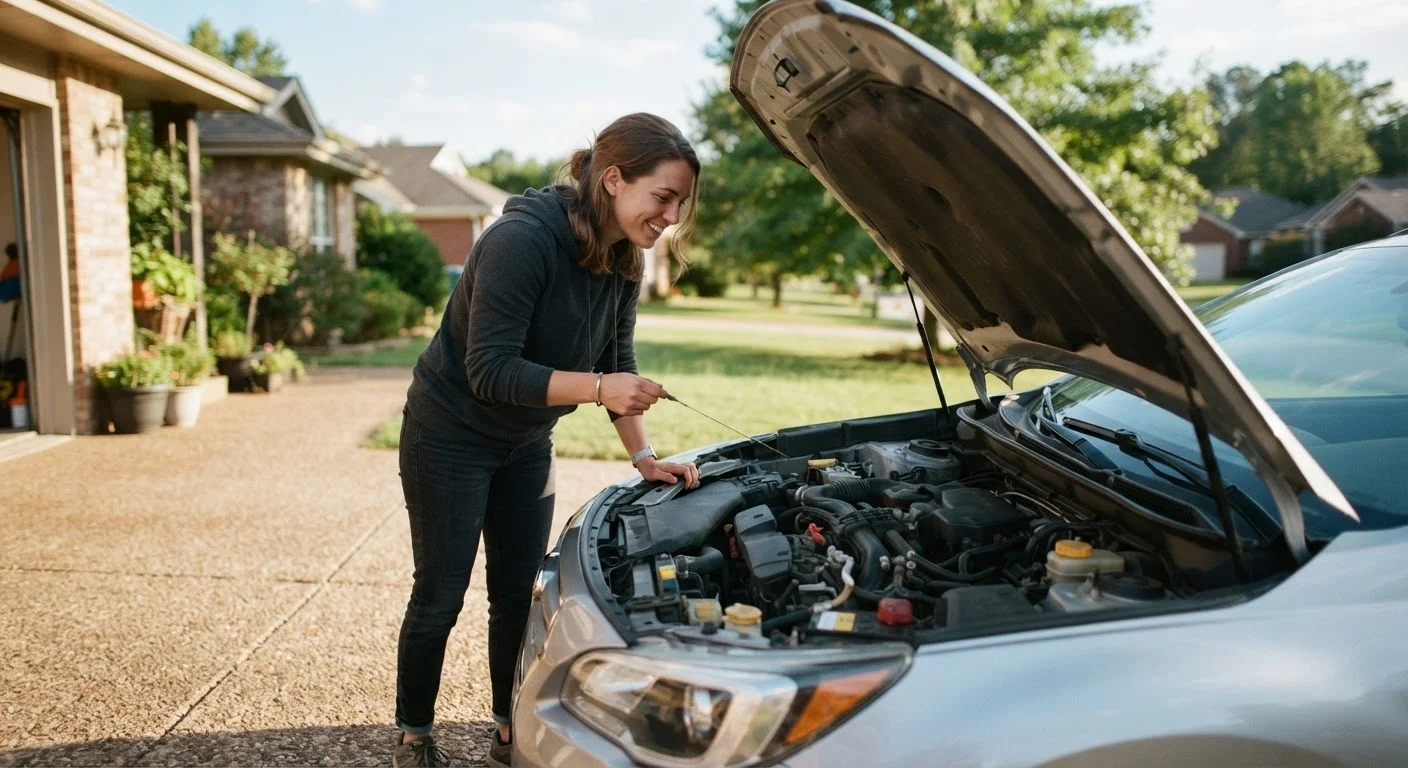
- Engine oil: Pull the dipstick (usually marked with a bright handle near the engine), wipe it clean, reinsert it fully, then pull again. The oil level should fall between the two marks. Low oil is a serious concern; dark, gritty oil that smells burnt suggests an overdue change.
- Tire pressure: Use an inexpensive tire gauge to check each tire - including the spare - when tires are cold (before driving). The correct pressure is printed on a sticker inside the driver's door frame, not on the tire sidewall.
- Wiper blades: Run them on a wet windshield. Streaking or skipping means they need replacement, typically once a year depending on climate.
- Lights: Walk around the car periodically with the headlights and turn signals on to confirm everything is working.
For a more detailed walkthrough of under-hood fluids, see fluid checks you can do at home without a mechanic.
Check Tire Pressure When Tires Are Cold
Tire pressure readings change as tires heat up from driving. For an accurate reading, check pressure before you've driven more than a mile or two, or after the car has sat for at least three hours. The correct pressure for your vehicle is on the driver's door jamb sticker - not on the tire itself.
Understanding Your Maintenance Schedule
Your owner's manual contains a maintenance schedule specific to your vehicle - it's the most reliable source available, and it's often underused. Intervals are typically given in mileage and time (whichever comes first), because components degrade even when a car sits unused.
Common scheduled services include:
- Oil and filter changes - intervals vary widely by vehicle and oil type; consult your manual rather than assuming a fixed mileage rule applies
- Tire rotation - usually every 5,000-7,500 miles to promote even tread wear
- Air filter replacement - typically every 15,000-30,000 miles, though dusty driving conditions shorten that
- Brake inspection - at minimum once a year; brake pads wear gradually and unevenly depending on driving style
- Coolant flush - often every 30,000-50,000 miles, though this varies significantly by manufacturer
For a full breakdown of what's due and when, the complete car maintenance timeline is a useful reference. It's also worth knowing which widely repeated maintenance rules don't actually hold up - common car maintenance myths can steer you wrong if you take them at face value.
Warning Signs You Should Never Ignore
Modern vehicles are designed to alert drivers before small problems become large ones - but only if those alerts are taken seriously. Here are the signals that warrant prompt attention:
- Check engine light: This light indicates the onboard diagnostic system has logged a fault code. Have the code read to determine severity before deciding whether to drive on.
- Brake warning light or spongy brake pedal: Either can indicate low brake fluid or worn pads. Brake failure is a safety issue - don't delay having this checked by a qualified mechanic.
- Temperature gauge climbing toward red: Engine overheating causes rapid, expensive damage. Pull over safely and let the engine cool before investigating.
- Unusual sounds: Grinding when braking, knocking from the engine, or squealing from under the hood all point to specific mechanical issues that benefit from early diagnosis.
- Vibration or pulling while driving: Often related to tire or alignment problems, both of which affect handling and safety.
Don't Drive on a Lit Brake Warning Light
A brake system warning light can indicate critically low brake fluid or a hydraulic failure - either of which can reduce your ability to stop the vehicle. If this light comes on, have the car inspected by a qualified mechanic before driving further when at all possible. This is a safety issue, not a wait-and-see situation.
When something seems off, consulting a mechanic early almost always costs less than waiting. See when to DIY versus take it to a shop for guidance on which issues belong in each category.
Building a Simple System That Sticks
The most effective maintenance routine is one you'll actually follow. A few structural habits make consistency much easier:
- Keep a log. Record every service - date, mileage, and what was done. A notebook in the glovebox works fine. Maintenance records also add real value when selling a vehicle or helping a mechanic diagnose a recurring issue.
- Set mileage-based reminders. Note your current mileage after each service and set a phone reminder for the next interval. This removes the guesswork.
- Do a monthly walk-around. A five-minute visual check - tires, lights, any fluid spots on the ground beneath the car - catches problems early with almost no effort.
- Think seasonally. Certain checks are especially important at seasonal transitions: battery condition before winter, coolant and AC function before summer. Seasonal car care ties these checks to the time of year so nothing gets overlooked.
Habits built in the first months of driving tend to persist. The investment of time is small; the potential savings - in repairs avoided and safety maintained - are substantial.
This article provides general educational information about vehicle maintenance. It is not a substitute for advice from a qualified mechanic, and specific guidance for your vehicle should always come from your owner's manual or a licensed automotive professional.