

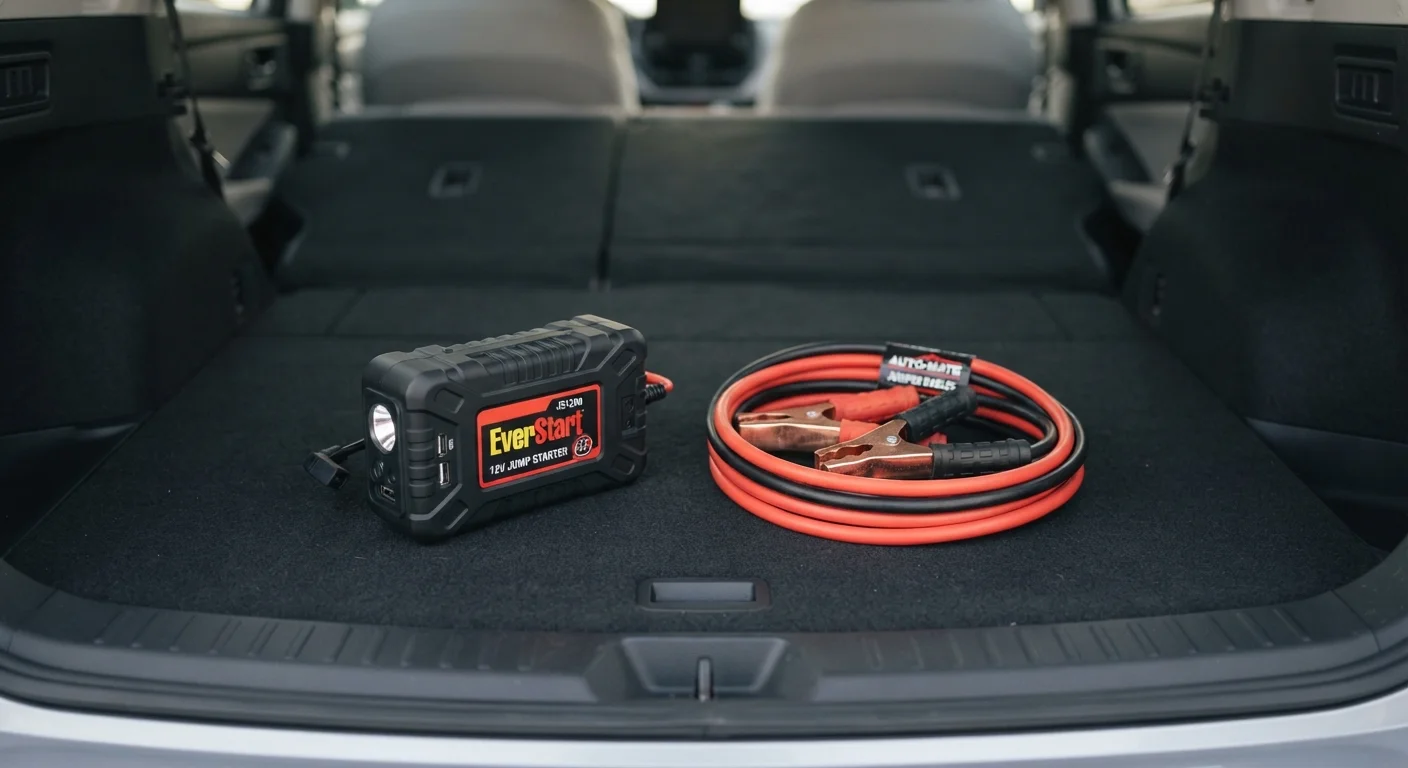
Key Takeaways
- Portable jump starters let you revive a dead battery without a second vehicle present.
- Jumper cables are inexpensive, require no charging, and rarely degrade with age.
- Portable units must be kept charged to work - a neglected unit may fail when you need it most.
- Modern vehicles with sensitive electronics benefit from jump starters with built-in protection circuits.
- Both tools have legitimate roles; some drivers carry one of each for redundancy.
- Your driving patterns and typical parking environment should drive the decision.
Option A
Portable Jump Starter
The self-contained, no-help-needed option.
Best for: Drivers who frequently travel alone, park in remote areas, or want complete independence from a second vehicle.
Option B
Jumper Cables
The simple, durable, low-cost classic.
Best for: Drivers who usually travel in populated areas and are comfortable relying on a good Samaritan or roadside assistance.
If you frequently drive or park alone in low-traffic areas
Portable Jump Starter
Without another vehicle nearby, jumper cables are useless. A charged portable unit means you're never stranded waiting for help.
If you're looking for an ultra-simple, nearly zero-maintenance backup
Jumper Cables
Cables don't need charging, have no battery to degrade, and can last decades with minimal care - just coil them and forget them until needed.
If you drive a newer vehicle with complex electronics
Portable Jump Starter
Quality jump starters include voltage regulation and reverse-polarity protection that reduce the risk of damaging sensitive onboard systems.
If you're building an emergency kit on a tight budget
Jumper Cables
A reliable set of cables costs a fraction of a portable unit and delivers the core function as long as another willing driver is available.
If maximum roadside preparedness is your priority
Portable Jump Starter
Carrying both is even better, but if forced to choose one tool for comprehensive readiness, the portable unit covers more scenarios independently.
How Each Tool Actually Works
Jumper cables are two insulated wires with clamps at each end. You connect them between a dead battery and a live battery in a running vehicle, let the donor car charge the dead one briefly, then attempt to start your car. Simple physics, no moving parts, and nothing to charge beforehand.
Portable jump starters - sometimes called jump packs or battery boosters - contain a built-in lithium-ion or lead-acid battery. You clamp them directly to your own dead battery, and the unit delivers enough current to start the engine without any second vehicle involved. Many modern units also double as USB chargers for phones and other devices.
The core operational difference: cables depend entirely on having a second functioning vehicle and a willing driver nearby. A jump starter depends on having a unit that was kept charged. Neither tool works unconditionally - they just fail under different circumstances.
For a broader look at what else belongs alongside these tools, see what every driver should keep in the trunk year-round.
Head-to-Head: Key Differences at a Glance
Before committing to one tool or the other, it helps to see the trade-offs laid out clearly. The table below covers the practical factors most drivers care about.
| Criterion | Portable Jump Starter | Jumper Cables |
|---|---|---|
| Requires second vehicle | No | Yes |
| Typical cost range | Higher upfront investment | Low cost |
| Ongoing maintenance | Regular recharging needed | Minimal - inspect periodically |
| Ease of use | Straightforward with instructions | Requires knowing correct sequence |
| Electronics protection | Many units include surge protection | No built-in protection |
| Shelf life | Battery degrades over time | Decades if stored properly |
| Additional functions | Often includes USB charging, light | Jump-starting only |
| Cold weather performance | Lithium units may lose capacity in extreme cold | Unaffected by temperature |
One detail worth emphasizing: cable quality matters. Thin, cheaply made cables can overheat or fail to deliver adequate amperage for larger engines. Look for cables rated for your vehicle's engine size, and check the gauge - lower gauge numbers indicate thicker, more capable wire.
The Maintenance Reality of Each Option
Jumper cables are about as close to set-and-forget as automotive tools get. Coil them properly, store them in a bag to prevent corrosion on the clamps, and inspect the insulation occasionally for cracking. That's essentially it. A good set can outlast the vehicle.
Portable jump starters require more active upkeep. Lithium-ion units should be recharged every three to six months even when not in use, or their internal battery degrades and may fail to hold enough charge to start a car. Leaving one in a hot trunk over summer accelerates that degradation. If you buy a portable unit and forget about it for two years, don't count on it working during an emergency.
Check Your Jump Starter Before Winter
Cold weather is the most common trigger for dead batteries, and it's also when a neglected portable jump starter is most likely to fail. Before temperatures drop, plug in your unit, charge it fully, and verify it holds that charge over a day or two. A jump starter that reads 'full' but discharges overnight likely has a degraded internal battery that won't deliver reliable starting power when you need it most.
This maintenance gap is one of the most underappreciated differences between the two tools. Drivers who are diligent about keeping a jump starter topped up will find it invaluable. Those who tend to set-and-forget their gear may be better served by cables.
Also worth noting: both tools carry real risk if connected incorrectly. Reversed polarity - connecting positive to negative - can damage electronics or cause a battery to arc. Always verify the correct sequence before connecting anything. Our guide on jump-starting a car safely without damaging modern electronics walks through the proper steps.
Which One Fits Your Driving Life?
Think honestly about where and how you drive. If your commute runs through suburban neighborhoods with regular traffic and you always have cell service, jumper cables plus a roadside assistance plan may cover your needs. Help is rarely more than 30 minutes away, and cables weigh almost nothing.
If you routinely drive rural roads, work overnight shifts, or travel to areas with spotty cell coverage, a portable jump starter is a more self-sufficient choice. The same goes for drivers who frequently sit in a parked car with accessories running - a hazard that can drain a battery faster than most people expect.
Some drivers simply carry both: cables for the cases when another car is available and a jump starter for solo situations. The combined weight and cost may be worth it depending on your circumstances. See how this kind of preparedness thinking applies to your vehicle overall with our article on seasonal car prep.
If you're also weighing broader ownership decisions - like whether your next vehicle should be electric - it's worth knowing that EVs require different jump-start procedures and some cannot be jump-started in the conventional sense. Our breakdown of electric vs. gas vehicle lifetime costs covers what changes when you switch drivetrains.
This article is for general informational purposes. Always follow your vehicle manufacturer's guidelines for battery-related procedures, and consult a qualified mechanic if you're uncertain about safe jump-start practices for your specific vehicle.