

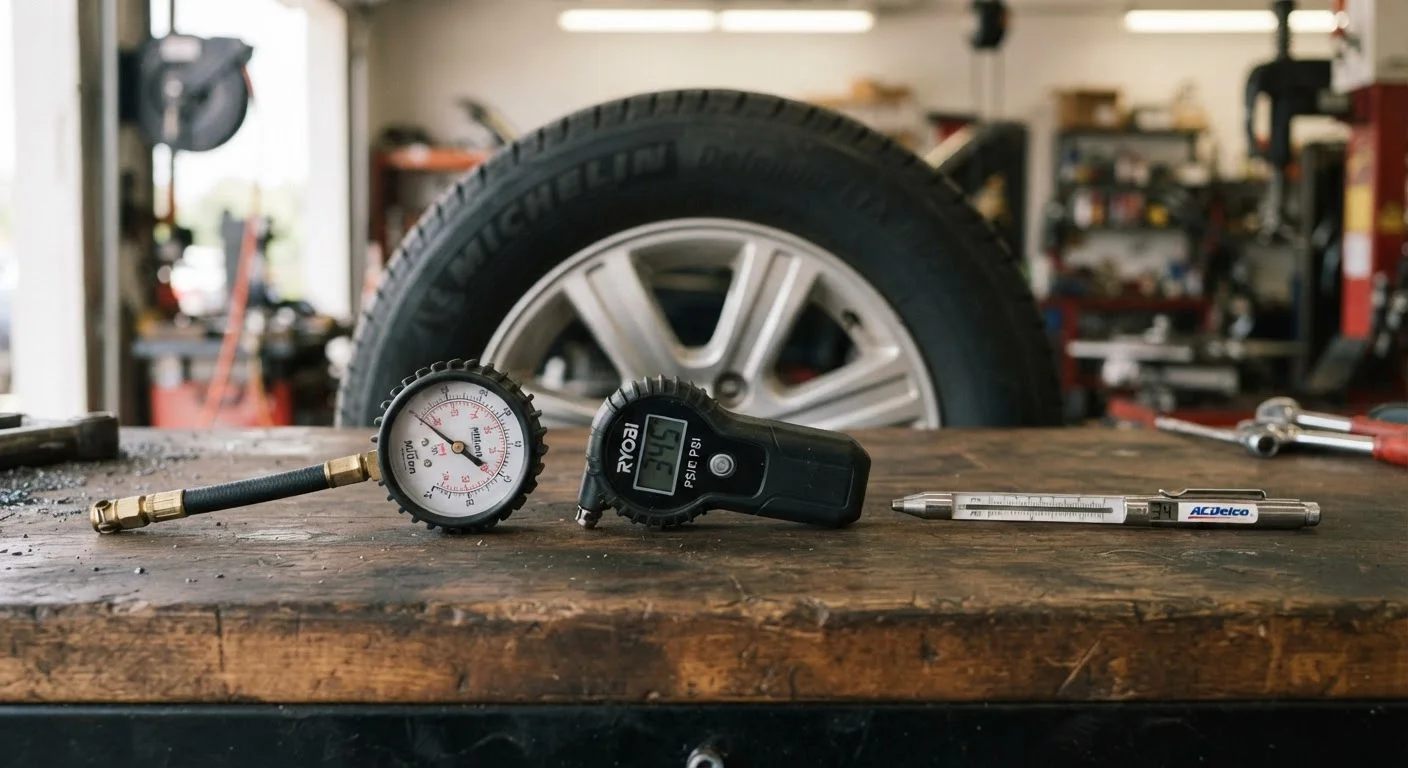
Key Takeaways
- Dial gauges offer the best combination of readability and durability for most drivers.
- Digital gauges provide the most precise readings but require batteries and careful handling.
- Stick gauges are the most compact and affordable, but accuracy can vary significantly.
- Any gauge is better than eyeballing tires - proper inflation improves safety and fuel economy.
- Check tire pressure monthly and before long trips, always when tires are cold.
Our Verdict
For most everyday drivers, a dial gauge hits the sweet spot of accuracy, readability, and ruggedness without any batteries or fragile electronics. Digital gauges suit drivers who want the sharpest precision and don't mind taking care of the unit. Stick gauges work fine as a glove-box backup, but shouldn't be your primary tool if accuracy matters.
| Best for | Recommended |
|---|---|
| Drivers who want reliable, everyday use without fuss | Dial gauge |
| Detail-oriented drivers who want maximum precision | Digital gauge |
| Drivers needing a compact emergency backup | Stick gauge |
Why Your Choice of Gauge Actually Matters
Tire pressure is one of the easiest vehicle checks a driver can do - but only if your gauge gives you a reading you can trust. Under-inflated tires reduce fuel efficiency, wear unevenly, and can overheat at highway speeds. Over-inflated tires reduce grip and make the ride harsh. Either condition affects safety in ways that add up over thousands of miles.
The three common gauge types - dial, digital, and stick - all measure the same thing, but they differ meaningfully in how they do it and how easy they are to use correctly. If you want a deeper look at technique, see our guide on checking your tire pressure the right way. For now, here's how the tools themselves stack up.
| Dial Gauge | Digital Gauge | Stick Gauge | |
|---|---|---|---|
| Typical accuracy | ±1-2 PSI | ±0.5-1 PSI | ±2-3 PSI |
| Ease of reading | Large analog face, easy | Clear LCD display | Small sliding rod, tricky |
| Battery required | No | Yes | No |
| Durability | High - handles drops well | Moderate - screen vulnerable | Moderate - rod can stick |
| Portability | Bulkier | Medium size | Very compact |
| Relative cost | Low to moderate | Moderate to higher | Lowest |
| Best use case | Everyday primary gauge | Precision-focused drivers | Emergency backup |
Dial Gauges: Workhorse Reliability
Dial gauges use an analog needle and a circular face, much like a clock. When you press the gauge onto the valve stem, air pressure moves a piston that deflects the needle. The scale is easy to read at a glance, and the large face makes it less likely you'll misread a number in dim light.
Because they contain no electronics, dial gauges don't need batteries and won't fail because of a dead power source. They're also more resistant to drops and temperature extremes than digital units. A quality dial gauge can last for years in a glovebox or toolkit without any maintenance. The tradeoff is size - they're bulkier than stick gauges and slightly harder to pocket.
Get More from Your Dial Gauge
Store your dial gauge away from direct sunlight and extreme heat, both of which can degrade the internal spring over time. Before each use, confirm the needle rests at zero when not pressurized - a needle that doesn't return to zero indicates the gauge may need replacement. Periodically cross-check your dial gauge against a calibrated gauge at a tire shop to confirm it's still reading accurately.
Digital Gauges: Precision at a Cost
Digital gauges display a numeric readout on an LCD screen, often to the nearest 0.5 PSI or even 0.1 PSI. That precision can matter if your vehicle's recommended pressure is, say, 35 PSI and you want to hit that number exactly rather than estimate from a needle position. Many digital units also include a backlit display, making them useful in a dark garage or at night.
The downsides are real. Batteries die, and if you haven't checked yours in months, the gauge may be useless exactly when you need it. LCD screens can crack or fail in extreme cold, and the electronics are less tolerant of being dropped on concrete than a dial gauge. Cost is also generally higher. Digital gauges reward careful owners; they're less forgiving of casual storage.
Stick Gauges: Simple but Limited
The stick gauge - a small metal or plastic tube that ejects a calibrated rod when pressed onto a valve stem - has been around for decades. It's inexpensive, fits easily in a glove box or pocket, and has no moving parts beyond the sliding rod. Those advantages make it appealing as a backup.
The problem is consistency. Stick gauges vary more widely in accuracy than dial or digital types, and the sliding rod can be tricky to read if you're not holding it at the right angle or in good light. They also tend to lose calibration over time. For occasional checks when you suspect a tire is significantly low, a stick gauge does the job. As your only gauge relied upon for regular maintenance, it may leave you less certain about where your pressure actually sits.
Proper tire pressure also has a direct connection to fuel costs - tires that are even a few PSI low can reduce efficiency noticeably. Our article on fuel economy and what you spend at the pump explains how these small factors accumulate over a year of driving.
~1%
Fuel efficiency lost per 1 PSI underinflation
The U.S. Department of Energy has noted that underinflated tires can reduce gas mileage by roughly 0.2% per 1 PSI drop across all four tires.
~25%
Passenger vehicles with at least one significantly underinflated tire
NHTSA research has found that a significant share of vehicles on U.S. roads are running on tires below the recommended pressure at any given time.
Making the Right Call for Your Situation
No single gauge type suits every driver. Think about how and where you'll use it. If your gauge lives in a toolbox and gets regular use, a dial unit offers the best durability-to-accuracy ratio. If you value a clear numeric display and will remember to keep a battery fresh, digital is a reasonable choice. If you need something tiny that rides in a bag or pocket, a stick gauge as a secondary tool is fine - just don't stake your maintenance routine on its readings alone.
Whichever type you choose, verify it against a known accurate gauge periodically, such as the calibrated units at many service stations. And always check pressure when tires are cold - that means the vehicle hasn't been driven for at least three hours or has traveled less than a mile - since heat from driving raises pressure readings and can lead to inaccurate adjustments. For more context on what the numbers on your tires mean, our explainer on tire load index and speed rating numbers is a useful companion read.