

| Load Index Range | Typically 70-126 for passenger vehicles (USTMA standardized load index tables) |
| Most Common Speed Ratings | S, T, H, V, W, Y (ETRTO / TRA industry standards) |
| Where to Find OEM Specs | Driver's door-jamb placard and owner's manual |
| Load Index 97 Equals | 1,609 lbs maximum per tire (Standard tire load index table) |
| Speed Rating H Allows | Up to 130 mph sustained (Industry-standard speed symbol table) |
What That Sidewall Code Actually Means
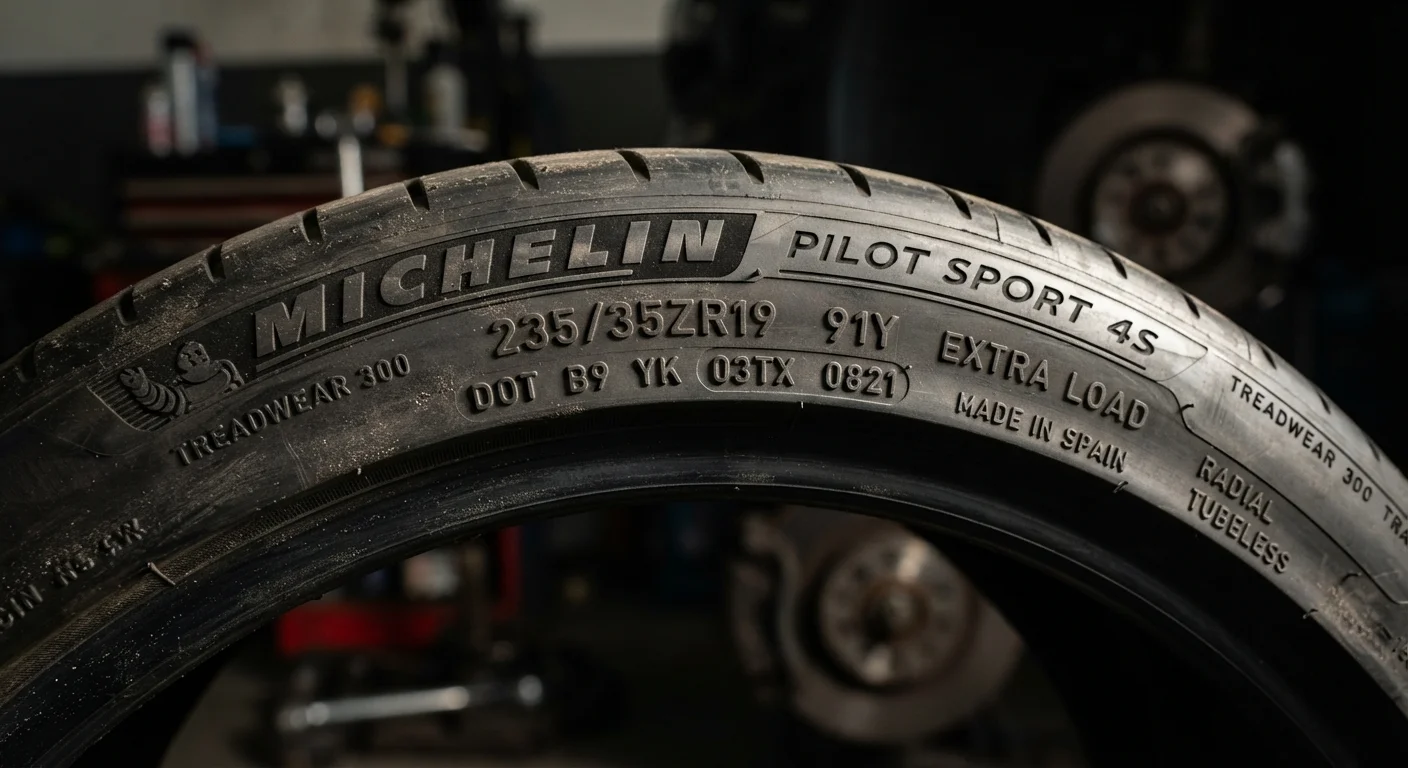
Somewhere on every tire sidewall you'll find a sequence like 225/55R17 97V. Most drivers know the first part describes tire size, but the two characters at the end - 97V in this example - carry genuine safety information. The 97 is the load index, and the V is the speed rating. Together they define the operating limits the tire was engineered to handle.
Understanding these codes matters because fitting a tire with a lower load index or speed rating than your vehicle manufacturer specifies is a safety compromise - not just a technicality. Tires operating beyond their rated limits can build heat faster than the structure can dissipate it, increasing the risk of a blowout. The numbers aren't marketing; they're engineering boundaries.
| Load Index Range | Typically 70-126 for passenger vehicles (USTMA standardized load index tables) |
| Most Common Speed Ratings | S, T, H, V, W, Y (ETRTO / TRA industry standards) |
| Where to Find OEM Specs | Driver's door-jamb placard and owner's manual |
| Load Index 97 Equals | 1,609 lbs maximum per tire (Standard tire load index table) |
| Speed Rating H Allows | Up to 130 mph sustained (Industry-standard speed symbol table) |
Load Index: How Much Weight Each Tire Can Carry
The load index is a two- or three-digit number that corresponds to a standardized maximum load capacity in pounds (or kilograms). The scale is not linear and isn't something you memorize - it's a lookup table. A load index of 91, for instance, represents a maximum load of 1,356 lbs per tire, while 100 represents 1,764 lbs.
Load Index
A standardized numerical code embossed on a tire sidewall representing its maximum load-carrying capacity per tire. Higher numbers correspond to greater weight limits according to an industry-standard lookup table.
Speed Rating
A letter code indicating the maximum sustained speed a tire is engineered to handle under its rated load. It reflects the tire's heat dissipation and structural integrity at high speeds, not a recommended driving speed.
XL / Extra Load
A tire designation meaning the tire is built to withstand higher-than-standard inflation pressures and carry a higher load than a comparably sized standard tire. Commonly required on heavier crossovers and European-market vehicles.
OEM Specification
The original equipment manufacturer's required tire size, load index, and speed rating for a specific vehicle. Found on the door-jamb placard and in the owner's manual; the baseline for any replacement tire decision.
To determine whether a tire's load index suits your vehicle, compare it to the original equipment specification listed in your owner's manual or on the door-jamb placard. Going one index point higher is generally acceptable; going lower is not. If you frequently haul heavy cargo or tow a trailer, pay close attention - your actual per-tire load can approach or exceed the rated limit if the vehicle is fully loaded.
One practical note: XL or Extra Load markings on a tire mean it's built to handle higher inflation pressures and carries a higher load capacity than a standard tire at the same index number. These are common on European-spec vehicles and crossovers. Substituting a standard tire for an XL-rated one without checking load requirements can be a hidden safety gap.
Speed Rating: The Sustained-Speed Ceiling
The speed rating is a single letter - sometimes two - indicating the maximum sustained speed the tire is designed to handle under load. Common ratings you'll encounter include:
- S - up to 112 mph (common on minivans and family SUVs)
- T - up to 118 mph (sedans, light trucks)
- H - up to 130 mph (sport sedans, coupes)
- V - up to 149 mph
- W - up to 168 mph
- Y - up to 186 mph
These aren't legal speed limits or driving recommendations - they're structural ratings. A tire rated H handles heat and stress differently at high sustained speeds compared to an S-rated tire. Fitting a lower-rated tire on a vehicle that calls for a higher one means the tire may degrade or fail at speeds the vehicle is legally and mechanically capable of reaching.
Temporary Spare Tires Are a Special Case
Compact spare tires (the smaller "donut" spares) carry their own speed and load ratings - typically a maximum of 50 mph and significantly lower load capacity than a full-size tire. Never treat a temporary spare as equivalent to your standard tires, and replace it with a properly rated tire as soon as practicable.
Matching or exceeding your vehicle's specified speed rating is the rule. Going higher than specified is permissible and sometimes done when selecting performance tires - but it doesn't override the load index requirement, and it won't improve fuel economy or ride quality.
Finding Your Vehicle's Required Ratings
Your vehicle's required tire specifications - including minimum load index and speed rating - appear in three places: the owner's manual, the tire and loading information placard on the driver's door jamb, and sometimes in the fuel-door label. The door-jamb placard is usually the fastest reference; it lists the OEM tire size, recommended inflation pressure, and the full tire code.
If you're replacing tires and want to understand the full picture of what the sidewall numbers mean, the same discipline applies as when reading any product specification sheet - focus on the numbers that define safety limits, not just size compatibility. For related maintenance fundamentals, checking your tire pressure correctly ensures that even a properly rated tire performs as its load index promises, since inflation pressure directly affects actual load capacity. And if a warning light appears on your dash after a tire swap, decoding your dashboard warning lights can help you understand whether it's a TPMS sensor reset or something more urgent.
This article provides general educational information about tire specifications. Always consult your vehicle's owner's manual and a qualified tire professional before making tire replacement decisions.