

Key Takeaways
- Slow engine cranking is often the earliest and most reliable sign of a weakening battery.
- Most car batteries last three to five years, depending on climate and driving habits.
- A swollen or leaking battery casing is a safety hazard requiring immediate attention.
- Electrical gremlins - flickering lights, sluggish accessories - can point to battery trouble.
- A simple load test at an auto shop can confirm whether replacement is actually needed.
Why Battery Failure Catches Drivers Off Guard
A dead battery rarely announces itself with fanfare. One morning your car starts fine; the next, you're turning a key and hearing silence. The frustrating part is that most batteries send clear warning signals weeks - sometimes months - before they fully give out. The problem is that most drivers don't know what to look for.
Car batteries are electrochemical devices that naturally degrade over time. Heat accelerates internal corrosion; cold weather reduces the battery's ability to deliver the cranking power needed to start an engine. Understanding the signs of a failing battery is straightforward preventive knowledge - and it can spare you a tow bill, a missed appointment, or worse, being stranded somewhere inconvenient. For a broader look at when battery checks fit into your overall maintenance calendar, see our seasonal car care guide.
Know Your Battery's Age
Most batteries carry a manufacture date stamped or printed on the casing - often in a code like "4/21" for April 2021. If your battery is approaching the three-year mark, it's worth having it tested proactively, even if it seems fine. Many shops will do this for free during a routine oil change visit.
Warning Signs to Watch For
Slow or Labored Engine Cranking
When you turn the key or press the start button, the starter motor draws a large burst of current from the battery. If the engine turns over sluggishly - slower than usual, with a low or strained sound - the battery may no longer be delivering adequate current. This is often the very first symptom drivers notice, and it tends to be most pronounced on cold mornings when a battery's output is naturally reduced.
A sluggish crank on cold mornings is often the battery's earliest distress call.
Dim Headlights or Interior Lights
Your vehicle's lighting draws directly from the electrical system. If the battery is struggling to maintain consistent voltage, lights may appear noticeably dimmer than usual - especially when the engine is idling or off. You might also notice dashboard lights flickering or interior lights that seem less bright than they once were. These subtle changes are easy to dismiss but worth paying attention to.
Dimmer-than-normal headlights at idle are a quiet signal worth taking seriously.
Electrical Accessories Acting Erratically
Power windows that move slowly, a radio that resets itself, seat adjusters that hesitate, or a backup camera that takes longer to load - these can all point to insufficient battery voltage. Modern vehicles rely on a stable electrical supply for dozens of onboard systems. When the battery weakens, these systems are often the first to show irregular behavior. Dashboard warning lights may also illuminate as a result.
Sluggish power windows or a resetting radio can trace back to battery voltage problems.
The Battery Warning Light Is On
Most vehicles have a dedicated battery or charging system warning light - often shaped like a battery icon. When it illuminates while driving, it typically signals that the charging system isn't maintaining adequate voltage. This could indicate a failing battery, a failing alternator, or a loose or corroded connection. Either way, it warrants prompt attention from a mechanic rather than being ignored.
The battery warning light is the vehicle's own diagnostic system flagging a problem.
Visible Corrosion on the Terminals
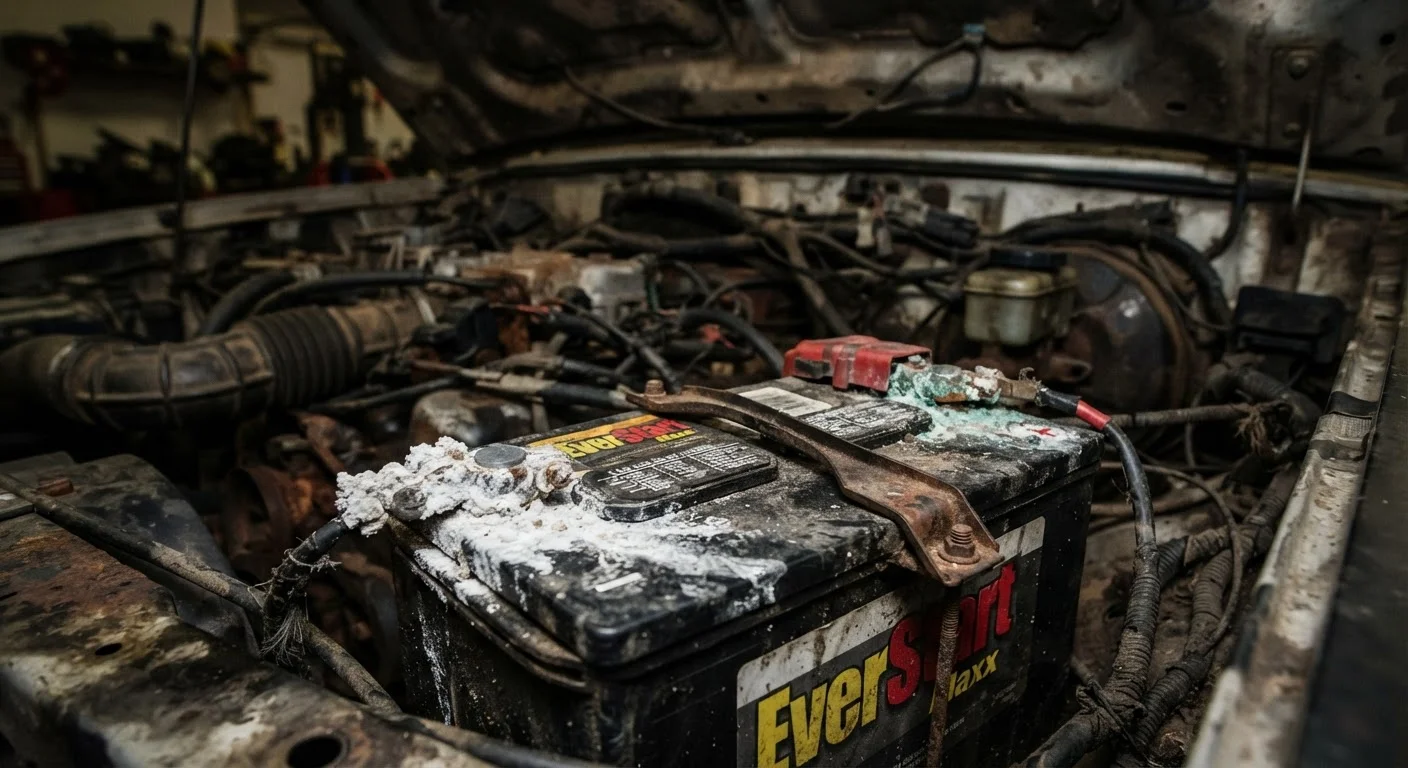
White, blue, or greenish powdery buildup around the battery terminals is a sign of corrosion. This buildup increases electrical resistance, which can prevent the battery from charging or discharging efficiently. In some cases, terminal corrosion alone causes starting problems even when the battery itself still has usable capacity. Corroded terminals can often be cleaned - but they should be inspected to determine whether the corrosion is a symptom of a leaking battery casing, which is a more serious issue.
Terminal corrosion raises electrical resistance and can cause starting failures on its own.
Swollen, Bloated, or Leaking Battery Case
A battery casing that appears swollen, bulging, or misshapen has typically been exposed to excessive heat or overcharging. This causes gases to build up inside the sealed casing. A swollen battery should be treated as a safety concern - it may leak battery acid or, in extreme cases, rupture. Do not attempt to test or jump-start a visibly damaged battery. Have it inspected and removed by a professional as soon as safely possible.
A bloated or leaking battery casing is a safety hazard requiring immediate professional attention.
Frequent Jump-Starts Needed
Needing a jump-start once after accidentally leaving your lights on is an inconvenience. Needing multiple jump-starts across a short period is a clear sign the battery is no longer holding a charge the way it should. A battery that can't sustain a charge under normal driving conditions has reached end-of-life, regardless of how old it is by the calendar. At this point, a load test will almost certainly confirm replacement is overdue.
Repeated jump-starts in a short period are a reliable sign the battery needs replacing.
What to Do When You Spot These Signs
If you recognize one or more of these indicators, the first practical step is a battery load test. Many auto parts stores and repair shops offer this service at no charge. A load test applies a controlled draw to the battery and measures how well it holds voltage - it's far more informative than just checking the resting voltage with a multimeter.
Don't assume the battery is always the culprit. A failing alternator can mimic battery symptoms because it's the alternator's job to recharge the battery while the engine runs. A qualified mechanic can test both components together to pinpoint the actual source of the problem.
If you do end up needing a jump-start in the meantime, be careful - modern vehicles have sensitive electronics that can be damaged by improper jump-starting procedures. Our guide on jump-starting a car safely walks through the correct sequence. And before any long drive, it's worth running through a pre-departure vehicle check - battery condition included.
Battery Life Varies by Climate
Drivers in hot climates - particularly in the South and Southwest - often see batteries fail sooner than the commonly cited three-to-five-year range. Sustained heat accelerates the internal chemical breakdown that degrades battery capacity. If you live in a hot region, consider starting proactive battery testing after two years of use. Our seasonal vehicle prep guide covers additional steps that help reduce wear on key components year-round.