

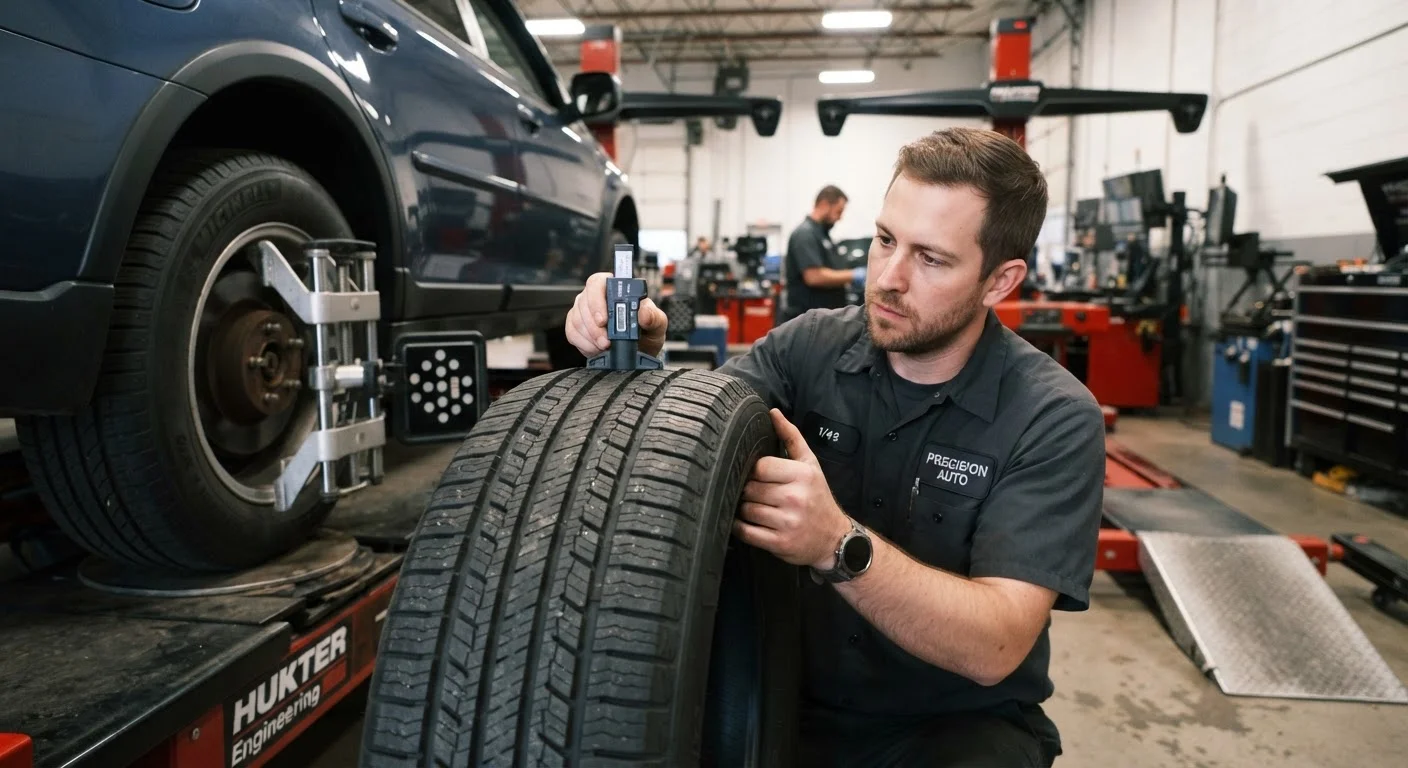
Key Takeaways
- Tire rotation moves tires to new positions to even out tread wear; alignment corrects the angles at which tires contact the road.
- Neither service replaces the other - skipping one undermines the benefit of doing the other.
- Most vehicles benefit from rotation every 5,000-7,500 miles and alignment checks at least once a year.
- Misalignment often shows up as pulling to one side or uneven tread wear before any obvious handling problem appears.
- Both services are relatively low-cost compared to replacing a full set of prematurely worn tires.
Our Verdict
Tire rotation and alignment address completely different problems, yet each depends on the other to deliver lasting results. Rotating tires on a misaligned vehicle simply spreads wear unevenly across all four tires instead of just two. Getting an alignment without rotating means one axle continues wearing faster than the rest. Treating both as routine, scheduled maintenance - rather than reactive fixes - is the most cost-effective approach for any driver.
| Best for | Recommended |
|---|---|
| High-mileage commuters who want to maximize tire lifespan | Regular rotation on a strict mileage schedule |
| Drivers who frequently navigate rough roads, potholes, or curbs | Alignment check after any significant impact, plus annual inspections |
| Budget-conscious drivers trying to avoid premature tire replacement | Combining both services at each major service interval |
What Tire Rotation Actually Does
Tires wear unevenly depending on where they sit on a vehicle. Front tires handle steering forces and, on front-wheel-drive cars, also transmit engine power - so they wear significantly faster than rears. Rotation moves each tire to a different position on the vehicle according to a set pattern (front-to-rear, cross-rotation, or side-to-side depending on tire type and drivetrain), so no single tire bears the brunt of wear indefinitely.
The practical outcome is that all four tires approach the end of their usable life at roughly the same time, which means replacing a full set together rather than buying tires in mismatched pairs. Most manufacturers and tire industry guidelines recommend rotation every 5,000-7,500 miles, though your owner's manual is the authoritative source for your specific vehicle.
Rotation does not fix an underlying handling or geometry problem. If your car is pulling to one side, rotating tires will redistribute wear but will not correct the pull. That's an alignment issue - a separate service entirely. For a broader look at which routine tasks are worth learning about, see our no-jargon maintenance overview.
What Wheel Alignment Actually Does
Alignment is not about the tires themselves - it's about the suspension geometry that controls how the tires sit relative to the road and to each other. Technicians measure and adjust three primary angles:
- Camber: The inward or outward tilt of the tire when viewed from the front. Excessive camber wears one edge of the tread.
- Toe: Whether the fronts of the tires point inward (toe-in) or outward (toe-out) when viewed from above. Incorrect toe is one of the fastest ways to destroy tire tread.
- Caster: The angle of the steering axis viewed from the side, which affects straight-line stability and steering feel.
Alignment drifts out of spec through normal use - hitting a pothole, clipping a curb, or simply accumulating miles on worn suspension components. Annual alignment checks are a reasonable baseline; more frequent checks make sense after any significant road impact.
| Tire Rotation | Wheel Alignment | |
|---|---|---|
| What it addresses | Uneven tread wear across positions | Incorrect suspension geometry angles |
| Typical frequency | Every 5,000-7,500 miles | Annually or after major impacts |
| Warning signs | Visibly uneven tread depth | Pulling to one side, steering off-center |
| Can it be DIY'd? | Possible with proper jack stands and torque wrench | Requires specialized alignment rack - shop service |
| Replaces the other? | No - does not fix geometry | No - does not equalize tread wear |
| Primary benefit | Extends usable tire life across all four | Protects tires from edge wear; improves handling |
It's worth understanding that alignment problems often appear gradually. Many drivers don't notice pulling or wandering until it's pronounced, by which point measurable tire wear has already occurred. Common maintenance myths can lead drivers to ignore early warning signs, so knowing what to look for matters.
How the Two Services Interact
The key insight most drivers miss: these services are interdependent. Rotating tires on a vehicle with poor alignment distributes uneven wear to all four tires rather than concentrating it. Conversely, correcting alignment on a vehicle with heavily worn, mismatched tires may not fully restore straight tracking because the tires themselves are now uneven.
Schedule Both at the Same Visit When Possible
If your mileage interval for rotation coincides with a time when alignment is due, handling both in one shop visit minimizes labor duplication. Ask your technician to perform an alignment inspection during each rotation - many will check toe and camber visually at no extra charge and flag only confirmed issues for correction.
A practical approach used by many service shops is to perform a visual alignment check whenever tires are rotated - this catches developing issues before they become expensive. Some shops bundle both into a single appointment, which can save time without necessarily saving money, so it's worth asking what's included. For context on thinking through DIY versus professional service decisions, our comparison of DIY and shop maintenance lays out when each approach makes sense.
Keeping records of when each service was performed also pays dividends - it helps a mechanic spot patterns (like alignment going out of spec repeatedly) that might point to a worn suspension component. Maintaining a vehicle service log is one of the simplest habits that protects your investment over time.