

Key Takeaways
- Indoor cats are not inherently bored - poor environmental design is the real culprit.
- Effective enrichment targets hunting instincts, sensory stimulation, and social connection.
- Rotating activities and setups prevents habituation and sustains mental engagement.
- Feeding enrichment transforms mealtimes into cognitively stimulating events.
- Human interaction structured around play is one of the most powerful enrichment tools available.
- Signs of under-enrichment include over-grooming, aggression, and excessive inactivity.
Why Indoor Cats Need More Than Food and Comfort
It is easy to assume that a cat who sleeps sixteen hours a day is simply content. In reality, domestic cats retain a deeply wired behavioral repertoire - stalking, chasing, climbing, investigating - that does not disappear just because prey is no longer required for survival. When those drives go unmet, the result is not contentment but behavioral frustration that can manifest as destructive scratching, excessive vocalization, or withdrawal.
Indoor living removes genuine hazards - traffic, predators, infectious disease - but it also strips away the environmental complexity that would otherwise occupy a cat's senses and problem-solving capacity. The solution is not to let cats outside by default; it is to bring that complexity indoors intentionally. As our broader coverage of why cognitive enrichment matters for pets explains, mental engagement is as essential to wellness as physical exercise.
Behavioral Problems Are Often Welfare Problems
Destructive scratching, aggression, and compulsive behaviors in indoor cats are frequently expressions of unmet environmental needs - not personality flaws. Before labeling a cat as 'difficult,' evaluate whether its space, social interaction, and sensory access genuinely match its behavioral requirements. Improvements in enrichment resolve a significant proportion of common complaints reported to veterinary behavior clinics.
The Five Pillars of Feline Enrichment
Veterinary behaviorists typically organize feline enrichment around five functional categories. Together they address the full scope of what a cat's nervous system expects from its environment:
- Sensory stimulation - sights, sounds, and scents that engage curiosity
- Cognitive challenge - puzzles and foraging that require problem-solving
- Physical outlets - climbing, jumping, and chasing that exercise muscle and coordination
- Social interaction - engagement with humans or compatible animal companions
- Choice and control - the ability to withdraw, observe, or opt in on the cat's own terms
No single pillar substitutes for the others. A cat with plenty of toys but no vertical space, or plenty of vertical space but no interactive play, will still show signs of understimulation. For a species-level comparison of how cats differ from other pets, see species-specific enrichment strategies.
~16 hrs
Average daily sleep for adult indoor cats
While cats are crepuscular hunters, extended inactivity during waking hours often indicates under-stimulation rather than natural rest.
14×
Cat's sense of smell vs. humans
Cats possess roughly 200 million scent receptors compared to approximately 5 million in humans, making olfactory enrichment highly impactful.
65%
Indoor cats showing attachment behaviors to owners
Research by Vitale, Behnke, and Udell published in Current Biology found the majority of cats tested displayed secure attachment to their caregivers.
Sensory Enrichment: Activating All Five Senses
Cats are sensory animals first. Their hearing range extends well beyond human perception, their sense of smell is estimated to be roughly fourteen times more sensitive than ours, and their vision is calibrated for detecting motion in low light. Tapping into these capabilities is one of the most efficient enrichment investments an owner can make.
Practical sensory setups
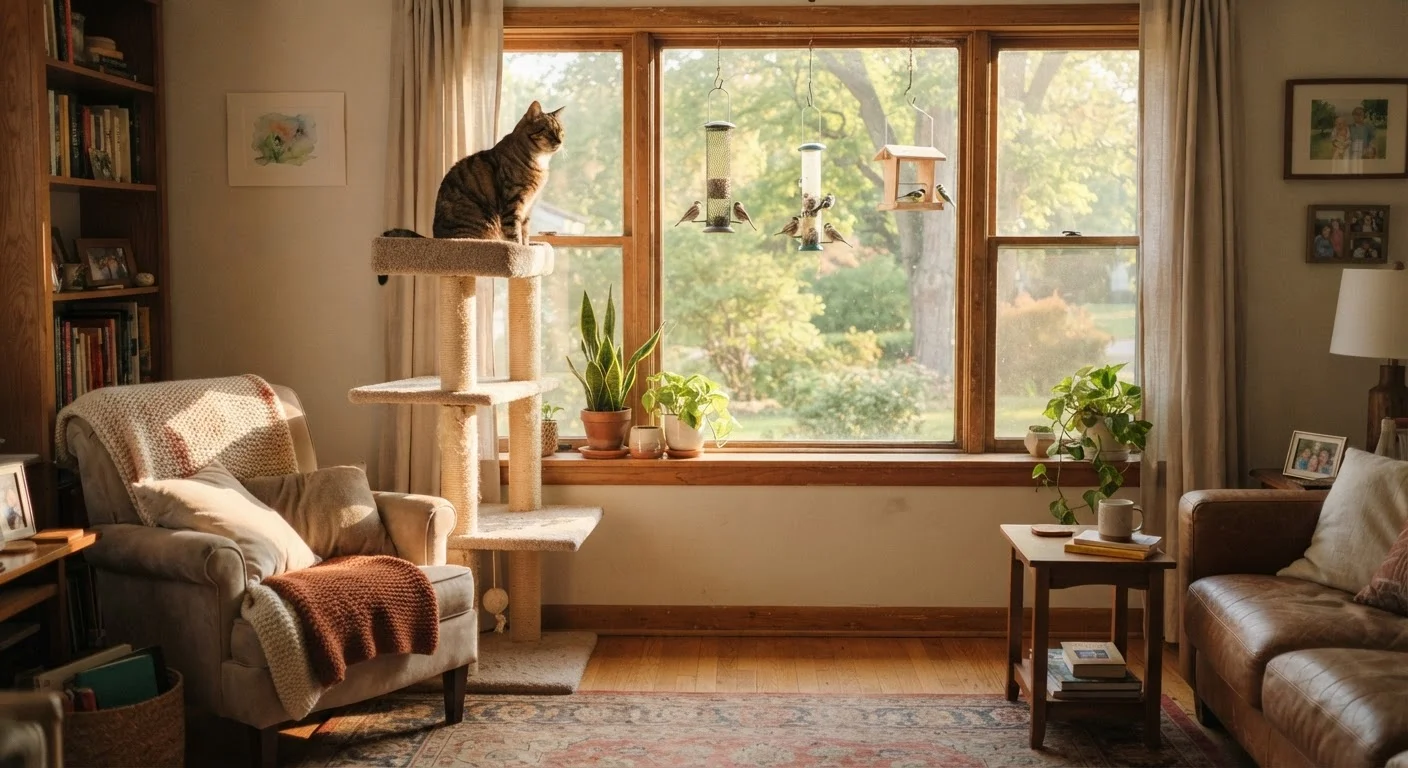
- Window perches with bird feeders outside - creates a live "cat TV" that activates visual and auditory tracking instincts for hours each day.
- Safe herbs - silver vine and valerian root are supported by research as alternatives to catnip and engage cats who do not respond to catnip's active compound, nepetalactone.
- Nature soundscapes - recordings of birdsong or rustling leaves played at low volume have been observed to prompt investigative behavior in indoor cats.
- Cardboard boxes and paper bags - new textures and enclosed spaces satisfy novelty-seeking and provide a sense of security simultaneously.
Rotate which windowsill or perch you place the bird feeder near each month. Cats quickly learn fixed vantage points and the novelty fades - moving the action keeps engagement high.
Cats habituate to predictable sensory environments rapidly. Spatial novelty reactivates investigative interest without requiring new purchases.
When introducing a new scent enrichment item, place it a foot away from the cat rather than directly in front of them. Letting the cat choose to approach respects their autonomy and results in a more engaged, relaxed investigation.
Cats that feel control over an interaction show more exploratory behavior and lower stress indicators, consistent with research on feline agency and welfare.
Feeding Enrichment: Making Meals an Activity
In the wild, a cat would spend a significant portion of its waking hours in hunt-related activity - stalking, pouncing, catching - before consuming a meal. Delivering nutrition from a bowl in thirty seconds eliminates that entire behavioral sequence. Feeding enrichment restores it.
Methods that work
- Puzzle feeders - commercially available or DIY versions that require the cat to bat, roll, or manipulate a container to release kibble or treats.
- Scatter feeding - distributing dry food across a snuffle mat or hiding small portions around the home turns the cat's entire territory into a foraging ground.
- Licki mats with wet food - slows consumption and extends sensory engagement, which is particularly useful for cats prone to eating too quickly.
- Hunting feeders - small, prey-shaped containers hidden in different locations each mealtime mimic natural caching behavior.
Any shift in feeding method should be gradual. A cat that is entirely unfamiliar with foraging work may refuse to eat if the puzzle is too complex at the outset. Start simple and increase difficulty over days or weeks. Good pet nutrition foundations still apply - enrichment changes the delivery, not the dietary content.
Start With One Puzzle, Not Five
Owners often introduce too many enrichment tools at once, which can overwhelm a cat unaccustomed to earning their food. Introduce a single, easy-level puzzle feeder for the first week before adding complexity or variety. Success - meaning the cat engages and is rewarded - builds the behavioral confidence to tackle harder challenges.
Social Enrichment and the Human-Cat Bond
Despite their reputation for independence, cats form genuine social attachments. Research on cat-owner relationships - including work building on the landmark attachment security studies by Vitale, Behnke, and Udell - suggests that many cats display attachment behaviors toward owners consistent with those seen in human infants and dogs. This has practical implications: structured interactive play with a human is one of the most potent enrichment tools available, and it costs nothing beyond time and a suitable toy.
Maximizing interactive play
- Use wand-style or feather toys that allow a realistic prey movement pattern - erratic, ground-level scurrying punctuated by pauses.
- Allow the cat to complete the predatory sequence by catching the toy regularly. Play that never ends in a "catch" can increase frustration rather than satisfaction.
- Schedule at least two sessions per day of ten to fifteen minutes each; timing one session before the cat's primary meal reinforces the hunt-eat-groom-sleep sequence.
For owners curious about how indoor play compares to supervised outdoor access, indoor vs. outdoor enrichment covers the tradeoffs in depth.
“The indoor environment need not be impoverished. With thoughtful design, it can be richer in some ways than outdoor life - safer, more predictable, and tailored precisely to what that particular animal finds engaging.”
— Tony Buffington, Veterinary Internal Medicine specialist and author of the Indoor Pet Initiative, The Ohio State University
Building an Enrichment Routine That Lasts
Consistency matters, but so does novelty. Cats habituate to static environments quickly - the same toys left out indefinitely lose their appeal within days. A sustainable enrichment strategy rotates elements regularly without requiring constant owner investment.
Rotation principles
- Divide toys into two or three sets and rotate them on a weekly basis. A toy that has been "away" for a week is perceived as novel again.
- Rearrange furniture or cat furniture periodically to alter the spatial landscape of the environment.
- Introduce one new scent, texture, or object monthly to maintain investigative behavior.
Our dedicated article on rotating your pet's enrichment routine provides a structured framework for doing this without overwhelming yourself or your cat.
Recognizing when enrichment is working
Signs of a well-enriched indoor cat include: confident exploration of the full home territory, engagement with offered items, a visible predatory play sequence (stalk, pounce, carry), and a calm post-play settling period. Signs that the current approach is insufficient include over-grooming, inter-cat aggression in multi-cat households, and prolonged inactivity combined with apparent vigilance or tension rather than relaxed rest.
If behavioral concerns persist despite consistent enrichment efforts, consultation with a veterinarian or a board-certified veterinary behaviorist is the appropriate next step. Behavioral change can sometimes signal underlying medical conditions that warrant professional evaluation.
This article is for general informational purposes only and is not a substitute for professional veterinary or behavioral advice. Always consult a qualified veterinarian for concerns about your cat's health or behavior.