

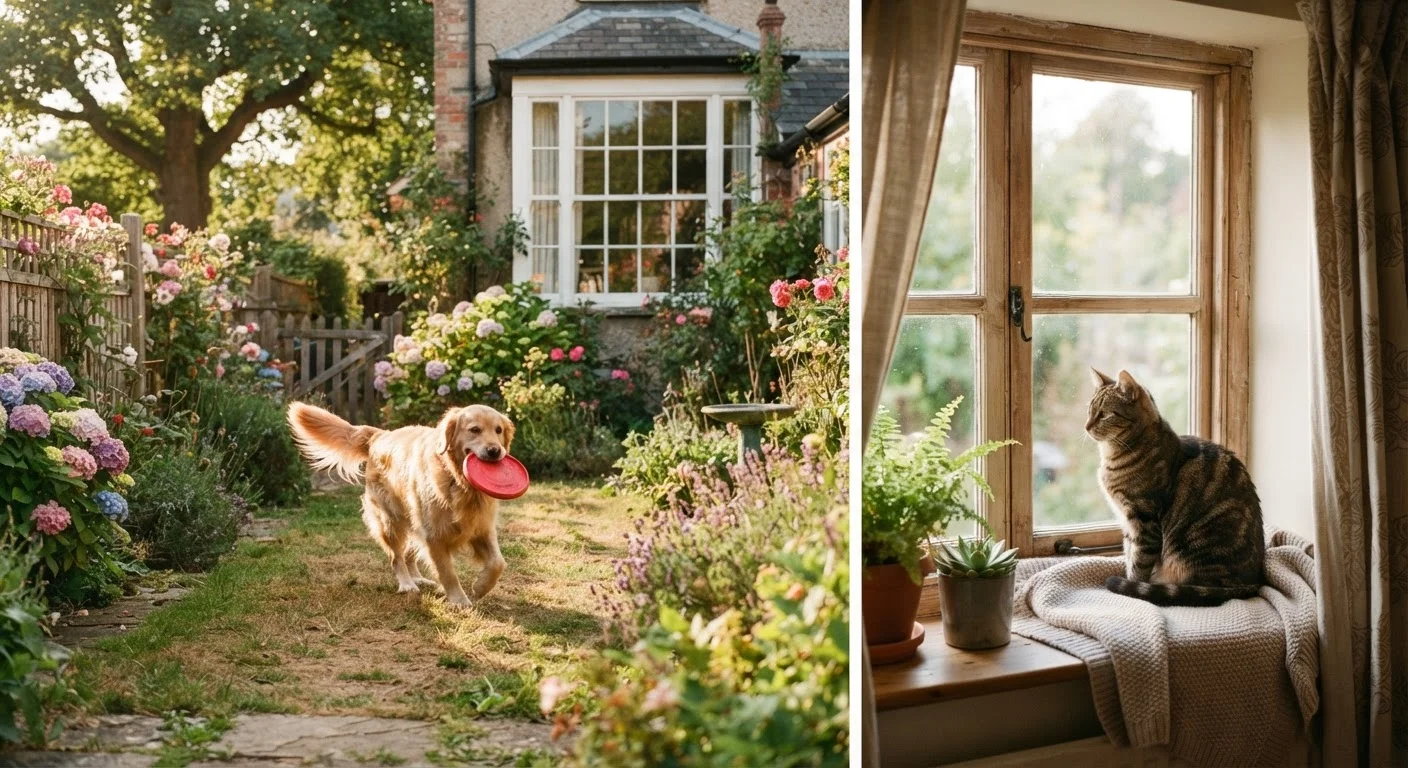
Key Takeaways
- Indoor enrichment offers consistency and safety, while outdoor enrichment provides unmatched sensory variety.
- Neither environment alone is sufficient - a balanced combination serves most pets best.
- Species, temperament, and health status should guide how much of each type your pet receives.
- Simple, low-cost activities in both settings can meaningfully improve a pet's quality of life.
- Outdoor access should always be managed with safety and your pet's individual risk factors in mind.
Option A
Indoor Enrichment
The controlled, consistent foundation of daily pet wellness.
Best for: Pets who spend most of their time inside, or owners who need reliable, weather-independent enrichment options.
Option B
Outdoor Enrichment
The sensory-rich, dynamic experience that mirrors natural behaviors.
Best for: Pets who thrive on novel stimuli, physical exertion, and exposure to the natural environment.
If your pet has mobility limitations or health concerns
Indoor Enrichment
Controlled indoor activities can be tailored to physical limitations without the unpredictability of outdoor environments.
If your dog shows signs of boredom or pent-up energy
Outdoor Enrichment
Outdoor exposure delivers the physical exercise and novel stimuli that indoor settings simply cannot replicate at the same intensity.
If you want enrichment that works around a busy schedule
Indoor Enrichment
Puzzle feeders, scent games, and environmental setups can engage your pet independently, regardless of weather or your availability.
If your pet is a high-energy working or sporting breed
Outdoor Enrichment
These breeds typically need the physical challenge and sensory complexity that outdoor environments provide to remain well-balanced.
If you want to strengthen your bond while enriching your pet
Indoor Enrichment
Training games, interactive play, and cooperative puzzles inside the home build trust and communication alongside mental stimulation.
What Each Environment Actually Offers
Enrichment is broadly defined as anything that satisfies a pet's physical, cognitive, and instinctual needs. But where that enrichment happens - inside your home or out in the world - shapes the quality and type of stimulation your pet receives in fundamentally different ways.
Indoor enrichment thrives on predictability. You control the space, the safety, and the pace. Puzzle feeders, training sessions, hide-and-seek games with treats, and environmental modifications - like cat trees, tunnels, or foraging trays - can all be delivered inside. For many pets, especially cats, small mammals, and birds, indoor enrichment is the primary form they will ever receive. Done well, it is genuinely sufficient. Indoor life can be richly stimulating for cats when their environment is thoughtfully designed.
Outdoor enrichment, by contrast, is inherently dynamic. A single walk exposes a dog to dozens of novel scents, sounds, textures, and social encounters that no indoor setup can fully reproduce. For many dogs - and some adventurous cats via supervised outdoor access - the outdoors delivers a density of stimulation that accelerates mental fatigue in the most productive sense, leaving pets calmer and more satisfied afterward.
| Criterion | Indoor Enrichment | Outdoor Enrichment |
|---|---|---|
| Sensory variety | Limited; requires deliberate design | High; naturally diverse stimuli |
| Safety control | High; owner manages all variables | Lower; external risks present |
| Weather dependence | None; always available | Significant; weather-limited |
| Physical exertion potential | Moderate; space-constrained | High; space for full movement |
| Cognitive engagement | High with proper activity design | High through natural complexity |
| Best suited for | All pets; especially cats, birds, small animals | Dogs; adventurous cats with supervision |
| Novelty over time | Requires active rotation by owner | Naturally refreshed by environment |
The Real Tradeoffs: Safety, Consistency, and Stimulation
The case for indoor enrichment is strongest when safety, predictability, and routine matter most. Weather never cancels an indoor puzzle session. A fearful dog won't be overwhelmed by traffic noise during a training game in the living room. Pets recovering from illness or surgery can still receive meaningful cognitive engagement without physical risk.
The case for outdoor enrichment rests on what behavioral scientists call environmental complexity - the idea that animals benefit from engaging with varied, unpredictable stimuli that mirror their evolutionary context. Mental stimulation is a recognized pillar of pet wellness, and outdoor environments deliver it in ways that are difficult to replicate artificially.
The honest tradeoff is this: outdoor enrichment is harder to control and carries real risks - parasites, toxic plants, traffic, and unpredictable animal encounters - but its stimulation ceiling is higher. Indoor enrichment is safer and more consistent, but requires more deliberate design to remain genuinely engaging over time. Rotating your pet's enrichment routine is essential indoors, where novelty doesn't arrive on its own.
Outdoor Access for Cats: A Nuanced Picture
Supervised outdoor access - through enclosed catios, leash walks with a harness, or secure garden enclosures - can offer cats meaningful enrichment without the risks of free-roaming. The health tradeoffs of indoor versus outdoor cat life involve real considerations around lifespan, disease exposure, and predator risk. Consulting your veterinarian about what level of outdoor access suits your individual cat is always worthwhile.
Building a Balanced Routine
For most pets, the goal is not to choose between indoor and outdoor enrichment but to combine them strategically. A balanced week might pair daily indoor cognitive work - scent games, training, foraging activities - with several outdoor sessions that deliver physical exertion and sensory novelty. Planning a full week of enrichment doesn't require elaborate preparation; consistency matters more than complexity.
Species and individual temperament should guide the ratio. High-energy dogs may need substantial outdoor time daily, while a senior cat may thrive almost entirely on thoughtfully arranged indoor experiences. Species-specific enrichment strategies help owners match activities to what their particular animal actually needs rather than what looks impressive.
One overlooked benefit of combining both approaches: the activities that work best are often the ones that involve you directly. Enrichment that doubles as quality time with your pet strengthens the human-animal bond alongside the stimulation itself - whether that's a scent trail laid through your backyard or a training game on your living room floor.
This article provides general information for educational purposes and is not a substitute for advice from a qualified veterinarian familiar with your individual pet's needs.