

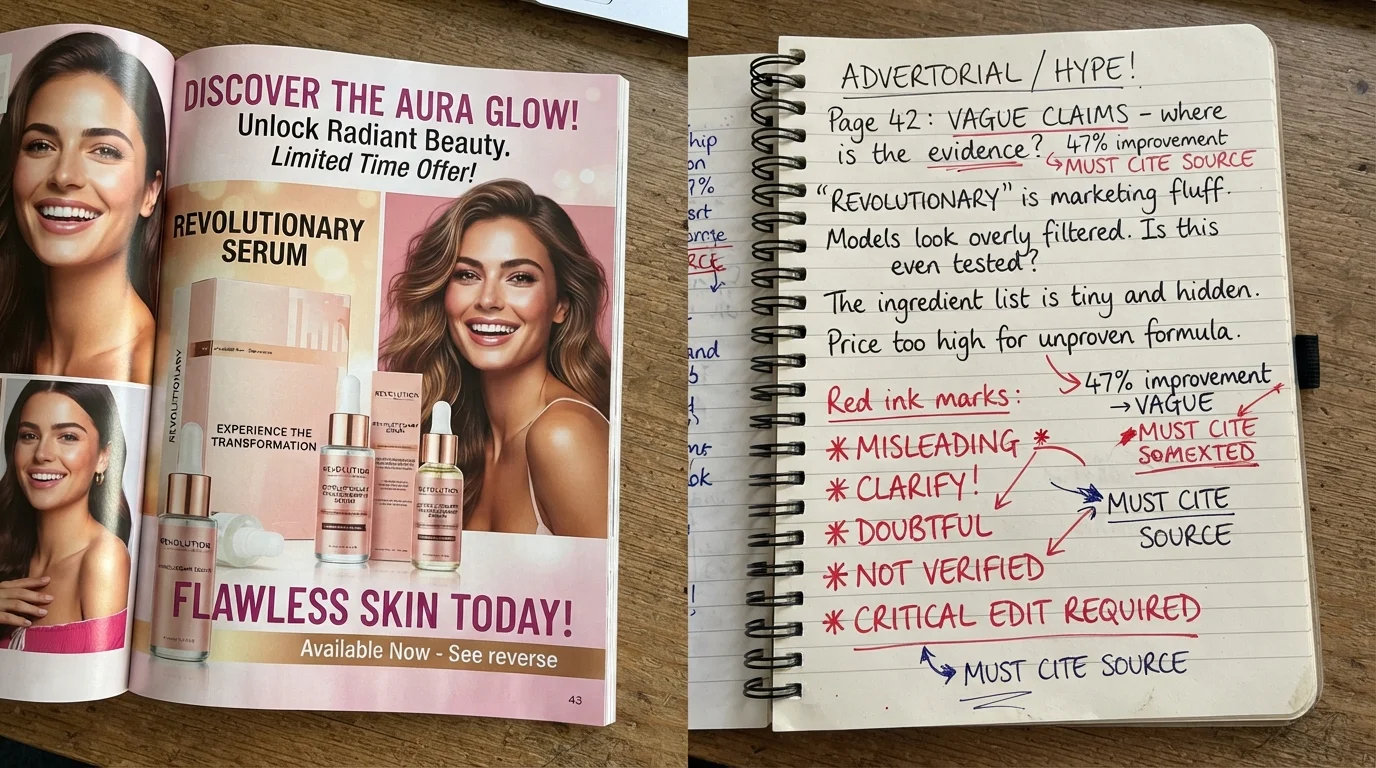
Key Takeaways
- Sponsored content involves a financial relationship between the publisher and the brand being featured.
- Independent reviews are editorially controlled, with no payment or product consideration influencing conclusions.
- FTC rules require clear disclosure when content is paid or incentivized, but enforcement is uneven.
- Vague praise, absent criticism, and prominent affiliate links are common signals of undisclosed bias.
- Cross-referencing multiple independent sources is the most reliable way to validate a product claim.
Option A
Sponsored Content
Paid placement dressed as editorial.
Best for: Understanding when a publication or creator has a financial relationship with the product being covered.
Option B
Independent Reviews
Editorially driven, conflict-free evaluation.
Best for: Readers seeking unbiased assessments from sources with no financial stake in the outcome.
If you want to understand a product's potential downsides
Independent Reviews
Independent reviewers have no financial incentive to omit flaws. Sponsored content is rarely permitted - by contract - to publish negative conclusions.
If you're researching a newly launched product with limited coverage
Independent Reviews
Sponsored launches generate lots of early buzz with little critical depth. Seek out independent voices who received no brand payment or free product.
If a piece of content helped you discover a product you didn't know existed
Sponsored Content
Sponsored content can be legitimately informative for product discovery - as long as it's disclosed and you treat it as marketing, not editorial judgment.
What Each One Actually Is
Sponsored content is any article, video, social post, or review where the publisher received payment, free product, or another form of compensation in exchange for coverage. That compensation may be direct (a flat fee), indirect (affiliate commissions tied to purchases), or in-kind (samples, trips, early access). The U.S. Federal Trade Commission (FTC) requires that this relationship be clearly disclosed - but the size, placement, and phrasing of that disclosure vary enormously in practice.
Independent reviews, by contrast, are produced without any financial arrangement with the brand or seller. The reviewer purchases the product at retail, receives no compensation for coverage, and retains full editorial control over conclusions - including the freedom to publish a negative verdict. This doesn't make them infallible, but it does remove a structural conflict of interest.
The practical problem: both formats can look almost identical on the page. Understanding the structural differences - not just the labels - is what actually protects you. For a deeper look at how credible editorial reviews are constructed, see the anatomy of a trustworthy product review.
Side-by-Side: How They Compare
The table below maps the key structural differences between sponsored content and independent reviews. No single signal is conclusive on its own - it's the pattern that matters.
| Criterion | Sponsored Content | Independent Reviews |
|---|---|---|
| Compensation involved | Yes - payment, product, or commission | No financial arrangement with brand |
| Editorial control | Brand may approve or restrict conclusions | Reviewer retains full editorial control |
| Disclosure requirement | Required by FTC; compliance varies | Not applicable - no relationship to disclose |
| Likelihood of criticism | Low - negative conclusions often excluded | High - flaws are part of the evaluation |
| Affiliate or purchase links | Frequently embedded throughout | Absent or clearly separated from editorial |
| Testing methodology disclosed | Rarely described | Typically explained and reproducible |
| Trust signal | Useful for discovery; treat as marketing | Higher credibility baseline when sourced well |
One important nuance: disclosure language is required by law but doesn't automatically make sponsored content worthless. A clearly labeled sponsored post from a credible outlet can still contain accurate product information. The issue arises when the financial relationship is hidden, or when readers mistake paid coverage for editorially independent judgment.
The Warning Signs Most Readers Miss
Disclosures aren't always obvious. Phrases like "in partnership with," "presented by," or "this post contains affiliate links" are all disclosure formats - but they're often buried in footers, rendered in small gray text, or placed after several paragraphs of glowing product copy. Some sponsored posts use no explicit disclosure at all, which is an FTC violation but does still occur.
~62%
Consumers who can't identify native ads
A Stanford History Education Group study found a majority of participants could not distinguish sponsored articles from independent news content.
~45%
Online reviews estimated as fake or incentivized
Independent market research and platform audits have consistently identified a substantial share of online reviews as incentivized, manipulated, or inauthentic.
Beyond disclosure language, watch for these behavioral signals:
- No criticism present. Genuine independent reviews almost always identify at least one limitation. Content that describes only positives is a credibility red flag.
- Generic, unverifiable claims. Phrases like "game-changer" or "loved by thousands" without sourcing suggest promotional copy, not testing.
- Prominent calls to purchase. Independent editorial doesn't typically include buy buttons or tracked referral links woven through the text.
- Identical language across multiple sites. Brand-distributed press content often appears nearly verbatim across several publications simultaneously.
For related signals in product listings themselves, see warning signs in product listings.
Affiliate Links Aren't Always a Problem
Many legitimate independent publications use affiliate links to fund journalism - meaning they earn a commission if a reader purchases through a link. This arrangement requires disclosure and doesn't automatically compromise editorial integrity. The key distinction is whether the affiliate relationship influences which products are reviewed or what conclusions are drawn. A publication with a transparent affiliate policy that still publishes negative reviews and rejects advertiser control can still qualify as independent editorial.
How to Verify What You're Actually Reading
A few practical verification habits significantly reduce your exposure to undisclosed bias:
- Search the publication's disclosure policy. Reputable editorial outlets publish clear policies separating advertising from editorial content. If none exists, treat coverage with extra skepticism.
- Look for methodology. Independent reviews typically explain how the product was obtained, how long it was tested, and what criteria were used. Sponsored content rarely does.
- Cross-reference with community sources. Forums, subreddits, and enthusiast groups often surface long-term ownership experiences that paid coverage never would. See finding reliable user communities for product feedback for guidance on evaluating those sources.
- Check the star rating context. High aggregate scores can be manufactured or inflated. Decoding star ratings critically is a skill worth developing alongside spotting sponsored content.
Before committing to any purchase based on a review - independent or sponsored - it also pays to understand the return terms. Reading the return policy before you buy is a practical safeguard when a product doesn't match the coverage that led you to it.
This article is for general informational purposes only. It does not constitute legal or regulatory advice. Disclosure requirements vary by platform and jurisdiction; consult the FTC's official guidance or a qualified professional for specific compliance questions.