

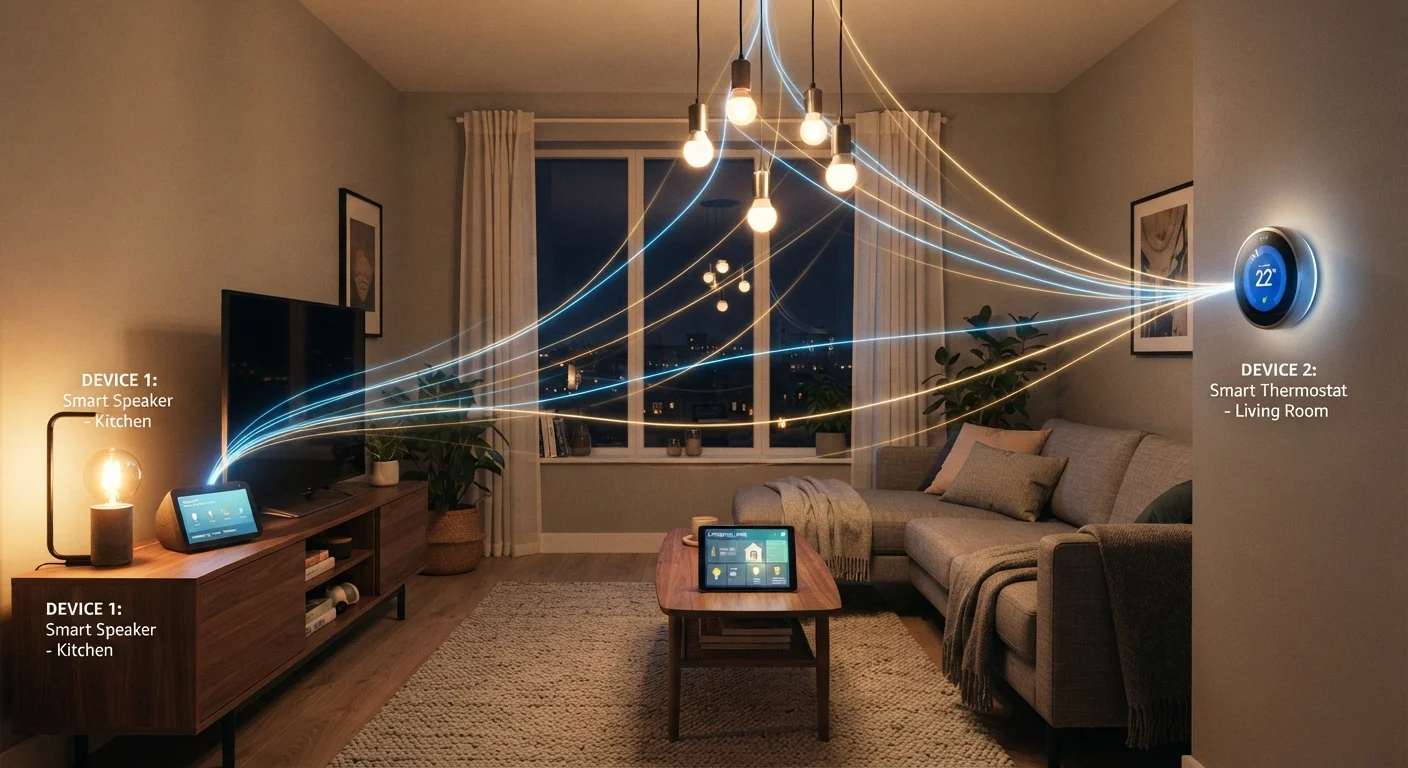
Key Takeaways
- Matter lets devices from different brands work together without switching apps or platforms.
- It runs on Wi-Fi and Thread, enabling local control even when the internet is down.
- Apple, Google, Amazon, and Samsung all participated in developing the standard.
- Matter adds a layer of security through on-device cryptographic verification.
- Not every existing smart home device will automatically gain Matter support.
Matter (Smart Home Standard)
Matter is a universal connectivity standard that allows smart home devices from different manufacturers to communicate with each other reliably, without requiring the same app or ecosystem. It was developed by the Connectivity Standards Alliance (CSA), a consortium that includes major technology companies. Think of it as a common language that smart light bulbs, locks, thermostats, and speakers can all speak - regardless of who made them.
Matter operates over IP-based networks (Wi-Fi and Thread), using cryptographic device attestation to verify authenticity and secure local communication without mandatory cloud dependence.
Why Smart Homes Needed a Common Language
For years, the smart home market resembled a tower of Babel. A thermostat that worked beautifully with one voice assistant might be completely invisible to another. Bulbs certified for one ecosystem required their own dedicated app. Locks, sensors, and cameras each lived in separate silos, and the average household managing three or four platforms quickly found the promise of a "smart" home more frustrating than freeing.
The fragmentation was not an accident - it was a business model. Each major platform had a financial incentive to keep users inside its own walled garden. The consequence for consumers was real: device choices were constrained by whichever ecosystem they had committed to first.
Matter was developed specifically to dismantle those silos. Backed by the Connectivity Standards Alliance and co-developed with input from Apple, Google, Amazon, and Samsung, it defines a shared set of rules for how smart home devices discover, authenticate, and communicate with one another at the application level.
200+
Companies in the Connectivity Standards Alliance
The CSA, which governs the Matter standard, includes over 200 member companies spanning device makers, platform providers, and silicon manufacturers.
Oct 2022
Matter version 1.0 release date
Matter's first official release came in October 2022, roughly a year later than originally projected when the project launched in 2019.
4
Major platforms with announced Matter support
Amazon Alexa, Apple Home, Google Home, and Samsung SmartThings all announced integration with the Matter standard.
What Matter Actually Does - and Doesn't Do
Matter is an application-layer standard. That means it governs how a smart lock tells your phone it's locked, how a sensor reports temperature, and how a hub authorises a new device - not the radio signals themselves. For wireless transport, Matter relies on existing protocols: Wi-Fi for bandwidth-hungry devices and Thread for low-power sensors and switches.
One frequently misunderstood aspect is local control. Earlier smart home systems often routed every command through a cloud server - meaning if the manufacturer's servers went offline, your light switch stopped working. Matter is explicitly designed so that devices on the same local network can talk directly without touching the internet. If your router is running, your automations generally keep running too.
What Matter does not do is magically upgrade every device you already own. Manufacturers must implement the standard in their firmware, and that decision rests with them. Some devices have received retroactive Matter support through software updates; many have not and will not.
Check for the Matter Logo Before You Buy
When shopping for smart home hardware, look specifically for the Matter certification mark on product packaging or in the product's technical specifications. This confirms the device has passed interoperability testing and is not locked to a single platform. Certification details can be cross-checked in the CSA's public product registry.
Why It Took So Long to Arrive
The standard was originally announced in 2019 under the name Project CHIP (Connected Home over IP) and was projected to launch in late 2021. It finally reached version 1.0 in October 2022 - a delay of roughly a year. The gap reflects a genuine engineering challenge: getting competing corporations to agree on technical specifications while each protects its own product roadmap is extraordinarily difficult.
Security added further complexity. Matter requires every certified device to carry a unique cryptographic certificate, verified during setup to confirm the product is genuine. Building that attestation infrastructure - including a global registry and certificate authority - took time to establish properly.
“The goal was to make it so that consumers don't have to think about which ecosystem a device belongs to - they just buy it, and it works.”
— Connectivity Standards Alliance spokesperson, Representative, Connectivity Standards Alliance (CSA)
The result is a standard that, while slower to arrive than anticipated, was built with considerably more rigour than most of what preceded it. For consumers setting up smart speakers and hubs for the first time, that security foundation matters in a practical sense too.
What This Means for Your Home Setup
If you are evaluating smart home devices now, looking for the Matter logo on packaging is one of the most reliable signals of long-term platform flexibility. A Matter-certified device is not locked to a single app - you can control it through whichever assistant or hub fits your household, and switch later without replacing the hardware.
For those with existing devices, the practical advice is more nuanced. Check your manufacturer's support page to see whether your specific model has received or is scheduled for a Matter firmware update. Do not assume compatibility based on brand alone.
Smart thermostats illustrate the stakes clearly. Smart thermostats that use occupancy sensing and learning algorithms represent a meaningful investment; ensuring they work within a flexible, open ecosystem protects that investment over time.
Privacy-conscious consumers should also note that local-first communication - a core Matter principle - reduces the volume of data routed through third-party servers. That said, platform-level data practices still apply, and it is worth reviewing what each app collects. For a grounded look at what smart home privacy risks are real versus overstated, see our piece on common myths about smart home privacy.