

| Typical phone RAM range | 4 GB - 16 GB |
| Common storage capacities | 64 GB, 128 GB, 256 GB, 512 GB |
| Standard display refresh rates | 60 Hz, 90 Hz, 120 Hz |
| Typical battery range (smartphones) | 3,000 - 5,000+ mAh |
| SoC process nodes (current generation) | 3 nm - 6 nm |
Why Phone Specs Read Like a Foreign Language
Pick up any phone's spec sheet and you'll find a cascade of abbreviations, gigabytes, gigahertz, and nanometers - numbers that sound important but rarely come with plain-English context. The problem isn't complexity; most of these concepts are straightforward once translated. This glossary covers the core specs you'll encounter most often: what they measure, why they exist, and how they actually affect your day-to-day experience.
For a broader primer on navigating product spec sheets across categories, see reading spec sheets without getting lost. And if camera specs are your particular puzzle, reading a phone's camera spec sheet covers aperture, sensor size, and zoom in depth.
RAM
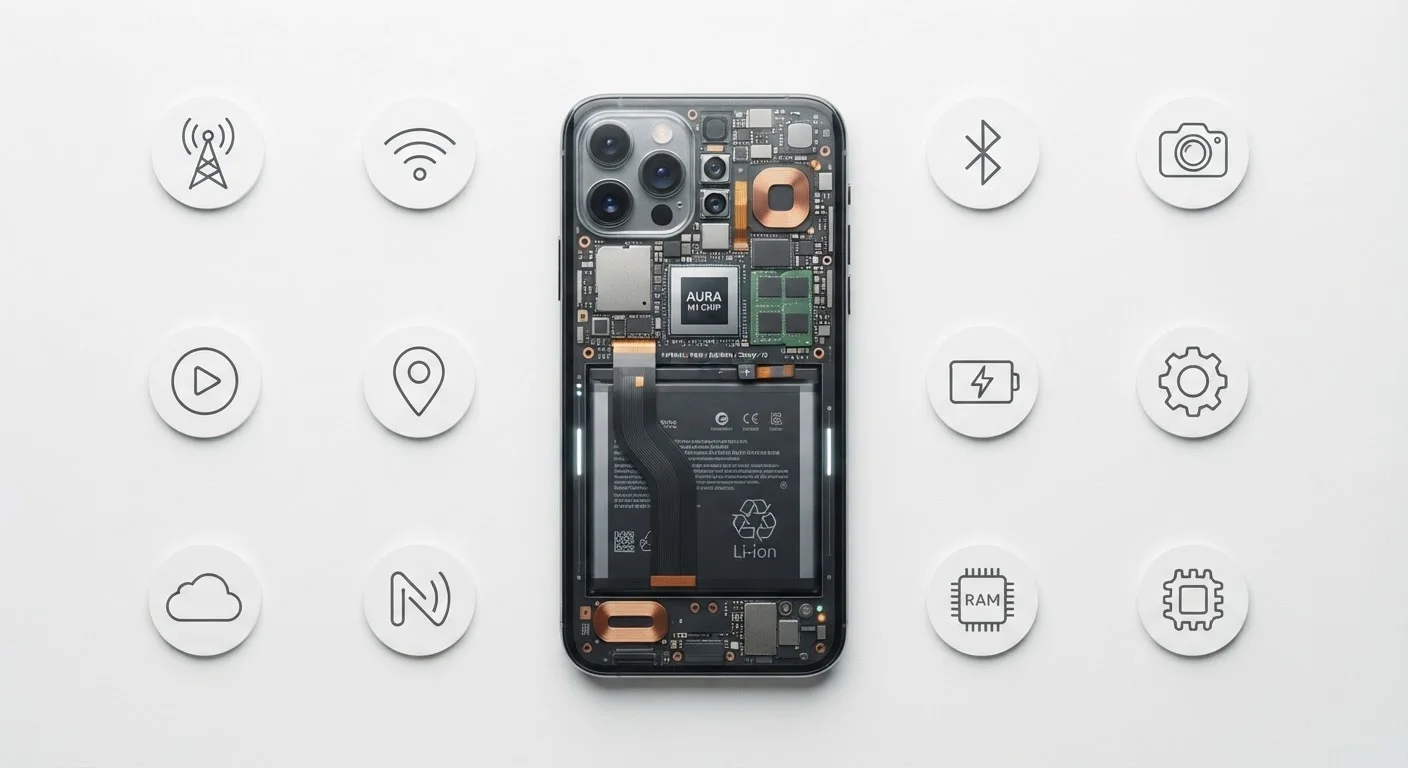
Random Access Memory - the phone's short-term workspace that holds active apps and data. More RAM allows more apps to stay loaded simultaneously without needing to reload.
Internal Storage
The permanent memory that holds your photos, apps, and files. Unlike RAM, it retains data after the phone is powered off. Speed varies by storage type (UFS vs. eMMC).
SoC (System on a Chip)
A single integrated circuit that combines the processor, graphics unit, modem, and other components. It acts as the phone's central brain and largely determines performance and efficiency.
Clock Speed (GHz)
Measured in gigahertz, clock speed describes how many processing cycles a chip can execute per second. Higher isn't always faster in practice - chip architecture and efficiency matter equally.
Refresh Rate (Hz)
How many times per second the screen redraws its image. Higher rates (90 Hz, 120 Hz) produce smoother scrolling and animations compared to the standard 60 Hz.
mAh (Milliamp-Hours)
The unit used to express battery capacity. A higher mAh rating generally indicates a larger energy reserve, though real-world battery life also depends on software and screen efficiency.
UFS (Universal Flash Storage)
A fast internal storage standard commonly found in mid-range and high-end phones. UFS enables quicker app launches and faster file transfers compared to older eMMC storage.
5G
The fifth generation of mobile network technology. It offers faster data speeds and lower latency than 4G LTE, but performance depends on carrier coverage and the specific 5G band in use.
Process Node (nm)
Measured in nanometers, this figure describes the size of transistors on a chip. Smaller nodes generally mean greater energy efficiency and more transistors per chip, not necessarily raw speed.
Wi-Fi 6 (802.11ax)
A wireless networking standard offering improved speed, capacity, and efficiency compared to Wi-Fi 5. Benefits are most noticeable in environments with many connected devices.
RAM, Storage, and Processors Explained
These three specs account for the majority of confusion - and the majority of marketing noise. Here's what each one actually controls.
| Typical phone RAM range | 4 GB - 16 GB |
| Common storage capacities | 64 GB, 128 GB, 256 GB, 512 GB |
| Standard display refresh rates | 60 Hz, 90 Hz, 120 Hz |
| Typical battery range (smartphones) | 3,000 - 5,000+ mAh |
| SoC process nodes (current generation) | 3 nm - 6 nm |
RAM (Random Access Memory)
RAM is your phone's short-term workspace. When you open an app, the phone loads it into RAM so it can respond instantly. More RAM means more apps can stay loaded simultaneously - so switching between your browser, email, and navigation doesn't force each app to reload from scratch. Common phone RAM ranges run from 4 GB on entry-level devices to 12 GB or more on high-end models. For most everyday tasks - calls, social media, streaming - 6 GB to 8 GB is a comfortable baseline.
Internal Storage (ROM or eMMC/UFS)
Storage is your phone's long-term filing cabinet: photos, apps, downloaded music, and the operating system all live here. Unlike RAM, storage doesn't clear when you restart. You'll see capacities listed in GB (gigabytes) or TB (terabytes). The type of storage also matters: UFS (Universal Flash Storage) is significantly faster than older eMMC formats, which affects how quickly apps launch and files save.
The Processor (SoC)
The processor - often called a chip or SoC (System on a Chip) - is the brain coordinating everything else. It handles calculations, graphics, AI tasks, and cellular connectivity. Two figures you'll often see are core count (how many processing units the chip has) and clock speed (measured in GHz, how fast those units operate). But neither number tells the full story alone. Chip architecture shapes real-world performance in ways that core counts and GHz don't capture - efficiency, heat management, and AI processing all factor in. Also worth noting: the manufacturing process node (e.g., 4nm, 3nm) influences how efficient the chip is, not just how fast.
Several persistent myths grow out of these specs. Common smartphone myths - like the idea that more cores always means a faster phone - are worth understanding before you shop.
Other Specs You'll Encounter
Beyond the big three, a few other terms appear regularly enough to warrant plain-language definitions.
Specs Don't Tell the Whole Story
Two phones with identical RAM and processor specs can feel very different to use, because software optimization plays a major role. The operating system, how efficiently apps are coded, and how well the manufacturer tunes hardware-software integration all shape real-world performance. Always consider user experience reports alongside raw numbers.
Refresh Rate (Hz)
Measured in hertz, refresh rate describes how many times per second the screen updates its image. A 60 Hz display redraws 60 times per second; a 120 Hz display does so twice as fast. Higher refresh rates make scrolling and animations feel noticeably smoother, though they can also draw more battery power.
Battery Capacity (mAh)
Milliamp-hours (mAh) measure how much energy a battery holds. A higher mAh number generally means longer battery life - but software efficiency and screen brightness matter just as much. A well-optimized phone with a smaller battery can outlast a poorly optimized one with a larger pack.
Connectivity Standards (5G, Wi-Fi 6, Bluetooth)
These specs describe the wireless technologies your phone supports. 5G refers to the fifth generation of cellular networks. Wi-Fi 6 (802.11ax) is a faster, more efficient wireless standard. Bluetooth version numbers (5.0, 5.3, etc.) affect range and audio quality with wireless accessories. In each case, you need compatible infrastructure - a 5G phone on a 4G-only plan won't deliver 5G speeds.
For a deeper look at how processor choices compare across laptops and desktops as well, the RAM and storage explainer for computers applies many of the same principles to a different form factor.