

Key Takeaways
- Most vehicle break-ins are triggered by visible items, not forced entry of a locked, empty-looking car.
- Parking location, time of day, and visibility of contents are the three biggest risk variables.
- Standard auto insurance typically does not cover stolen personal property inside the vehicle.
- A habit of clearing the car before parking is more effective than any single anti-theft device.
- Even low-value items like change or a charging cable can attract a smash-and-grab attempt.
Opportunistic Vehicle Break-In
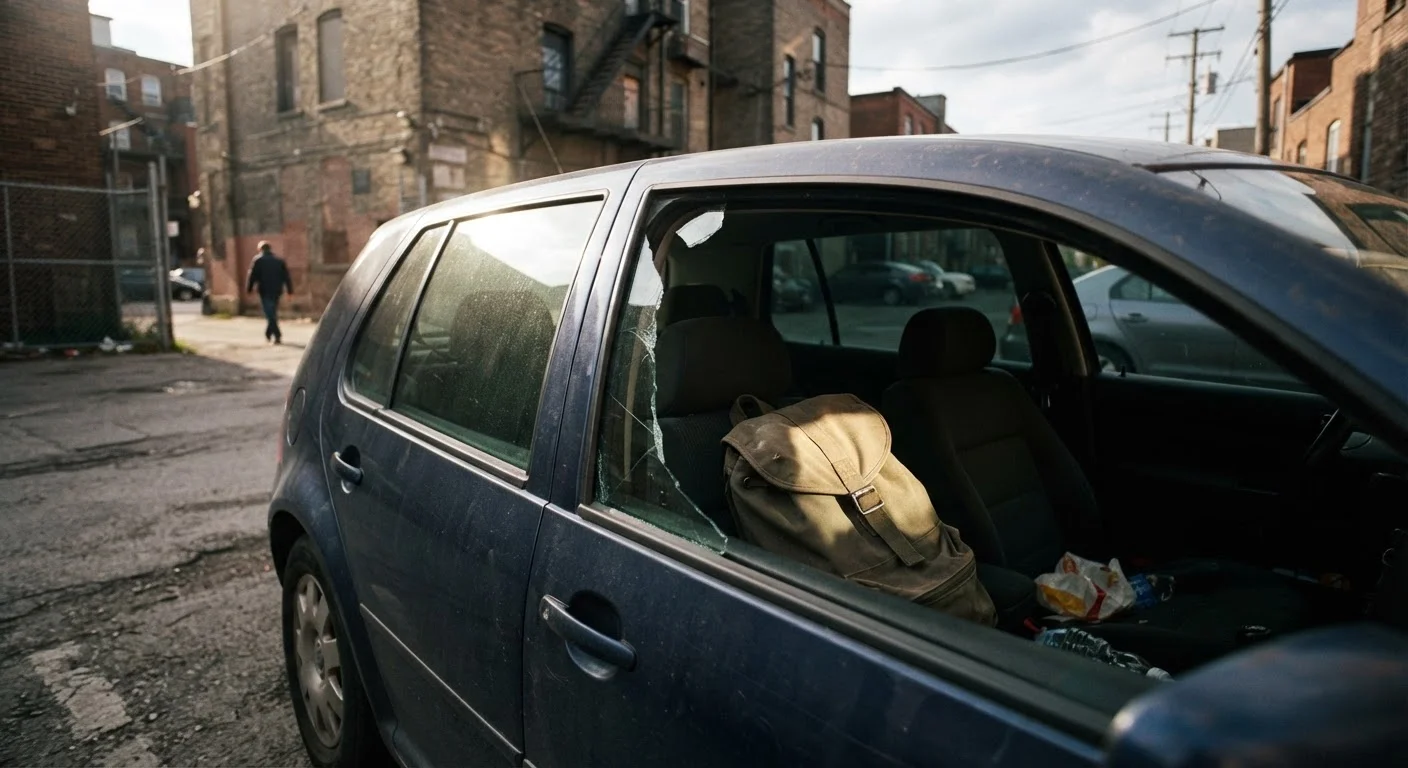
An opportunistic vehicle break-in occurs when a thief targets a car not because it was pre-planned, but because something visible inside made it worth the risk. Most auto break-ins fall into this category - a bag on a seat, a phone on a dash, or a laptop sleeve poking out from under a coat is enough to prompt a smashed window. Unlike targeted vehicle theft, the goal is usually a quick grab of whatever is accessible.
Law enforcement and insurance data consistently classify the majority of vehicle burglaries as crimes of opportunity rather than premeditated offenses, which means prevention is largely behavioral rather than technological.
Why Most Break-Ins Are Not Random
When a car window gets smashed and something goes missing, the event feels random and violating. In practice, the overwhelming majority of vehicle break-ins follow a predictable logic: a thief walked past, spotted something worth taking, and made a quick calculation about risk versus reward.
That pattern matters because it means the trigger is almost always visible. A laptop bag on a back seat, a phone charging on the console, a jacket folded over what might be hiding something - each of these signals potential value. The car itself is rarely the target. The contents are.
Understanding this shifts the protective strategy away from elaborate gadgets and toward one core habit: don't leave anything visible in a parked car. That sounds obvious, but research on vehicle crime consistently shows that a large proportion of victims report leaving items in plain sight. Habit erosion is the real risk factor.
Visible Items Are the Primary Trigger
Studies on vehicle burglary patterns consistently point to visibility as the leading factor in target selection. A car that appears completely empty is passed over far more often than one with any visible item, regardless of that item's actual value. This is why clearing the cabin matters even when you think what's inside isn't worth stealing.
The Variables That Raise or Lower Your Risk
Three factors interact to determine how likely a parked car is to be targeted: location, visibility of contents, and time of day.
Location
High-traffic areas - shopping centers, tourist spots, trailheads, and transit park-and-ride lots - see disproportionate rates of vehicle burglary. Thieves work areas where they can blend in, move quickly, and count on distracted owners. Poorly lit or unmanned parking garages also carry elevated risk. Well-monitored, covered structures with active attendants or cameras tend to present a harder target.
Visibility
Visibility is the most controllable factor. Items stashed under a seat or covered with a blanket reduce temptation but are not foolproof - a visible bulge under fabric can itself attract attention. The most reliable approach is to move valuables to the trunk before you arrive at your destination. Loading the trunk in front of a parked vehicle gives any nearby observer exactly the information they need.
Time of Day
Late-night and early-morning hours carry higher risk in residential areas. Busy daytime hours in commercial zones carry their own risk because foot traffic gives cover. There is no universally safe window - which again points toward behavioral habits rather than timing strategies as the primary defense.
~1 million
Vehicle burglaries reported annually in the U.S.
The FBI's Uniform Crime Reporting program has historically recorded approximately one million vehicle burglaries per year in the United States.
Under 30 sec
Time needed for a smash-and-grab theft
Law enforcement agencies frequently note that opportunistic vehicle break-ins - smashing a window and grabbing visible items - can be completed in under 30 seconds.
~60%
Break-ins involving no forced entry
Many vehicle burglaries involve unlocked doors rather than broken windows, according to law enforcement reporting - underscoring how often basic precautions are skipped.
The Insurance Reality Drivers Often Miss
A cracked window and a missing laptop create two separate financial problems: repairing the window and replacing the stolen property. Auto insurance typically handles the window repair (minus your comprehensive deductible), but personal property stolen from the vehicle is almost always excluded from auto coverage.
Renters or homeowners insurance may cover stolen personal belongings, but only after you meet the deductible - which can easily exceed the value of what was taken. High-value electronics, cameras, or jewelry may also be subject to sub-limits within a standard policy. It's worth reading your policy's personal property provisions carefully rather than assuming coverage exists.
For a broader look at where standard policies fall short, the article on insurance coverage gaps walks through some of the most common blind spots drivers and renters encounter.
Load the Trunk Before You Arrive
If you're running multiple errands, place purchases in the trunk before driving to your next stop - not after you park. This prevents anyone nearby from watching you load valuables and knowing exactly where to look. It's one of the simplest and most effective habits you can build.
Building Habits That Actually Work
No single device or system replaces consistent behavior. Window tinting, steering wheel clubs, and alarm systems all add friction, but the most durable protection is a parking routine you follow every time.
- Clear the cabin before you park - not as you get out, but before you leave home or your last stop if possible.
- Treat the glove box as visible storage - a thief who breaks in will open it immediately. Don't store valuables there.
- Bring your charging cables and adapters with you - they're small enough to grab in seconds and common enough to sell easily.
- Keep the car looking empty - even crumpled fast food bags and scattered items can signal that the owner is careless, which is its own signal.
If you're thinking through everything your car carries on a regular basis, the car organization guide offers a practical system for structuring your vehicle's storage so you know exactly what's inside and where.
It's also worth distinguishing between items you carry for convenience - and those you carry for safety. Items like a first aid kit, jumper cables, or a window breaker serve a different purpose than a laptop or a bag of gym gear. See what to keep in your trunk year-round for a breakdown of true road-safety essentials that are worth keeping regardless.
This article is for general informational purposes only. Insurance coverage, policy terms, and local crime statistics vary significantly. Consult a licensed insurance professional for advice specific to your situation.