

Key Takeaways
- Most overlooked car essentials cost very little but prove invaluable during roadside emergencies.
- A window breaker and seatbelt cutter can be the difference between escape and entrapment after a crash.
- Reflective triangles and a hand-crank flashlight improve visibility and safety during breakdowns.
- A simple notepad and pen remain useful when phones are dead or screens are unreadable.
- Knowing what to carry is only half the job - items must be accessible, not buried under cargo.
The Things Nobody Thinks to Pack
Most drivers know they should have jumper cables and a spare tire. Those basics are well-documented - see our trunk preparedness guide for a full rundown. But there's a second tier of items that rarely make anyone's mental checklist. They're inexpensive, take up almost no space, and become urgent at the exact moment you wish you'd thought of them months earlier.
The list below covers the items drivers most commonly overlook - not the obvious ones, but the small, specific things that fill the gaps left by a standard emergency kit. For a plain-language breakdown of what standard kit components actually do, this component-by-component guide is worth a read before you go shopping.
A window breaker and seatbelt cutter combo
This is arguably the most serious item on this list. In a crash that submerges a vehicle or jams a door, the ability to cut a seatbelt and shatter a side window can determine whether occupants escape. These combination tools are compact enough to clip to a sun visor or store in a door pocket. The key is placement: it needs to be reachable from a seated, seatbelted position. A tool stored in the glovebox may be unreachable when it matters most.
A window breaker stored in the glovebox may be unreachable when you need it most.
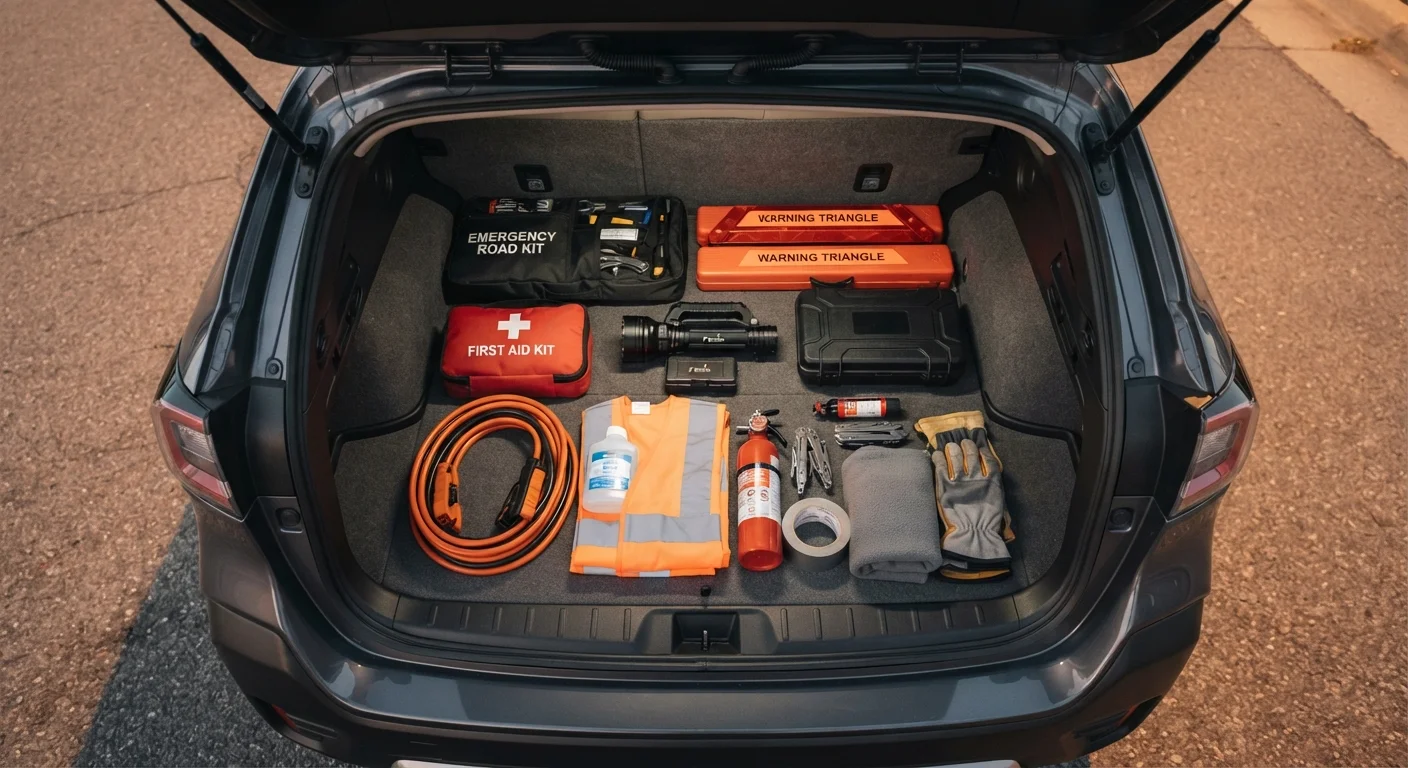
Reflective warning triangles
Road flares are familiar, but they're consumable, can be a fire hazard, and aren't legal everywhere. Reflective triangles are reusable, pack flat, and are accepted across all U.S. states. Placed behind a stopped vehicle, they give oncoming traffic meaningful advance warning - particularly important at night or in low-visibility conditions. Most drivers assume hazard lights are sufficient. They're not, especially on highways where traffic moves at speed. The Federal Motor Carrier Safety Administration requires commercial vehicles to carry them for good reason.
Hazard lights alone are not sufficient warning on high-speed roads - triangles extend that buffer significantly.
A hand-crank or battery-free flashlight
A phone's flashlight works until the battery dies - often the worst possible moment. A hand-crank flashlight requires no batteries and provides sustained light for changing a tire, reading a road sign, or signaling for help. Some models also include an emergency siren or a USB output for phone charging. These don't need to be large or expensive; the point is reliability independent of battery state.
A phone flashlight fails exactly when you can least afford it - a hand-crank unit removes that risk.
A notepad and a working pen
After a collision, you'll need to exchange insurance and registration information with another driver. Phones can be cracked, waterlogged, or dead. A small notepad and a reliable pen take up almost no space and eliminate reliance on technology at a stressful moment. This also helps when you spot a maintenance issue during a roadside stop that you want to describe accurately to a mechanic later.
After a collision, a cracked phone screen can make exchanging information far harder than it needs to be.
A copy of your insurance and registration (physical)
Most states require drivers to produce proof of insurance during a traffic stop or after an accident. Digital copies stored on a phone are accepted in many jurisdictions but not all - and again, a dead or damaged phone removes that option entirely. A physical copy of your current insurance card and vehicle registration, stored in the glovebox, is a simple backstop. Update it when you renew. It costs nothing and removes one variable in an already stressful situation.
A dead phone can leave you unable to prove insurance - a printed card costs nothing and solves that entirely.
A basic tire pressure gauge
Under-inflated tires increase fuel consumption, reduce handling, and accelerate wear - none of which are visible to the naked eye. Many modern vehicles have a tire pressure monitoring system (TPMS), but these typically only alert drivers when pressure is significantly low, not marginally off. A simple manual gauge lets you check pressure against the manufacturer's recommended level (found on the door jamb sticker, not the sidewall). Monthly checks take about two minutes and catch slow leaks before they become roadside emergencies.
TPMS alerts arrive late - a manual gauge catches gradual pressure loss before it becomes a problem.
Making It All Actually Useful
Carrying these items only helps if they're reachable. A window breaker buried under a folded stroller is useless in a submerged car. A notepad wedged behind the rear seat doesn't help when you're standing in the rain after a fender-bender. Aim to keep the highest-urgency items - the breaker, the cutter, the flashlight - somewhere within arm's reach of the driver's seat.
Do a quick accessibility audit
Once a month, sit in the driver's seat and physically locate each of these items without getting out. If you have to unbuckle, climb into the back, or move cargo to reach something, reposition it. The goal isn't a tidy trunk - it's fast access when conditions are chaotic.
It's also worth reviewing whether your auto insurance covers scenarios that might make these items relevant - towing, roadside assistance, and certain accident scenarios vary widely by policy. Coverage gaps are more common than most drivers realize; this overview of standard policy gaps outlines where drivers are often caught off-guard.
None of these items require significant investment or planning. The friction is simply remembering to think about them before something goes wrong - and now you have.