

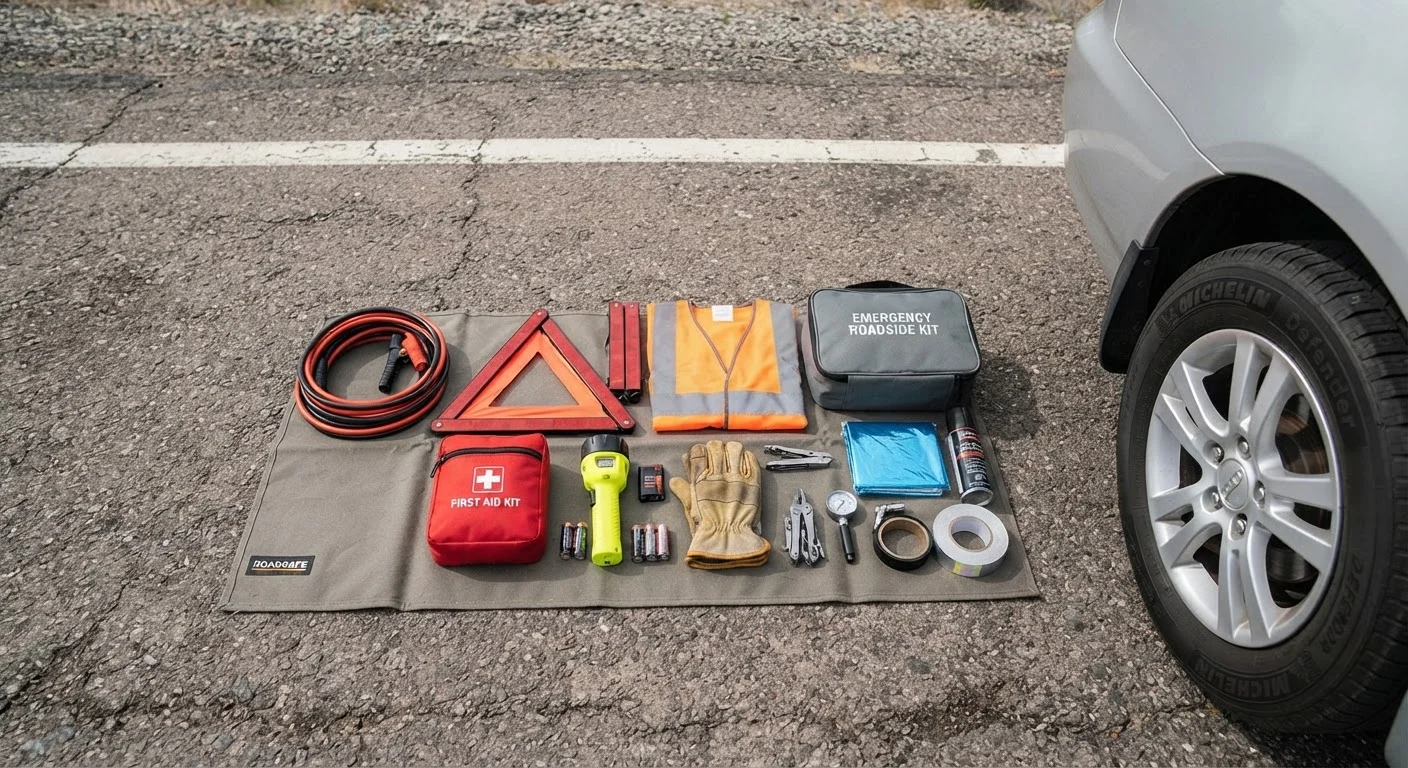
Key Takeaways
- Every item in a roadside kit serves a specific, practical purpose - not just peace of mind.
- Jumper cables or a jump starter address one of the most common breakdown causes: a dead battery.
- Reflective triangles and a flashlight keep you visible to passing traffic, which is a critical safety factor.
- A basic first aid kit handles minor injuries on the spot while waiting for emergency services.
- Seasonal conditions should influence which items you prioritize in your kit.
- Knowing how to use each item matters as much as having it.
Roadside Emergency Kit
A roadside emergency kit is a collection of tools, supplies, and safety items kept in your vehicle to help you manage breakdowns, accidents, or unexpected situations on the road. The goal is to keep you safe and visible until help arrives or you can resolve the issue yourself. A well-stocked kit addresses the most common roadside scenarios: dead batteries, flat tires, minor injuries, and low visibility.
Kits should be tailored to your region and season - items that matter in a northern winter differ from those needed in a desert summer climate.
Why Understanding Each Item Matters
Most drivers own a roadside kit - far fewer know what each piece actually does or when to use it. A kit you don't understand is only marginally better than no kit at all. This breakdown explains the function behind every common component so you can use what you have with confidence.
For a broader view of what belongs in your trunk beyond emergency scenarios, see what every driver should keep in the trunk year-round. This article focuses specifically on emergency kit components and their purpose.
A Kit Is Only as Good as Your Knowledge
Owning the right tools provides no benefit if you're unfamiliar with how to use them. Take 15 minutes to read through the instructions for your jump starter and practice setting up reflective triangles in a safe location. Muscle memory under stress is built beforehand, not in the moment.
Visibility and Warning Devices
Reflective triangles or road flares are placed behind your stopped vehicle to warn approaching drivers well before they reach you. Triangles are reusable and require no flame; flares burn brightly but must be handled carefully and replaced after use. Place them at 100-300 feet behind your vehicle, increasing distance on highways.
A high-visibility reflective vest makes you visible when you step outside the vehicle at night or in low-light conditions. This is especially important when changing a tire on the shoulder of a busy road.
A flashlight or headlamp serves double duty: illuminating your work in the dark and signaling your position to others. A headlamp keeps both hands free - useful when checking under the hood or changing a tire. Keep spare batteries or choose a rechargeable model.
~1 in 3
Drivers who've experienced a roadside breakdown
Industry surveys consistently find a significant share of drivers encounter at least one breakdown or roadside emergency annually, with battery failure and flat tires among the leading causes.
4-6 min
Average time for traffic to reach a stopped vehicle
Highway safety research highlights that vehicles stopped on or near travel lanes face rapid approach from traffic, underscoring why immediate deployment of warning devices is critical.
Battery and Starting Supplies
Jumper cables transfer power from a working vehicle's battery to a dead one. Look for cables that are at least 12-16 feet long with thick gauge wire (lower gauge number = thicker wire = better power transfer). Knowing the correct clamp sequence - red positive to dead battery first, then to donor; black negative to donor, then to an unpainted metal surface on the dead vehicle - prevents sparks near the battery.
A portable jump starter pack removes the need for a second vehicle. These compact lithium battery units can jump-start most passenger vehicles and are worth understanding even if you have cables. Charge the pack every few months so it's ready when you need it.
For context on how routine car maintenance reduces the likelihood of battery failure, refer to our maintenance hub.
Tire and Fluid Essentials
A spare tire, jack, and lug wrench form the core of flat tire response. Many vehicles ship with a compact spare (often called a "donut") rated for limited speed and distance - know your vehicle's specific limits before relying on one. The jack lifts the vehicle safely; the lug wrench removes the fastening bolts. Practice the sequence in a driveway before you need it on the roadside.
A can of tire inflator sealant offers a temporary fix for minor punctures when a full tire change isn't feasible. It pumps sealant and air into the tire simultaneously. Note that it is a stopgap - the tire will still need professional inspection and likely replacement.
Gloves protect your hands when handling greasy components, hot metal, or road debris. Heavy rubber or mechanic's gloves are more practical than latex for vehicle work.
Check Tire Equipment Before You Need It
Many drivers discover their spare is flat or their jack is missing only when they have a flat on the road. Every few months, pull out your spare and check the air pressure - many compact spares require 60 PSI, significantly higher than a standard tire. Confirm your jack and lug wrench are present and accessible.
First Aid Supplies
A roadside first aid kit should cover minor injuries sustained during a breakdown or collision - cuts from debris, scrapes from pavement, or burns from hot surfaces. Core supplies include adhesive bandages in multiple sizes, sterile gauze pads, medical tape, antiseptic wipes, nitrile gloves, and a CPR face shield.
The kit is not a substitute for emergency medical care. For serious injuries, call 911 immediately and use the kit only for stabilization while waiting. If you travel with pets, note that pet first aid is a separate consideration - pet first aid preparedness covers supplies specific to animals.
Tools and Overlooked Extras
A multi-tool or basic toolkit (screwdrivers, pliers, zip ties) handles minor mechanical issues that might otherwise leave you stranded - a loose clamp, a disconnected wire, a broken fastener.
A window breaker and seatbelt cutter are two of the most commonly skipped items, yet they serve a specific role if you're trapped in a vehicle. These compact tools are often combined in a single unit and clip to a sun visor or door pocket. Several items in this category are explored in depth in our article on items drivers overlook until they need them.
Water and a non-perishable snack address the basic human needs if you're waiting an extended time in heat or cold. A mylar emergency blanket retains body heat and weighs almost nothing.
Before any long drive, reviewing a pre-departure vehicle check can reduce the chances you'll need your kit at all.