

Key Takeaways
- Reference prices are only meaningful when they reflect a price the item was genuinely sold at for a reasonable period.
- Retailers have been found to inflate 'original' prices specifically to make discounts appear larger than they are.
- The FTC and several state attorneys general have taken action against deceptive reference pricing practices.
- Comparing the sale price to real-world market data is more reliable than trusting a crossed-out number.
- A large percentage discount does not automatically mean a product offers good value.
Option A
Sale Price
The discounted figure retailers put front and center.
Best for: Shoppers who want to know what they'll actually pay at the register today.
Option B
Original (Reference) Price
The anchor figure used to frame a deal as a deal.
Best for: Understanding context - but only when that context is accurate and verifiable.
If you want to know what you're actually paying
Sale Price
The sale price is the real transaction number. Focus here first, then validate whether it's genuinely competitive using external price history tools or market comparisons.
If you want to assess whether a deal is real
Original (Reference) Price
A legitimate reference price - one that reflects actual prior selling history - gives useful context. Always verify it independently before treating it as proof of savings.
If you're comparing value across similar products
Sale Price
Side-by-side price comparisons across retailers are more grounding than any single store's own reference figure, which you cannot independently audit.
What Is Reference Pricing - and Why Does It Matter?
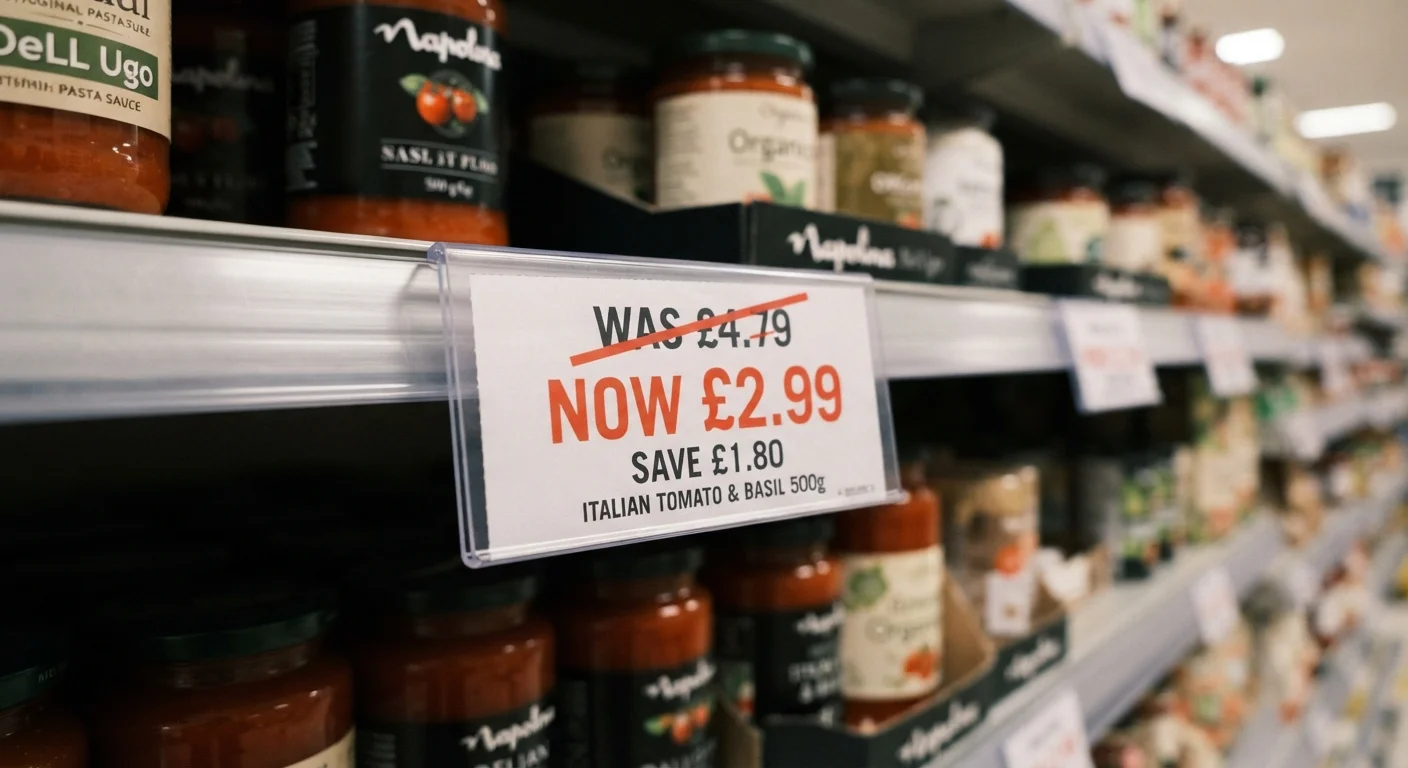
Walk through any retail environment - physical or digital - and you'll encounter the same visual pattern: a higher number crossed out, a lower number displayed prominently beneath it. That higher number is the reference price (also called a comparative price or original price). The lower number is the sale price. The gap between them is meant to communicate savings.
The problem is that reference prices aren't always grounded in reality. A retailer can set an artificially high "original" price, leave an item at that price briefly or never sell it there at all, and then display a "sale" price that was, in effect, the intended selling price all along. The result: a discount that looks compelling but reflects no genuine reduction in value.
This matters because reference pricing exploits a well-documented psychological mechanism - anchoring - where the first number we see shapes how we perceive every number that follows. Understanding how this works is foundational to recognizing the pricing tactics that influence perceived value across retail environments.
| Criterion | Sale Price | Original (Reference) Price |
|---|---|---|
| What it represents | Price charged at point of sale | Historical or comparative anchor price |
| Reliability | Always the actual transaction price | Varies - may or may not reflect real prior pricing |
| Regulatory scrutiny | Low - it's the real price | High - FTC and state AGs monitor misuse |
| Consumer utility | Essential - what you'll pay | Useful only when independently verified |
| Risk of manipulation | Low | High - easily inflated by retailers |
| How to verify | Compare across other retailers | Use price history tools or third-party data |
The Legal Line Between Legitimate and Deceptive
Reference pricing isn't inherently deceptive. When a retailer genuinely sold a product at a higher price for a substantial period, displaying that price as a benchmark gives shoppers useful context. The U.S. Federal Trade Commission (FTC) has published guidance on this: a former price is considered a legitimate reference only if the item was openly offered at that price for a reasonably substantial period in the recent past.
Where it crosses into deception is when the reference price was never a real selling price - it was set artificially high to manufacture the appearance of a discount. Several state attorneys general have pursued enforcement actions against retailers for exactly this practice, particularly in categories like bedding, luggage, and apparel where "perpetual sale" pricing has been documented.
FTC Guidance on Comparative Price Advertising
The FTC's Guides Against Deceptive Pricing state that a crossed-out 'former price' should represent the price at which the article was openly and actively offered for sale for a reasonably substantial period of time. A token offering at an inflated price - or no offering at all - does not qualify. Shoppers can reference these guides publicly on the FTC's website for more detail on what constitutes a legitimate comparative price claim.
The practical implication: a "50% off" tag only has meaning if the original price was a real price. Absent that, it's a number chosen to make the sale price look attractive - not evidence of savings.
How to Evaluate a Sale Price on Its Own Merits
Rather than trusting the reference price a retailer provides, treat the sale price as a standalone figure and test it against real-world benchmarks:
- Price history tools: Browser extensions and third-party websites track historical pricing on major platforms, showing whether a "sale" price is actually lower than what was charged in prior months.
- Cross-retailer comparison: Search the same item across multiple sellers. If the "sale" price at one retailer matches the standard price everywhere else, the reference price may be fabricated.
- Cost-per-use thinking: A sale price that still leaves you overpaying for something you'll rarely use isn't a deal. Price-per-use analysis reframes what affordable actually means across the product's lifespan.
- Seasonal context: Some categories genuinely do drop in price at predictable times. Understanding when seasonal pricing cycles work in your favor adds another layer of validation.
It's also worth remembering that a large discount percentage doesn't automatically signal quality. Research on price and quality consistently shows that inflated original prices can make mediocre products appear premium. The number being crossed out tells you nothing reliable about the product itself.
~87%
Products bought on "sale" at major retailers
A multi-year analysis of pricing data by the Wall Street Journal found that the vast majority of items at several major U.S. retailers were sold at promotional prices rather than the listed 'original' price.
$50M+
Settlement value in reference pricing cases
Several large U.S. retailers have settled class-action lawsuits related to deceptive reference pricing practices, with combined settlements exceeding tens of millions of dollars in recent years.