

Key Takeaways
- Research consistently shows that price and measurable quality correlate weakly across many product categories.
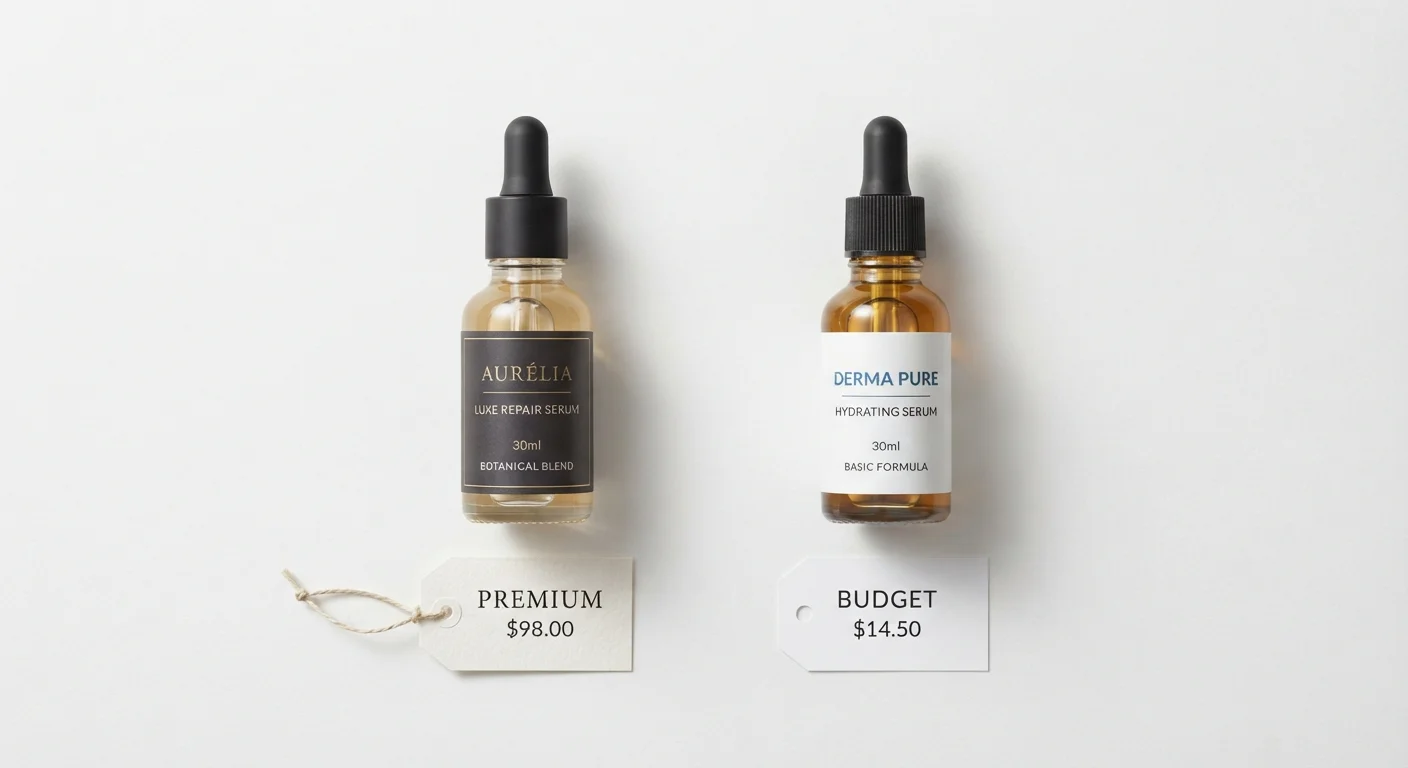
- Premium pricing often reflects brand positioning, packaging, and marketing spend - not product performance.
- Blind tests and independent lab data routinely find lower-priced products matching or exceeding expensive alternatives.
- Certain categories, such as professional tools or medical devices, do show stronger price-quality links.
- Using third-party testing data is a more reliable quality signal than price alone.
Why We Assume Price Equals Quality
The belief that a higher price signals a better product is one of the most deeply embedded assumptions in consumer culture. It's intuitive - surely companies wouldn't charge more for something that performs the same as a cheaper option? And in some cases, that logic holds. But in many others, it does not.
Psychologists call this the price-quality heuristic: a mental shortcut where cost is used as a stand-in for quality when other information is limited or overwhelming. Retailers and marketers understand this well. Pricing a product higher can, counterintuitively, increase perceived value - even when the underlying product is unchanged.
The practical consequence is that shoppers routinely overpay, not because they're careless, but because they're using a signal that the market has learned to game. Understanding where this assumption holds and where it breaks down is essential to shopping smarter. For a related look at how retailers manipulate perceived value through discounts, see our guide on how reference pricing works.
What Research and Testing Actually Show
Independent product testing organizations - including consumer advocacy groups that conduct blind lab evaluations - have repeatedly found that price is a weak predictor of performance. In categories ranging from over-the-counter pain relievers to kitchen appliances and clothing fabrics, lower-cost products frequently match their premium counterparts on objective measures.
A commonly cited pattern in pharmaceutical research is that store-brand medications with identical active ingredients, dosages, and formulations to name-brand versions are regulated to the same standards - yet sold at a fraction of the price. The premium reflects branding, not chemistry. Our article on store brand vs. name brand research explores this in detail.
~30%
Categories where price predicts quality
A meta-analysis published in the Journal of Consumer Research examined 40 years of price-quality studies and found price explained roughly 15-30% of quality variation depending on category - leaving most quality differences unexplained by cost.
Up to 85%
Savings on equivalent store-brand medications
The FDA notes that generic drugs, which must meet the same standards as brand-name versions, can cost 80-85% less at retail - one of the clearest documented examples of price-quality decoupling.
Where price-quality links are stronger, context matters. Professional-grade tools, precision instruments, and safety-critical equipment - think medical devices, climbing gear, or load-bearing hardware - often do command higher prices because of tighter manufacturing tolerances and more rigorous testing. But these categories are the exception, not the rule.
Common Myths, Corrected
Let's address the most persistent misconceptions consumers carry into purchasing decisions.
Myth
If a product costs more, it must be made with better materials or craftsmanship.
Fact
Price reflects many factors beyond materials - including marketing budgets, brand equity, and retail markup - none of which affect functional quality.
Manufacturing cost is only one component of retail price. A significant portion of what you pay for premium products often goes toward advertising, celebrity endorsements, elaborate packaging, and distribution margins. Blind material tests on textiles, cookware, and electronics frequently reveal that construction quality at mid-price points rivals or matches luxury-tier items at a fraction of the cost.
Myth
Cheap products always break faster and end up costing more in the long run.
Fact
Durability varies by product and category, and some lower-priced products outlast expensive alternatives in independent durability tests.
Longevity is a function of design, materials, and manufacturing standards - not sticker price. Some budget-tier manufacturers compete specifically on durability to differentiate from flashier competitors. Conversely, some premium products are engineered for obsolescence or rely on proprietary parts that make repair expensive. The best approach is to look for durability data specific to the product category rather than inferring it from price.
Myth
Premium-priced supplements and health products are more effective than generic versions.
Fact
For regulated products like over-the-counter medications, generic and store-brand versions must meet the same efficacy and safety standards as name brands.
Regulatory agencies set standardized requirements for active ingredients, potency, and bioavailability in OTC drug products. A store-brand ibuprofen at a lower price point contains the same active ingredient at the same dosage as the name-brand equivalent. However, it is worth noting that for unregulated supplements - where oversight is looser - neither a high nor low price reliably signals safety or effectiveness. Consulting a qualified healthcare provider before using any supplement is always advisable.
This article provides general consumer information only and is not medical advice. Always consult a qualified healthcare professional before making decisions about medications or supplements.
Myth
Paying more for a financial product or insurance plan means you're getting better coverage or returns.
Fact
Higher premiums or fees don't guarantee superior coverage, service, or performance - terms and value vary widely by provider and plan structure.
In insurance, a higher premium may reflect the insurer's risk assessment of you personally, not the comprehensiveness of the policy. In investment products, higher management fees have historically been associated with lower net returns over time, not higher ones, because fees reduce compounding. Always compare coverage terms, exclusions, and fee structures directly rather than using price as a stand-in for value. Speaking with a licensed adviser is the appropriate route for any personal financial or insurance decision.
This is general financial information, not personalized financial or insurance advice. Consult a licensed professional for guidance specific to your situation.
Myth
A dramatically low price signals a defective or counterfeit product.
Fact
While very low prices can be a red flag, they can also reflect genuine cost efficiencies, direct-to-consumer models, or competitive positioning.
Price alone is not sufficient to judge authenticity or quality in either direction. A direct-to-consumer manufacturer with low overhead can legitimately offer a quality product at a price that undercuts established brands. Conversely, some counterfeits are priced near or at the market rate to appear credible. More reliable indicators of legitimacy include verifiable specifications, traceable brand information, and independent testing data - not price point alone.
A More Reliable Framework for Judging Quality
If price isn't a trustworthy proxy, what signals actually work? A few practical approaches stand up to scrutiny:
- Third-party test results: Independent lab evaluations measure actual performance - durability, chemical composition, output - rather than marketing claims.
- Specification comparison: For electronics, appliances, and tools, published specs (motor wattage, material grade, thread count) allow objective side-by-side assessment.
- Cost-per-use analysis: A higher upfront price can still represent worse value if the product fails sooner. Our price-per-use framework explains this calculation clearly.
- Verified user reviews at scale: Not one-off opinions, but aggregate data from verified purchasers over time, ideally from sources with no financial stake in the outcome.
Price Is a Signal - But Not the One You Think
Marketers have spent decades calibrating prices to trigger quality associations in the consumer's mind, independent of actual product merit. Recognizing this means treating price as just one data point among several, never as a reliable standalone quality indicator. Combine it with independent test results, verified specs, and total cost of ownership for a clearer picture.
Before assuming a deal is good value, it also pays to account for what isn't visible in the listed price. Hidden costs - shipping, subscriptions, accessories, or disposal fees - can materially change the total cost of ownership. See our piece on hidden costs that inflate a deal's true price for a full breakdown. The same principle applies when evaluating product listings that seem suspiciously priced in either direction - our guide on warning signs in product listings can help you spot red flags early.