

Key Takeaways
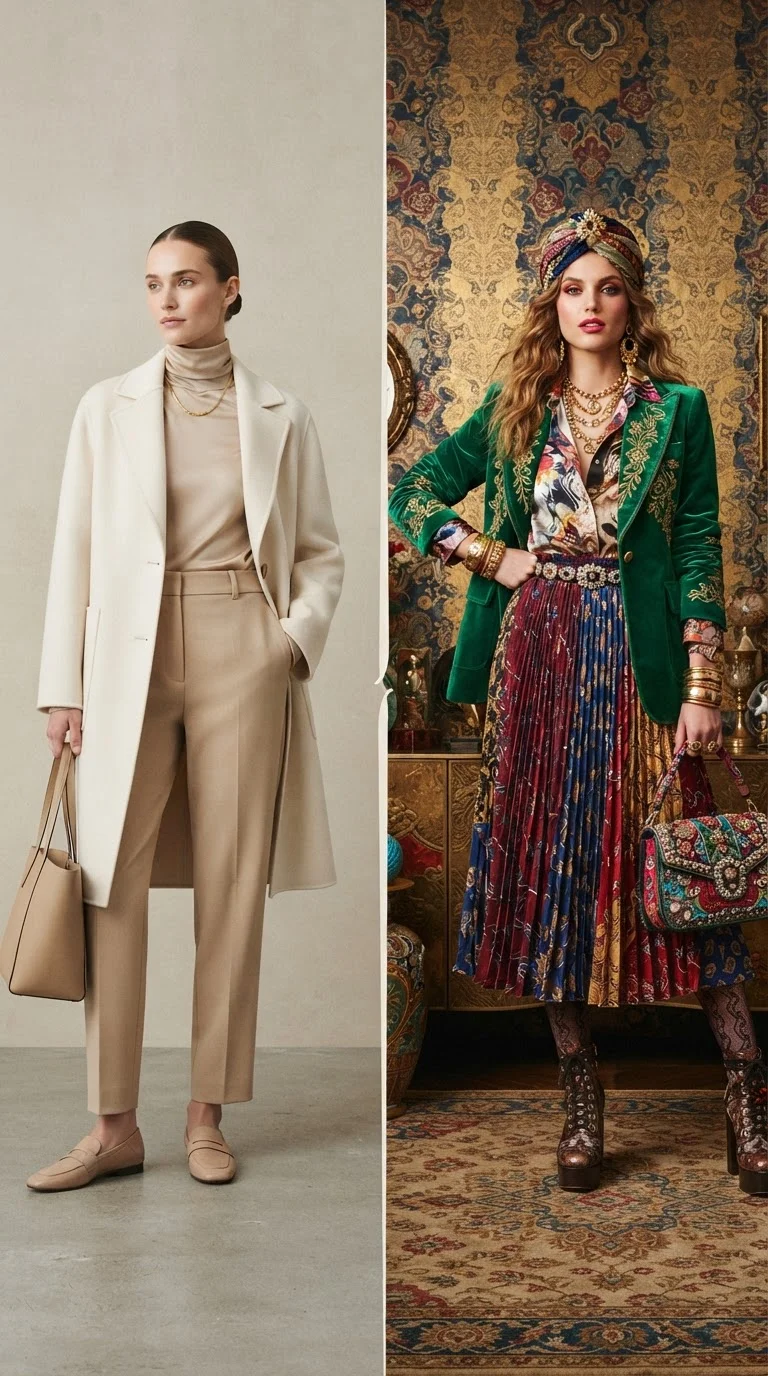
- Quiet luxury prioritizes restraint, neutral tones, and exceptional fabric quality over visible branding.
- Maximalism embraces layering, pattern mixing, and color saturation as intentional forms of personal expression.
- Neither aesthetic is inherently more expensive - both require thoughtful, deliberate choices.
- Your lifestyle, personality, and wardrobe goals should guide which approach feels most authentic.
- Elements of both aesthetics can coexist - many stylists blend them to achieve a balanced personal style.
Option A
Quiet Luxury
The understated, investment-minded approach to dressing.
Best for: Those who prefer a pared-back wardrobe built on neutral palettes, precise tailoring, and long-lasting, versatile pieces.
Option B
Maximalism
The expressive, abundance-forward styling philosophy.
Best for: Those who view clothing as a canvas for bold self-expression - mixing colors, prints, textures, and statement pieces freely.
If you prefer effortless, low-decision dressing every morning
Quiet Luxury
A neutral, curated wardrobe reduces decision fatigue and creates an immediately polished appearance with minimal effort.
If fashion is a primary means of creative self-expression for you
Maximalism
Maximalism gives you unlimited latitude to experiment with color, print, and layering as a form of artistic identity.
If you're building a wardrobe with long-term versatility in mind
Quiet Luxury
Timeless silhouettes and quality fabrics tend to retain relevance across multiple seasons and dress codes.
If you enjoy keeping up with seasonal trends and reinventing your look often
Maximalism
Maximalism naturally accommodates and celebrates trend cycles, making it easier to incorporate new pieces without losing coherence.
If you want a style that bridges casual and professional contexts with ease
Quiet Luxury
Understated tailoring and refined basics translate across a wide range of social and professional environments.
What Each Aesthetic Actually Stands For
Fashion rarely operates in absolutes, but two aesthetics have shaped contemporary style conversations more than most: quiet luxury and maximalism. Understanding what each philosophy actually represents - beyond the Instagram shorthand - is the starting point for deciding which, if either, belongs in your wardrobe.
Quiet luxury is grounded in restraint. It favors neutral palettes (think stone, ivory, navy, and camel), precise tailoring, and premium fabrics that speak through texture rather than decoration. Visible logos are intentionally absent; the quality of construction is the signal. It draws from a long tradition of European understated dressing and has been reinforced by cultural moments in television and editorial fashion that spotlight old-money aesthetics.
Maximalism, by contrast, operates on the principle that more is considered and intentional, not chaotic. It embraces layered prints, saturated color, mixed textures, bold accessories, and a willingness to break conventional style rules. When done with a clear point of view, maximalism reads as confident and curatorial rather than cluttered. For a deeper grounding in how these style philosophies evolve from broader fashion principles, understanding how fashion trends form is a helpful starting point.
Side-by-Side: How the Two Aesthetics Compare
Breaking down both aesthetics across practical dimensions makes the differences - and the surprising overlaps - easier to navigate.
| Criterion | Quiet Luxury | Maximalism |
|---|---|---|
| Color palette | Neutrals, muted tones | Bold, saturated, varied |
| Pattern use | Minimal to none | Layered, mixed prints |
| Silhouette focus | Precise, tailored structure | Expressive, layered volume |
| Branding visibility | Logo-free, understated | Varies; often statement-driven |
| Styling effort | Low daily decision-making | Higher curation investment |
| Trend responsiveness | Season-resistant classics | Naturally trend-inclusive |
| Versatility across dress codes | High - broad context range | Context-dependent |
One frequently misunderstood point: quiet luxury is not automatically more expensive than maximalism. A maximalist wardrobe built thoughtfully around thrifted statement pieces or well-chosen seasonal items can be highly cost-efficient. Similarly, quiet luxury taken to its extreme can involve significant investment in heritage fabrics and craftsmanship. Both aesthetics reward intentional shopping over impulse buying - a principle explored in depth in the smart budget buying strategies hub.
Where Each Aesthetic Shines - and Where It Has Limits
No style philosophy is universally practical, and being honest about the trade-offs is more useful than cheerleading for either camp.
Quiet luxury excels in professional and multi-context environments. A well-tailored camel blazer, a crisp white shirt, or a simple merino knit transitions with minimal effort from office to dinner. The challenge is that a purely quiet-luxury wardrobe can feel impersonal over time, particularly for people who find joy in dressing as play. There's also a risk of monotony if the foundational pieces aren't varied enough in silhouette or texture.
Maximalism, when executed with intention, is genuinely joyful and creatively stimulating. It's particularly well-suited to social environments where self-expression is valued - events, creative industries, and communities where fashion is treated as dialogue. The limitation is real: maximalism requires a strong enough visual literacy to avoid tipping into genuine overwhelm. Learning how to mix and scale prints effectively is one practical skill that separates intentional maximalism from accidental noise.
62%
Consumers dressing for self-expression post-pandemic
A 2022 McKinsey & Company report on consumer sentiment noted that a majority of shoppers cited self-expression as a primary driver of fashion purchases following the pandemic.
3-5x
Longevity advantage of quality over fast fashion pieces
Industry analysts and sustainable fashion researchers frequently cite that well-constructed garments typically outlast fast-fashion equivalents by a significant multiple when properly cared for.
Building a Wardrobe That Reflects Your Actual Life
The most durable personal style tends to blend principles from multiple aesthetics rather than pledging loyalty to one. A maximalist who anchors bold prints to a neutral bottom, or a quiet luxury devotee who introduces one sculptural accessory, creates something more personal and more resilient than either extreme.
If you're drawn to quiet luxury, consider whether a fully pared-back wardrobe actually serves your personality - or whether a capsule wardrobe balanced with selective trend pieces better reflects how you actually live. If maximalism resonates, developing a clear personal palette - even within abundance - creates cohesion. For either approach, the principles behind lasting personal style offer a grounding framework: intentional shopping, understanding fit, and anchoring new pieces to a consistent aesthetic point of view.
Personal Style Is Not a Fixed Label
Fashion aesthetics are descriptive tools, not identity categories. Many people find their style sits between quiet luxury and maximalism - or shifts between them depending on season, mood, or life stage. Treating these frameworks as inspiration rather than prescription gives you far more creative freedom and makes dressing less stressful overall.
Neither aesthetic should feel like a constraint. Think of them as starting points for a conversation about what you want clothing to do for you - signal expertise, spark joy, ease daily decisions, or all three simultaneously.