

Key Takeaways
- Passive enrichment works without your direct involvement, making it ideal for busy or work-from-home schedules.
- Active enrichment requires your presence but strengthens the human-pet bond more directly.
- Most pets benefit from a blend of both approaches rather than relying on one exclusively.
- Safety supervision matters more for some passive options than others - know your pet's habits.
- Your lifestyle, not an ideal standard, should guide how you balance the two approaches.
Our Verdict
Neither passive nor active enrichment is universally superior - each fills a different role in your pet's daily life. Passive options provide stimulation during the hours you can't engage directly, while active enrichment deepens trust and provides the interaction many animals genuinely need. A thoughtful mix of both, calibrated to your real schedule, produces the most consistent welfare outcomes.
| Best for | Recommended |
|---|---|
| Owners with demanding work schedules or long away-from-home hours | Passive Enrichment |
| Those who want to deepen the human-pet bond and enjoy hands-on interaction | Active Enrichment |
| Most everyday pet owners seeking balanced, sustainable routines | A Combined Approach |
Defining the Two Approaches
Enrichment describes any activity or environmental feature that engages a pet's senses, encourages natural behaviors, and supports mental wellbeing. The core distinction between passive and active enrichment comes down to one factor: whether you need to be present for it to work.
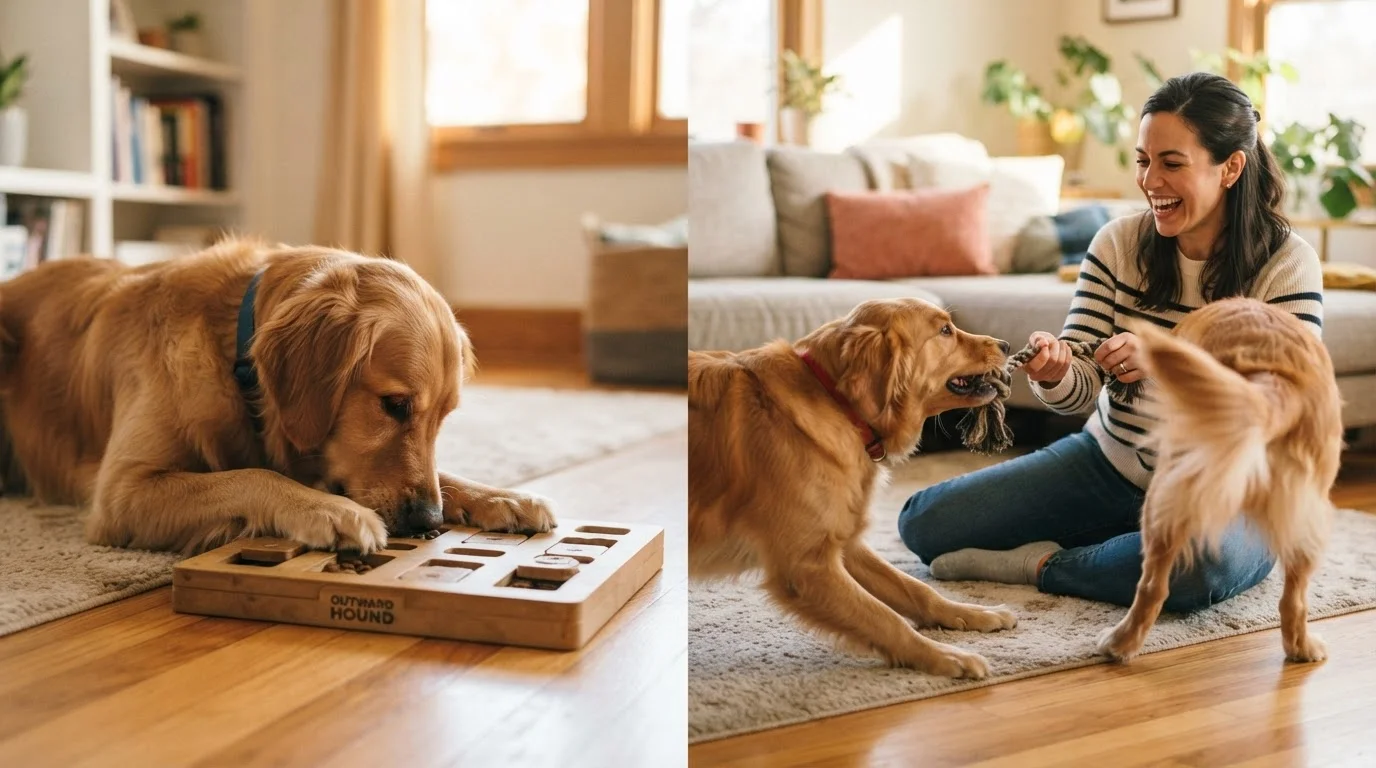
Passive enrichment is set up in advance and operates without ongoing human involvement. Think puzzle feeders left out before you leave, window perches that give a cat a view of backyard birds, or a foraging scatter of kibble in a dog's yard. Active enrichment requires your direct participation - a training session, an interactive play session with a wand toy, or a nose-work game you run yourself.
Understanding the difference matters because the tradeoffs are real. See our enrichment activities that double as quality time for examples of active sessions that serve two purposes at once.
Where Each Approach Excels
Passive enrichment's primary strength is consistency. It can deliver stimulation during windows when you're unavailable - early mornings, long workdays, or evenings when you're simply exhausted. For animals prone to boredom-related behaviors like destructive chewing or excessive vocalization, well-chosen passive options can reduce stress without demanding anything extra from you in the moment.
Active enrichment, by contrast, produces something passive setups cannot replicate: direct social interaction. Many companion animals - dogs especially - derive significant psychological value from activities that involve a trusted person. Training games build communication and reinforce the bond; play sessions create shared positive experiences. Research in animal behavior consistently points to social interaction as one of the most potent forms of enrichment for highly social species.
| Passive Enrichment | Active Enrichment | |
|---|---|---|
| Owner presence required | No - works independently | Yes - you must participate |
| Consistency when busy | High - set up in advance | Lower - depends on your availability |
| Bond-building potential | Limited - indirect interaction | High - direct shared experience |
| Setup effort | Moderate upfront; needs rotation | Low setup; higher ongoing time |
| Safety supervision | Varies by item and pet | Generally supervised by nature |
| Best species fit | All species; especially solitary animals | Highly social species (dogs, parrots) |
For species-specific guidance on which type resonates most, our article on enrichment by species breaks down natural instincts by animal type.
The Real Tradeoffs to Consider
Passive enrichment is not entirely hands-off. Initial setup takes time, and some options require rotation to stay novel - a puzzle your dog has memorized stops being enrichment. Safety is also a genuine consideration: chews, foraging toys, and DIY setups carry different risk profiles depending on your individual pet's chewing style, size, and tendencies. Unsupervised items that are appropriate for one animal may pose hazards for another.
Not All Passive Items Are Unsupervised-Safe
Before leaving a chew, toy, or foraging item with your pet unattended, consider their specific chewing behavior, whether they tend to ingest non-food material, and whether the item is sized appropriately. When in doubt, introduce new passive enrichment items with supervision first, then assess whether unsupervised use is appropriate for your individual animal.
Active enrichment's tradeoff is time and energy. On days when life is demanding, it's easy to skip, and inconsistency can leave pets under-stimulated precisely when schedules get busy. It also requires you to learn what genuinely engages your specific animal - not every dog loves fetch, and not every cat wants to chase a wand.
For a practical way to balance both across a week, the full-week enrichment planning guide offers a scheduling framework that accommodates real-life constraints.
Matching Your Routine to the Right Mix
There is no formula that works universally, but a few principles hold across most households. First, passive enrichment works best as a support layer, not a replacement for interaction. Second, even 10-15 minutes of focused active enrichment can be meaningful - quality matters more than duration. Third, your pet's age, species, and individual temperament all influence how much of each type they need.
If you're new to building an enrichment routine, starting simple is more sustainable than starting elaborate. The beginner's guide to enrichment is a useful foundation before layering in complexity. And if you're weighing whether to use indoor or outdoor setups for passive options, indoor vs. outdoor enrichment explores that dimension in depth.
Rotate Passive Options Regularly
Familiarity reduces the enrichment value of any passive setup. Cycling through different puzzle types, foraging configurations, or sensory items every few days helps maintain novelty. A simple log or rotation schedule prevents you from accidentally leaving the same puzzle out too long.
Ultimately, the right balance is the one you can maintain. An imperfect routine you actually follow will serve your pet better than an ideal plan that stalls within a week.
This article is for general informational purposes only and does not constitute veterinary or behavioral advice. Consult a qualified veterinarian or certified animal behaviorist for guidance tailored to your pet's individual needs.